
Rebecca Noble/Getty Images

Audio By Carbonatix
This spring, as the Phoenix City Council debated whether to pass a controversial parks ordinance that would ban distributing food and providing medical care to homeless people in city parks, the city commissioned a survey to gauge public sentiment on the issue.
But despite survey questions seemingly slanted to drum up support for the ordinance — which the city council ultimately passed — survey responses were overwhelmingly opposed to it. The results were never publicized.
Phoenix New Times obtained the buried survey via a public records request. One expert — Mike Noble, the CEO and founder of Noble Predictive Insights, a nonpartisan polling firm that was not involved with the city’s survey — found numerous methodological issues with the survey, which appears to have been stuffed in a metaphorical drawer.
That the survey produced such an anti-ordinance response is particularly notable, Noble said, given that the survey’s central question was so slanted in a pro-ordinance direction.
“That tells you there was real resistance in the responses, even if the survey itself was not methodologically strong,” Noble wrote in an email to New Times.
In a statement provided to New Times, Phoenix spokesperson Dan Wilson said the survey, which was “created with the assistance of Zencity,” was “one element of a comprehensive five-month stakeholder engagement process which began in January and continued into May. The non-scientific survey was designed to give residents an easy way to provide comments on the ordinance. The City also hosted a series of in-person and virtual meetings with stakeholders.”
The new ordinance makes distributing food and providing medical care in the city’s parks without a permit a misdemeanor. It bans needle exchanges and medical care with needles altogether. It also establishes a permitting process that allows two permits per approved park per month, for which individuals and organizations that provide food and medical care to homeless people can apply.
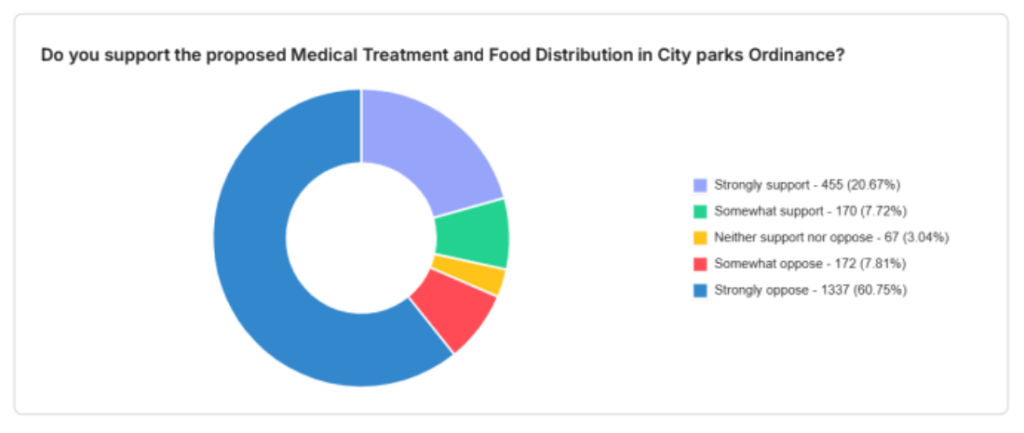
Nearly 70% of the 3,180 survey respondents indicated that they “somewhat opposed” or “strongly opposed” the ordinance, which went into effect in early June. Sixty percent of those responses were in the “strongly opposed” camp. In contrast, only 28% of people responded that they “strongly support” or “somewhat support” the ordinance. Another 3% chose “neither support nor oppose.”
City of Phoenix survey
That breakdown of responses is somewhat surprising given that what Noble called the survey’s “key question” seemed engineered to push respondents toward supporting the ordinance. The question was: “Do you support the proposed Medical Treatment and Food Distribution in City Parks Ordinance?”
Noble found several issues with the wording of that question. For one, a neutrally worded question would include both “support” and “oppose” to frame the issue evenly, and would give people who either don’t have an opinion or don’t know what the ordinance is a way to say “don’t know” or “not sure.” It would also give a basic summary of the law — “Medical Treatment and Food Distribution in City Parks Ordinance” does not hint that those activities would be restricted — rather than relying on respondents already being educated or looking into it themselves.
As worded, Noble said, the question skews responses towards “support” answers.
“Even with that support-framed wording, roughly two-thirds of respondents still opposed the ordinance,” Noble said.
Noble said the survey design was flawed overall. For example, it was available for responses for way too long — nearly a month — and it had no clear methodology or way of identifying demographic information or proving that respondents actually live in Phoenix. The people who responded also can’t be considered representative of Phoenicians, Noble said. Rather, they are representative of the people who care and are motivated to respond.
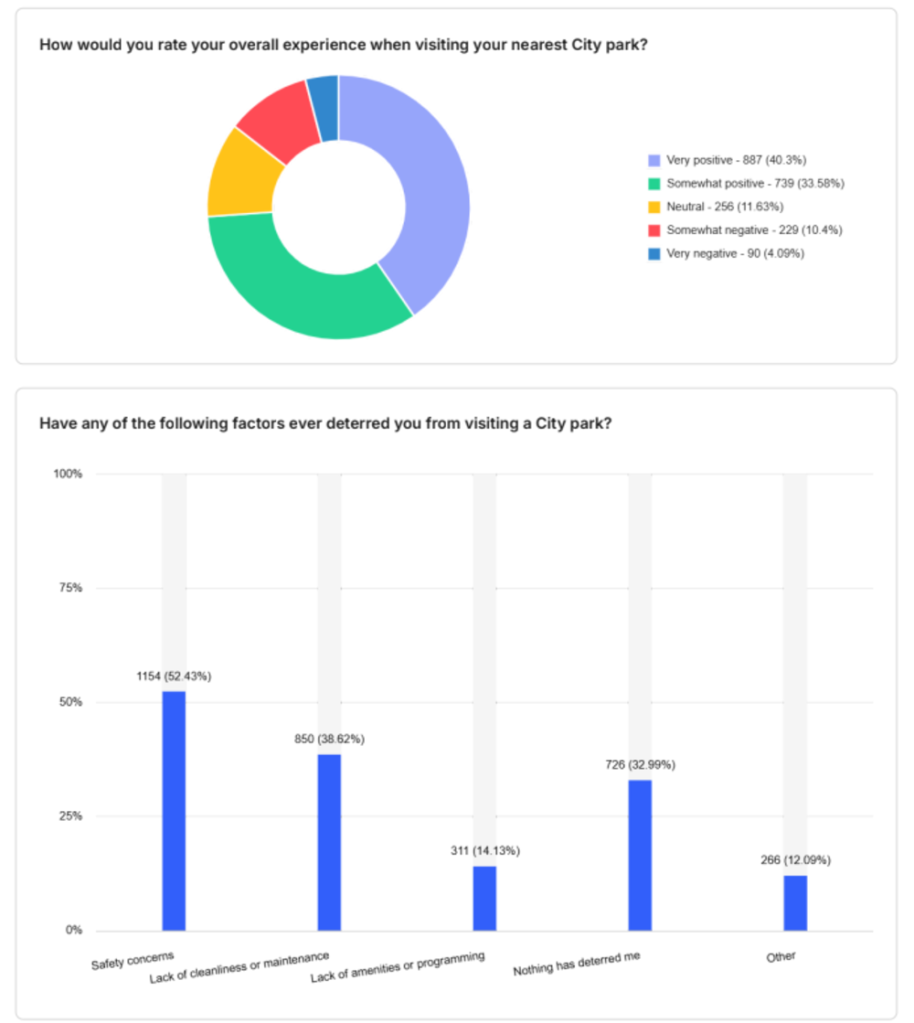
Three-quarters of people responded that their overall experience with city parks was “positive or “somewhat positive.” Eleven percent responded neutral, while 10% said “somewhat negative.” Only 4% of people who responded had “very negative” experiences.
The survey also found that 52% of respondents had been deterred from visiting a park because of safety concerns and 38% because of lack of maintenance and cleanliness. But that question was flawed as well, Noble said, because it asked all survey takers to answer it. Typically, only those who reported having had a negative experience at the park should be asked a question that elaborates on that experience.
City of Phoenix survey
Skeptical responses
The survey was available online to the public from March 30 to April 27, a week and a half before the Phoenix City Council voted 6-3 to pass the ordinance following a tense, seven-hour-long meeting.
Opponents of the ordinance said it would do more harm than good, ultimately straining city resources. Many of their concerns were expressed in response to open-ended questions at the end of the survey, including recommendations for other ways to address trash left behind in parks.
“If the intent is to keep parks clean, enforcement should use no littering laws that are currently on the books to address this,” one respondent wrote. “Right now it feels like the drafter of this ordinance is continuing to make parks less useful for the poor and most in need in our communities.”
Respondents also expressed the general frustration of opponents of the ordinance with the city’s uncooperative process and what they felt was a disregard for community input, especially from experts in the field.
The ordinance that the council passed in May was a revised version. In December, the council voted on a version that only targeted medical care. After community outrage, mainly from individuals and organizations that provide services, the city delayed implementing the ordinance to give itself time to rework it.
At first, opponents were hopeful that the city would work with them to find a middle ground. Instead, the city came back with the current version, which added a ban on food distribution. The new version was worse than the old, opponents said.
Morgan Fischer
“I heard that the healthcare professionals who know what they are doing offered to collaborate with you to come up with a better solution than we even have now,” one survey respondent wrote. “Did you do that with them? If not, why not?”
The ordinance has sparked two lawsuits that are currently working their way through federal court. Both suits — one filed by a religious group and another filed by two nonprofits — make First Amendment arguments against the new restrictions.
No rulings have been issued in the second case, but last month, the judge in the first case granted an emergency temporary restraining order to Orthodox Christian group St. Herman’s Table and its founder and minister, Lance Brace. The restraining order prevents the city from enforcing the ordinance against the plaintiffs while the court case pends. In her decision, U.S. District Court Judge Krissa M. Lanham noted that the city could consider “less-restrictive options” such as permits that regulate event size, trash levels or noise.
“Phoenix provides no evidence or meaningful argument explaining why a birthday party providing cake to twenty select two-year-olds is any less likely to strain park resources with noise or mess than a religiously-motivated gathering open to twenty members of the public,” Lanham wrote.
A survey respondent who wrote that they’d lived in the city for over a decade and had visited most of its parks raised nearly the same point.
“I have seen more trash and disruption in parks from children’s birthday parties than I ever have from organizations providing medical care or food to the unhoused,” the person wrote. “This ordinance will put Phoenix on the map on the national stage as a place that punishes Phoenicians for caring about other people’s wellbeing. I cannot express how strongly I oppose this ordinance.”