
fsHH (Pixabay), CC0, via Wikimedia Commons

Audio By Carbonatix
Editor’s note: This story has been updated with a response from the Phoenix Police Department.
***
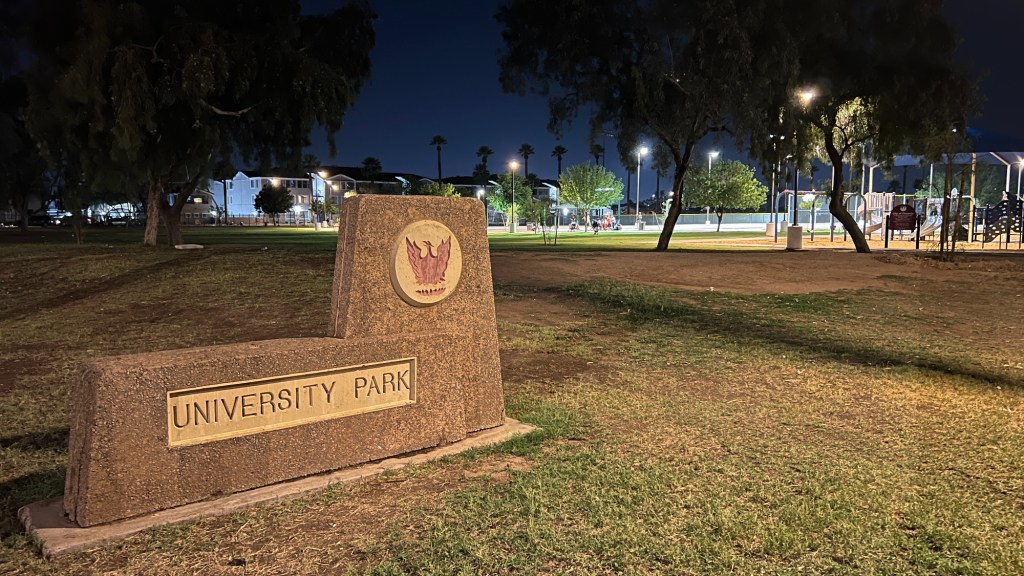
One after another, three vehicles entered University Park in central Phoenix the night of June 2. First, a Phoenix park ranger pickup truck, followed by a Phoenix police patrol Tahoe. A second ranger SUV brought up the rear.
It was just after 11 p.m. The park, situated just west of downtown Phoenix off Van Buren Street and 10th Avenue, had technically closed an hour earlier. But inside, under the bright park lights, people still milled. A man in a red shirt gathered his belongings as the three city vehicles drove slowly towards the group. He began to walk towards the open gate, but a park ranger, who’d just exited the SUV, stopped him and directed him to sit at the nearby table. The man in the red shirt couldn’t leave — not tonight.
The scene unfolds in a video shot that night by @unshelteredphx, an Instagram account that highlights the dangers faced by Phoenix’s homeless population. In it, the Phoenix park rangers and police officers detain the homeless people still in University Park after hours. They run their names for warrants and issue trespass citations. Then they make them leave the park.
Sophia Elicia shot the footage and runs unshelteredphx. She asked Phoenix New Times to use only her first and middle names out of fear of retaliation. She said that the rangers arrived at the park early and watched the group. Before entering, they shut all gates except for one, ensuring that no one could leave — presumably the thing they wanted the unhoused people in the park to do — without going through them. The people inside, many of whom have no way to tell the time, had no hope of complying before being cornered. And while no one was arrested for open warrants the night of June 2, that is not always the case.
The city’s park rangers and police use this tactic often, said Sophia Elicia, who regularly provides aid in the park. They leave the park open after closing time, lock all of the gates but one, and then pounce.
“That’s the most outrageous thing,” she said. “They’re not going to give you a warning. They’re going to tell you you are detained, and they’re going to trespass you from the park for at least 30 days.”
The Phoenix Parks and Recreation Department did not respond to requests for comment for this story. In an emailed statement, Phoenix police spokesperson Mercedes Fortune said, “Enforcement efforts are based on observed violations of the law and park rules. During these contacts, Park Rangers and officers lead with education, and may issue warnings or citations, investigate outstanding warrants, make arrests when appropriate, and take enforcement action consistent with state law and City ordinances.”
The interactions documented in the footage are examples of tactics that many homeless advocates consider unethical. They have fought to end their use in recent years, especially when the notorious homeless encampment The Zone was at its peak, with more than 1,000 people living there.
A 2022 federal lawsuit documented arrests of homeless people for sleeping on public property, including city parks. The judge in the case issued a preliminary injunction that prohibited the city from, among other things, arresting homeless people for sleeping in public parks. A 2024 report by the Department of Justice found that Phoenix police often “unlawfully detain, cite, and arrest people experiencing homelessness.” One case it highlighted involved a 69-year-old man with multiple arrests and citations. “Officers arrested him for ‘loitering in a closed park,’” the report reads.
Between the report and litigation, the city was hampered from using these tactics for a brief period. But in 2024, a Supreme Court ruling cleared the way for municipalities to arrest homeless people for sleeping in public places. That ruling weakened part of the 2022 injunction and opened the door for Phoenix to implement an ordinance banning camping within 500 feet of city parks, shelters, schools and childcare facilities. Last year, the Trump administration closed all federal civil rights investigations into police departments and withdrew all Biden-era findings, including the DOJ report on the Phoenix Police Department.
With those pressures gone, Phoenix’s aggressive tactics have returned with a vengeance. They have been playing out in parks across the city where homeless people with few other options tend to gather, advocates say.
“There’s no other reason to target that park,” said Elizabeth Venable, lead organizer and co-founder of the nonprofit Fund for Empowerment, which was a plaintiff in the 2022 lawsuit. “They’re doing it deliberately to try to crack down on people who are unhoused.”
Clarissa Sosin
‘Trying to get their numbers up’
University Park is located near many of the homeless services the city provides. Central Arizona Shelter Services, Andre House of Arizona and the homeless solutions hub Key Campus are all a 15-minute walk from the park. The Safe Outdoor Space, Phoenix’s sanctioned camping area for homeless people, is a 20-minute walk. The Zone, which still has people living in it, is also close.
University Park is also one of the few places nearby that people can avail themselves of shade, grass and a place to sit.
“I think that it frustrates the park rangers, probably,” Venable said. “I do think that they’re doing it connected to them being homeless, but it’s also because they’re homeless, they’re forced to take up public space, too.”
When New Times visited two nights after the video was shot, University Park was lively again with homeless people seeking a brief refuge from Phoenix’s streets.
Two large groups, each about nine people, had taken over the picnic tables, which were covered with scattered belongings, snacks and water jugs. Those who couldn’t fit on the filled benches sat on the ground or leaned against the ramada poles. Nearby, a man bounced a basketball by himself while another danced alone to ‘70s funk music emanating from a speaker. A bit further away, two people perched themselves on the top of the playground. Others sat quietly, dispersed throughout the park, under trees or near the bathrooms, their belongings beside them.
The park was set to close in about 45 minutes. Conversation at one of the picnic tables turned to the events in the video. None of the people around the table was in the park when the police and rangers arrived two nights earlier, but they’d all experienced similar situations before.
“They’ll leave the gate open to make us feel like we’re safe and like nothing’s happening, and then at like 10:15, 10:20, they’ll pull up with the police,” said a man who identified himself as Christopher.
“We don’t know what time it is,” said a woman named Kyra.
Excitedly talking over each other, the group explained what tends to happen. They are regulars in the park and know that it closes at 10 p.m., but they often lose track of time or don’t have a way of knowing what time it actually is. Their watches and phones are often stolen, they said, and they don’t have regular places to charge phone batteries.
That wouldn’t be an issue if park rangers warned them when closing time approached, which used to happen. But now, the rangers close the gates around them and don’t give them a chance to leave. Instead, they show up with Phoenix police officers, who check everyone for warrants and arrest those who have one. Everyone else gets trespassed, unable to return to the park for at least 30 days.
“I honestly think they’re trying to get their numbers up,” Christopher said.
Sophia Elicia watched the interaction between the rangers, officers and people in the park all the way through on the night of June 2. By 11:45 pm, the officers had left and the rangers were locking the one open gate. They too drove away. But a couple of minutes later, footage shows a woman with a cart walking towards the locked gate to leave, only to realize she couldn’t exit. Sophia Elicia notified the rangers, who returned to let her out. A few minutes before midnight, the park was finally empty.
A post on the unshelteredphx Instagram account last month called leaving the park gates open a “honeypot,” a term used to describe the use of attractive bait to lure someone into a trap. Leaving the park gates open past closing time tempts homeless people and gets their hopes up that they can be there, said Sophia Elicia.
“People think they’re catching a break,” she said.
Parks are the only reliable public places with shade, she said. And in the Phoenix sun, access to a park can mean life or death. When someone receives a trespass, they are banned from one park — or even all parks — for 30 days to one year. But homeless people who get a trespass citation aren’t going to stay away.
“You get trespassed from that park, and you have nowhere else to go,” Sophia Elicia said. “You’re going to be back in that park, like hands down.”
She used to stop by the park at night to warn people. The crowd hanging out two nights after she shot her video remembered her. They said she used to come by and yell at them to leave because the police would be coming soon.
But her warning efforts felt futile, she said. She’s stopped for now.
“I cannot be here every night to warn people,” she said.