
Alan Staats

Audio By Carbonatix
Before the meeting had even been gavelled to an end, before the Phoenix City Council chambers packed with attendees had emptied and they’d spilled into the evening, the sign had changed. What was once Cesar Chavez Plaza no longer bore that name.
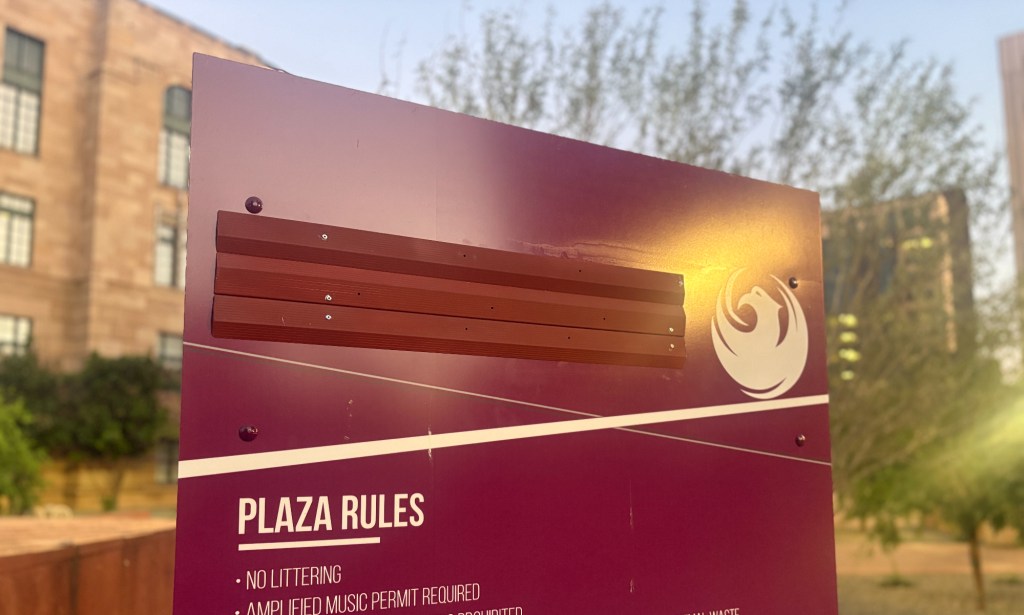
The late labor leader — now disgraced, after a recent New York Times report chronicled a distressing pattern of sexual abuse, including of minors — would not be honored in Phoenix anymore. Seemingly minutes after the city council voted unanimously on Wednesday to begin the process of erasing Chavez’s name from its many places of honor around town, city workers had begun executing it. Outside City Hall, they hammered maroon slats over Chavez’s name, obscuring it and leaving only the city’s logo and the plaza’s rules and hours.
When attendees finally filed out of the formal meeting, they walked through a plaza that was now nameless. It was the start of a long process to dismantle, literally and figuratively, Chavez’s legacy. The plaza sign was the first to go, and the ceremonial Cesar Chavez Boulevard signs along Baseline Road started coming down Wednesday night. Other memorials — like Cesar Chavez Park and Cesar Chavez Library, and the statue of Chavez that sits near both — will take longer to come down due to a series of bureaucratic hoops.
The Chavez vote was hardly contentious. Politicians of all political stripes have reacted in horror to the allegations that he may have repeatedly sexually abused teenage girls who aided in the farmworkers movement — and may have raped and fathered illegitimate children with Dolores Huerta, one of his closest collaborators — in the 1960s and 1970s. Only two members of the public commented on the decision.
Councilmember Betty Guardado said the council took action out of respect for the victims and for the workers who drove the movement. In addition to removing Chavez’s name and likeness, the city will rename the upcoming Cesar Chavez Day — March 31, his birthday — to “Farmworkers Day” for 2026. The holiday’s future after that would be decided at a later date.
“For all of the victims, we honor you all today,” Guardado said during the meeting. “We honor our workforce, we honor everyone that has been part of this movement and that has honored this movement.”
Councilmember Laura Pastor stressed the need to “recognize…the unsung heroes who do and did the work, who make the movement happen.” Fellow Councilmember Anna Hernandez encouraged the city to find ways to educate residents more about domestic and sexual violence and available resources in the wake of the allegations against Chavez.
“Sexual assault is rampant across this city, and in that time the ‘Me Too’ movement came and went, and our culture did nothing to end the sexual violence everywhere around us,” Hernandez said.
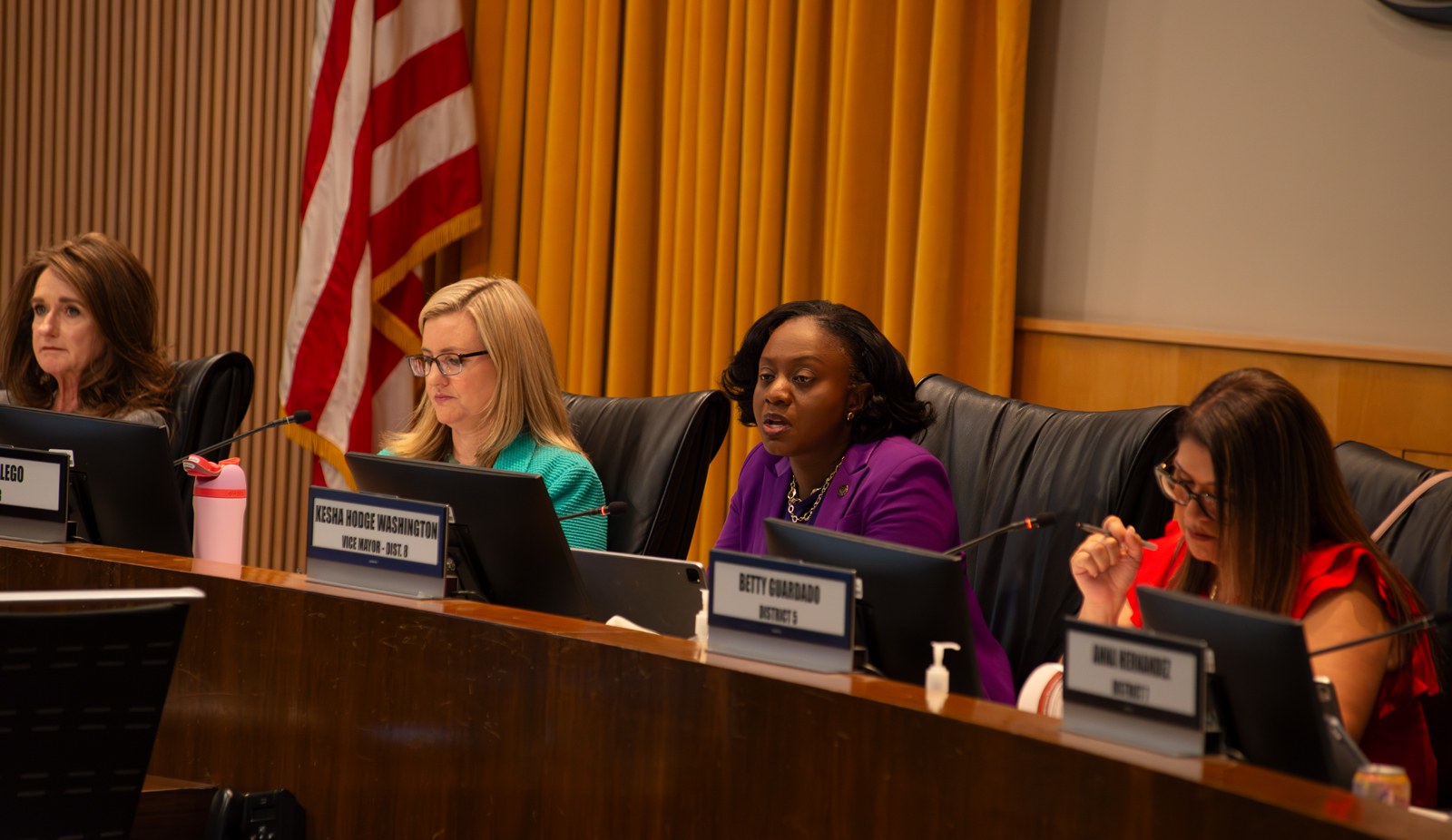
For a city that usually moves quite deliberately when making big decisions, the move to un-Chavez Phoenix was notably rapid. Vice Mayor Kesha Hodge Washington acknowledged that during the meeting, assuring the public that while their decision may seem hasty, she was reassured by the actions of the Chavez family and of his union, the United Farm Workers, and his eponymous foundation. Both UFW and the foundation cancelled planned Cesar Chavez Day events, while the family issued a statement that offered “peace and healing to the survivors” and stood with people who are victims of sexual assault.
The city is following their lead, Hodge Washington said, adding that “as a lawyer, due process is important to me.”
Clarissa Sosin
The ICE vote
The move was quick, especially compared to what followed later in the meeting: a vote to bar Immigration and Customs Enforcement from operating on city property.
Activists have been agitating for such a move ever since President Donald Trump reassumed office in January 2021 and kicked off his mass deportation agenda. ICE abuses have indeed been documented in Phoenix — though not to the level of Chicago and Minneapolis, which the Trump administration has targeted — and the city has been slow to react. In February, a council work session ended early because protesters interrupted it, demanding to be part of the process.
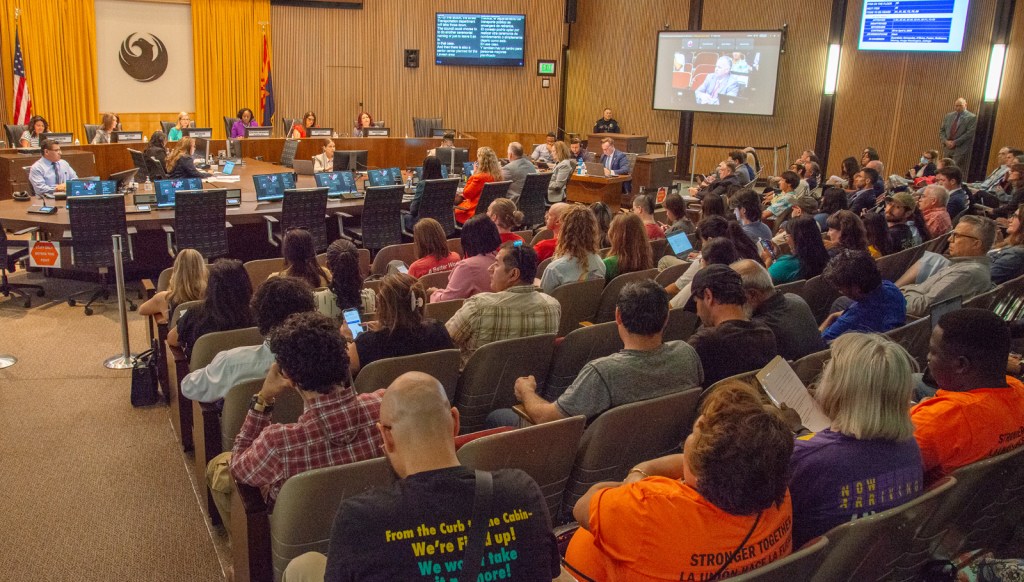
Many of those same activists filled a packed council chambers Wednesday, but they left the meeting far less agitated than they’d been 45 days earlier. With one dissenting vote — Jim Waring, the lone conservative on the council — the city passed its Community Transparency Initiative, which in part restricts ICE from performing some operations on city-owned property.
Only two speakers came out against the proposal. The rest were supportive.
A school employee spoke about driving past ICE detaining a student’s parent just blocks from campus. A group of Afghan refugees who worked with the U.S. military spoke about being scared to go to their jobs. One woman recounted how the fears that dominated the reign of former Maricopa County Sheriff Joe Arpaio had roared back. “Right now you have the opportunity to give families like mine peace of mind,” she told the council.
A man relayed how he’d come to the U.S. from the Democratic Republic of Congo when he was three years old after his parents were killed in a civil war. He’d always felt safe here, but that was changing. He worried he would be picked up by ICE because of his accent and looks. News reports of ICE using violence disturbed him, making him feel like a target. “That’s not the America that I know,” he said. “I’m asking you for protection.”
An airport worker referenced ICE’s recent arrival at Phoenix Sky Harbor International Airport. “We’re scared,” the worker said, “and we don’t want to be scared at work.” Francisca Gil, who works in refugee services for Lutheran Social Services of the Southwest, told the council about a group of refugees who’d skipped job interviews at the airport because they feared being detained by ICE.
“It is so unfair that they are afraid to be in the community and continue with their lives,” Gil said.
Councilmembers who spoke at the session all lauded community members for their input. “That’s helped us end up in a better place,” said Mayor Kate Gallego about the listening sessions born from the outrage. Pastor said the transparency initiative “really came about with not just one person but with a collective.”
ICE or any other civil law enforcement agency is now prohibited from using city property to stage operations, for processing or as an operations base, at least without permission from the city manager or police chief. There are exceptions, of course: The city cannot bar ICE from serving judicial warrants or from pursuing a fleeing suspect. Certain city-owned sites, such as the Phoenix Municipal Court or Phoenix Sky Harbor International Airport — the latter of which is federally regulated and has already seen an ICE presence — are fair game.
Phoenix will also erect signs that state such operations on city property are not allowed and will educate city workers on how to interact with ICE and what to do if ICE attempts to use city property improperly.
During the council meeting, Assistant City Manager Lori Bays laid out the measure’s many facets, walking attendees through its six points with a detailed slideshow. There will be a new portal run by the Office of Accountability and Transparency, where people can file complaints about ICE encounters that they think were illegal or violated their civil rights. A new website with Know Your Rights primers and other resources will be available in a multitude of languages. Bayes also clarified which types of city property Phoenix could bar ICE from using, and how city staffers would be trained to respond if they encounter an ICE agent.
She was also careful not to overpromise. She stressed that the city has to operate within state laws that prohibit it from obstructing federal immigration efforts. And while the city would investigate incidents involving ICE that could rise to the level of criminality, the public shouldn’t hope too hard for a ton of convictions.
“What I do want to be transparent about is that investigating these cases will be extremely difficult,” Bays said. “And therefore the likelihood of prosecution is low.”
Alan Staats
Cautious optimism
Despite the disillusioned rancor that led up to Wednesday’s vote, activist groups mostly walked away satisfied, at least for the moment.
The community organizing group Poder in Action was among several that collaborated to draft 14 demands for the city leading up to the vote, according to interim co-director Ben Laughlin. In an interview several days before Wednesday’s meeting, Laughlin told Phoenix New Times that the group “wanted to see policies that were about the people.”
What Phoenix ultimately adopted on Wednesday incorporated some of the group’s demands, most notably restricting ICE from staging on many city-owned or -run properties and providing outreach and educational material in multiple languages. However, there is still more the city could do, activists feel. Two demands that were left off were the creation of an immigration defense fund and a pledge to issue more citations rather than arrests for nonviolent crimes.
The latter would reduce the number of people booked into Maricopa County jails, where ICE agents operate under an agreement with the county sheriff’s office. A large number of people who wind up in immigration detention in Phoenix got there after being arrested by a Phoenix cop and booked into county jail, regardless of whether charges were ultimately brought against them.
Andrea Luna Cervantes, the Arizona campaign manager for the grassroots organization Organized Power in Numbers, told New Times after the vote that they want conversations with the city to continue.
“This is a great first step for the city to take in terms of a phase one of how are we going to protect our community of Phoenix residents,” she said. “We want them to know this is not just a one-and-done.”
That seemed to be the consensus at the meeting. A first step is fine, but it naturally implies the need for several subsequent ones.
“I want this to go a lot farther because the people we are dealing with do not believe in the Constitution of the United States,” said one speaker during public comment. Another, a member of the Democratic Socialists of America Phoenix-Metro chapter, warned that the passing of the initiative “does not remove the urgency behind these additional issues. These are critical.”
Jose Hernandez, the brother of Councilmember Hernandez, challenged the public officials and their staff to take their oaths to the city and its residents seriously. “What we shouldn’t disagree on is reprehensible violence that’s committed by a rogue agency,” he said.
Those will be discussions for another day. About four hours after the start of the meeting and after the successful vote, the activists stood outside council chambers in the plaza that now has no name, with a stack of discarded pizza boxes next to them. It was time for their post-mortem of the meeting. The refrain “cautiously optimistic” murmured through the circle. They gave themselves a round of applause.
For now.