

Illustration by Eric Torres

Audio By Carbonatix
In the sweltering summer of 2022, the Phoenix Police Department was almost a year into a Department of Justice civil rights investigation when it found itself facing a different kind of crisis: staffing. About 20 officers were leaving the department every month, said senior police officials, and recruitment was lagging woefully. The Phoenix City Council swiftly passed an ordinance that boosted new recruits’ pay by $20,000 a year, making Phoenix police officers the highest-paid cops in Arizona.
Soon, Scotty Bach joined Phoenix police as a civilian investigator. Within five months, he became a Phoenix police officer. His swift rise owed in part to deep experience. Roughly nine out of 10 cops the department hired in 2023 had been new recruits, but Bach came to Phoenix with more than 20 years of policing experience in Seattle. That seemingly made him eligible for a hiring bonus of $7,500, since he wasn’t a fresh recruit the department had to spend money to train. (Because his hire as an officer came after his initial civilian hire, Phoenix police officials later determined he was not eligible for the hiring bonus, the city said in a statement.)
Yet, like many veteran officers hired into short-staffed police departments, he also brought an unsavory past. Bach is also one of six Seattle police officers whom the Seattle Police Department investigated for their presence at the U.S. Capitol on Jan. 6, 2021.
Seattle’s Office of Police Accountability confirmed that Bach was present at the Capitol. But investigators found “inconclusive” evidence of misconduct and did not sustain any disciplinary charges against him. Bach left the department after the investigation was concluded.
Bach’s hiring in Phoenix offers a caveat about the aggressive drive to fill vacant positions, especially in a city where police routinely abuse their power in the streets.
TJ L’Heureux
Betrayal of the taxpayers
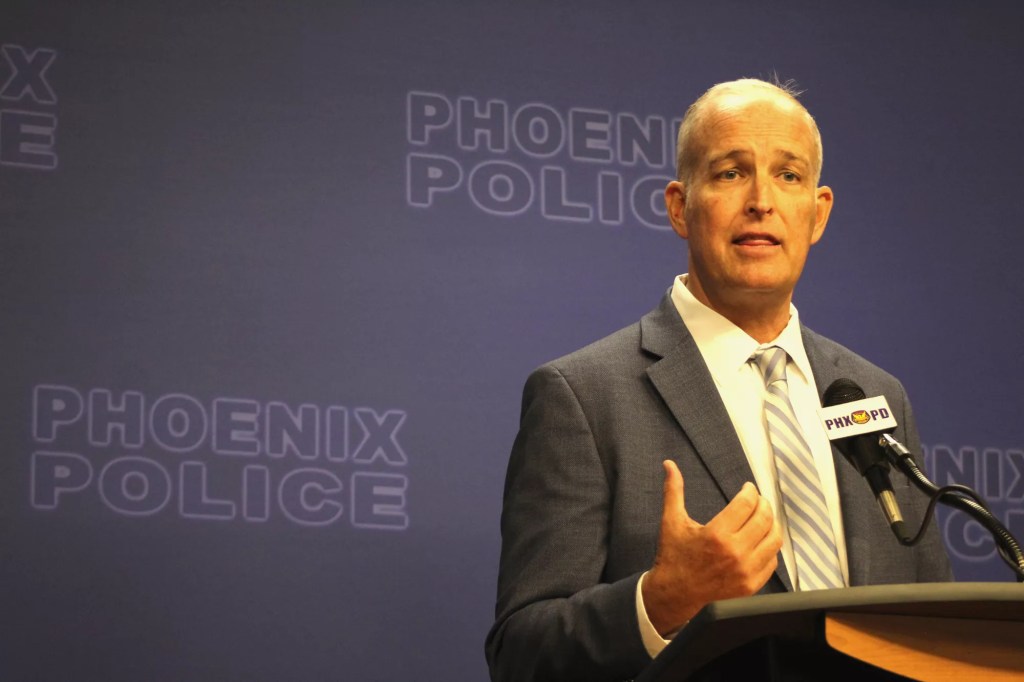
In May, the Trump administration dismissed the damning DOJ report that catalogued a pattern and practice of abusive behavior by Phoenix police. The cynical disavowal of the DOJ’s findings came months before the department hired a new police chief: Matt Giordano, who until recently was the executive director of the Arizona Peace Officer Standards and Training Board, or AZPOST. Under pressure, the department is trying to distance itself from its recent past.
All the more reason to consider the pedigree of its newest veteran officers.
Georgetown University law professor Vida Johnson, who has written about far-right extremism in policing on Jan. 6, told Invisible Institute, The Appeal and Phoenix New Times that by attending an event that challenged the presidential election results, officers undermine their ability to serve in law enforcement, even if they were not charged with wrongdoing.
“That’s a big betrayal of the taxpayers in my mind, and it really undermines community safety in a myriad ways,” said Johnson.
Johnson said it’s still an issue if someone traveled across the continent to attend Trump’s “Save America” rally without participating in the insurrection. She said attendees fell into two camps: those who believed the election was stolen, and those who supported Trump’s efforts to overturn the results even though they understood he had actually lost.
“Either way, this is not someone you would want in law enforcement,” Johnson said. Those in the first category are likely “prone to conspiracy theories,” while those in the second “don’t care about the rule of law” or “our American institutions that are centered around the idea of liberal democracy.” (Other First Amendment experts have disagreed about the implications of attending the Jan. 6 rally by police officers.)
In a statement, the Phoenix Police Department said Bach passed “an extensive and complete background investigation.” After more than a year of waiting, Invisible Institute, The Appeal and New Times received public documents from Phoenix police related to Bach. The department provided a heavily redacted 649-page file that briefly mentions investigators being aware of Bach’s presence at Jan. 6 but otherwise does not show them reconciling that fact with their hiring standards.
Bach’s transfer from Seattle to Phoenix was approved not only by Phoenix background investigators but also by officials with AZPOST, who audit the paperwork before it can be finalized. “We have to approve a new hire audit before an officer’s appointment can be finalized,” Giordano wrote in an email in his previous capacity as AZPOST executive director. “If we identify an issue we send it back to the agency for them to address. Some agencies use a web based platform and grant us access for the individuals file to review for our audit, while others provide us a hard copy HR file for our review. Either way, we do not remain in possession of the material after our review.”
The statement shared by Phoenix police included the finding that, after 20 years with the Seattle Police Department, Bach had “retired in good standing.”
Yet it’s clear that Bach prefers the public not know about his extracurriculars. In 2021, after a Seattle University law student and others filed a records request, he and five other officers who were facing Jan. 6 investigations sued to prevent their names from being publicly released. This despite the fact that Divest SPD, an activist group that helps maintain a public database of complaints against Seattle officers, had already identified him and other officers by comparing publicly available datasets.
Of those six officers who were investigated, two were publicly named when Seattle police leadership fired them for trespassing into restricted areas during the Jan. 6 insurrection attempt.
In February 2025, the Washington Supreme Court ruled that the rest of the officers had attended a “highly publicized and public event” and thus could not expect to remain anonymous. Their names were officially released in July after the U.S. Supreme Court rejected their appeal.

Matt Hennie
‘Be wary’
During the Great Recession, cities around the country struggled to hire and retain police. Phoenix was even more austere than most. In 2008, the city instituted a hiring freeze that lasted until 2015. Over the years, as veteran police officers retired with no one to replace them, the department’s roster shrank. Around the country, these dynamics increased the pressure on departments to recruit and hire new officers, and fast.
“I didn’t see anything that looked quite as stark as Phoenix” in terms of Recession-era police hiring freezes, said Ben Grunwald, a Duke University law professor and criminologist who studies police misconduct and employment trends. Grunwald has also analyzed data from AZPOST.
“It’s basically zero (hires) from 2009 to 2014,” he said.
In 2015, the city began a hiring spree. Since then, City Hall and Phoenix police have worked to eliminate a deficit of around 600 officers they say are needed on Phoenix’s streets. To do that, they’ve drawn from a pool of officers in other cities who — whether running from misconduct investigations in their old agencies, or for more benign reasons — are looking for a change.
Initially, the department expressed concerns about so-called “lateral” transfers from other departments. In 2017, the lieutenant who led recruitment efforts told the Arizona Republic, “We’ve learned that (lateral moves) are very strong indicators we should be looking very closely at.” He continued: “We barely manage to hire two a month … we just cannot survive them coming here and making mistakes.”
In 2021, the city intensified its recruiting efforts. It rolled out raises across the board and added hiring bonuses of up to $7,500 for lateral transfers from other departments. In 2022, the city council approved the same amount in retention bonuses for existing officers and created new positions for civilian investigators.
At the time, police hiring data showed that the department rejected the vast majority of lateral applications — as many as 95% in 2021. Then-Assistant Chief Bryan Chapman told the city council’s public safety subcommittee that this was because they failed to meet Phoenix’s hiring standards.
During the background investigation process, some applicants “may tell us things that their previous employer is not aware of, and/or we’re not comfortable with bringing them forward,” he told councilmembers.
This stance is in line with best practices promoted by organizations such as the Police Executive Research Forum (PERF), which cautions that departments should be careful when offering new recruits steep bonuses or big pay bumps.
“Agencies also have only a limited ability to learn about any misconduct an officer may have committed at a prior agency,” PERF warned in an August 2023 report on the police “staffing crisis.” It cautioned agencies to “be wary of lateral recruitment.”

Matt Hennie
‘Screaming’ for new officers
Just three months after the Phoenix City Council approved the new raises and bonuses, Phoenix’s human resources department presented a new plan to offer even higher raises to police officers during a remote meeting of the Human Resources Committee.
The meeting was not recorded or attended by any member of the public. According to the minutes, the committee approved the proposal after eight minutes of discussion.
The next week, the city council considered the plan during a public hearing. Over objections of some residents who questioned new raises for police under federal investigation, the council voted 8-1 to approve the raises, which cost the city nearly $20 million. Phoenix police were now the highest-paid in the state.
Within months, department officials reported improvements to the city council, including the hiring of more officers from out of state.
“We have seen a significant increase based on the market adjustment that was approved by the council to make Phoenix police officers the highest-paid officers in the state of Arizona,” Chapman told the public safety subcommittee in September 2022. “We continue to see increased attention and inquiries, not only from in the state of Arizona but across the country.”
By March 2023, Chapman was telling the subcommittee that he was hoping to recruit 40 to 50 lateral officers from other agencies per year.
The following months, after secret contract negotiations, brought a third raise for Phoenix officers in as many years. In October 2023, Commander Sara Garza, a recruitment lead for the Phoenix police, reported that hiring exceeded attrition for the first time in several years. She credited the successive pay raises.
Reporters obtained data on officer certification in Arizona that showed Phoenix police hired Bach as a lateral officer. That data was obtained through the work of the National Police Index, a project of Invisible Institute, Human Rights Data Analysis Group and Innocence & Justice Louisiana that tracks officer employment history.
Experts warn that these incentives provide openings for officers with histories of misconduct to cross jurisdictions, fueling a hiring environment that overlooks dangerous or even criminal past behaviors.
“Every agency is screaming for more police officer applicants, and so that makes hiring and the acceptance of officers who may have questionable backgrounds a problem for us,” said Patrick Solar, a former police chief in Illinois and a criminal justice professor at the University of Wisconsin-Platteville.
A program of Florida Gov. Ron DeSantis illustrates the issue. In 2021, Florida used four-figure hiring bonuses to lure officers who felt “mistreated” by reform policies in New York, Chicago and departments on the West Coast. As a result, Florida departments hired officers who have been arrested and charged with murder and kidnapping, or were hit with complaints for excessive force, false imprisonment and sexual extortion.
In Memphis, the police department spent millions of dollars on recruitment bonuses and requested dozens of waivers from the state to hire officers who would not otherwise meet hiring standards. In January 2023, five Memphis police officers beat Tyré Nichols to death during a traffic stop. All five had been hired under reduced standards as part of the department’s hiring push, including one accused of brutality and other misconduct in his past job at a Shelby County correctional facility in Tennessee.
“As a business decision, hiring former officers can offer benefits for any police department,” the late Dorothy Moses Schulz, a former police captain and professor emerita at the John Jay College of Criminal Justice, wrote in a 2022 report published by the conservative Manhattan Institute.
“But these departments must consider the possibility that they are attracting officers who are running away from problems.”
“I’m concerned about these incentives overall,” she said in a 2023 interview. “You’re recruiting from the same pool. This one’s offering $5,000, this one’s offering $7,000. But these smack to me of desperation. And I think it’s very sad that we’ve come to a point where police have to be desperate to recruit.”
As of March 2025, there were still 600 positions that the Phoenix Police Department was looking to fill. Three weeks after the DOJ report’s release, Phoenix police said they weren’t planning on making any changes to their recruitment strategy, including the four-figure bonuses. “We’re going to stay the course,” Commander William Jou told Arizona’s Family. “We believe our processes are tried and true and proven.
“We are going to continue to do the work we’re doing, so we don’t plan on changing that.”
Yana Kunichoff is a journalist and documentary producer with Arizona Luminaria. Reach her on Bluesky at @yanak or by email at ykunichoff@azluminaria.org. Sam Stecklow is an investigative journalist and FOIA fellow with Invisible Institute. Follow him on Bluesky at @samstecklow.bsky.social or email him at sam@invisibleinstitute.com.