
City of Phoenix

Audio By Carbonatix
On Wednesday, the Phoenix City Council voted 8-1 to bar organizations from providing testing kits, medical treatment and performing needle exchanges in city parks — but not before the meeting got heated and one councilmember chastised residents who opposed it.
Community health advocates, medical officials and state Sens. Lauren Kuby and Analise Ortiz packed the city council chambers to oppose the ordinance, which many public health experts said will make it more difficult to help unhoused residents struggling with addiction and other health issues.
“It is shameful that our answer to an overwhelming need for access to care is to lean forward criminalization and restrictions in our public parks,” said Councilmember Anna Hernandez, who provided the lone vote against the ordinance. “Nothing in this ordinance will make our parks safer.”
The new ordinance allows a park ranger or police officer to “issue a trespass notice for up to one year” for water activities (like swimming or bathing in parks), performing syringe exchanges, distributing drug testing kits, providing medical treatment or if they “obstruct or cause an obstruction, or impede or interfere, with other park’s guests use of a park or use of park amenities.” The provisions appear aimed squarely at nonprofit organizations that perform harm reduction activities in parks to help unhoused people who cannot access medical care or who are at risk of overdosing.
Groups performing those services through city-run programs are exempt from the ordinance. So is the distribution of naloxone, which is used in emergencies to reverse opioid overdoses. However, Hernandez pointed out that the city’s programs already struggle to serve a growing unhoused population.
“We as a city have already been clear that we do not have the financial resources to meet the needs of our most vulnerable neighbors,” she said. “The reality is that we rely on all of you as medical providers, the harm reduction providers and the community health providers, to ensure residents have the access to the care that they need.”
Before the vote, the council sat through a deluge of residents expressing opposition or support for the ordinance, which will go into full effect on March 30. Individuals from Circle the City, Arizona Alliance for Community Health Centers, Sonoran Prevention Works, Terros Health, Shot in the Dark Arizona and more spoke against the ordinance.
Many complained about a lack of communication about the proposed ordinance, which was first reported by LOOKOUT only last week. According to members of several health organizations, they were not made aware of the ordinance until last week. Jennifer Longdon, the chief external affairs officer of Arizona Alliance of Community Health Centers, said she learned of the ordinance just “within the past several days.”
Others criticized the ordinance as ill-advised and ineffective. Arlene Mahoney, the executive director of Southwest Recovery Alliance, said her initial reaction to the ordinance — which she also learned about last week — was that it is “bad public health policy” and “the opposite of public health.” Barring harm reduction activities won’t stop the harm – i.e., drug use — but it will make it harder to help those who need it.
“They’re doing this under the guise of increasing public safety, and yet none of the evidence provided to the councilmembers today state it’s going to improve public safety,” Mahoney said.
‘You ought to look in the mirror and be ashamed’
The onslaught of opposition didn’t sway any councilmembers besides Hernandez, who had previously stated she was against the ordinance.
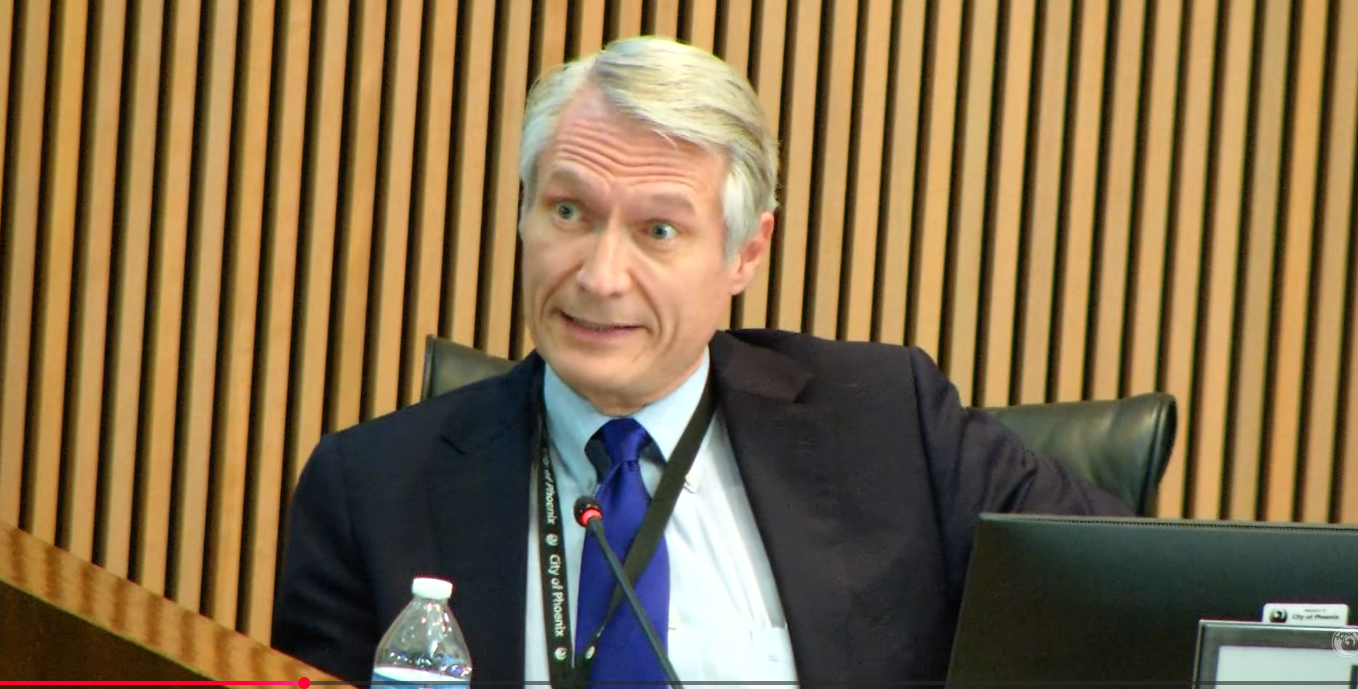
Councilmembers Betty Guardado, Kesha Hodge Washington and Kevin Robinson said they receive phone calls and photos about syringes in parks and that constituents are uncomfortable having their kids play in city parks. Guardado said her own son once picked up a needle. Jim Waring, the councilmember from District 2 and the council’s most conservative member, was among the most vocal in support of the ordinance, speaking for six minutes.
“We’re losing customers at these extremely valuable city properties because they don’t like what they’re finding when they go there,” Waring said.
Waring also fired back at attendees who opposed the ordinance. Waring lectured those in the audience about respecting people who favor the ordinance, which included a mother who said she wouldn’t take her kids to city parks because of drug users in them and a Little League coach who said parents pulled kids from his team over park concerns.
“If you’re clapping after hearing some of these stories, you ought to look in the mirror and be ashamed, because that’s a word that gets thrown around a lot,” Waring said.
Waring also singled out one woman who spoke against the measure, Rebecca Denis. “The young lady said, ‘I don’t like politics. It’s beneath me,’” Waring said. “Yeah, but you know what? We get to decide. That’s the perk, so maybe you should step up and try to do it … You’ll probably lose.”
Denis, who said she is thinking about possibly running for a council seat, said she felt Waring’s comments were “pointed” and an “attack” against her. “If you really loved problem-solving, and you were creative, you would not come with weak policy,” Denise said. “You would not put this on a platter in front of us and act like it’s OK. You should be ashamed. This city constantly undermines the community, and we tell you what we need over and over.”
Dr. Jack Palmer from Circle the City, a healthcare organization that provides services for individuals experiencing homelessness, also spoke directly to Waring after his testimony, offering him the opportunity to tag along to see his group’s efforts.
“I’m disappointed in Councilman Waring’s response during the last ordinance discussion,” Palmer said, “and I’d love to invite you out to work with us, to come out with my teams, to see the incredible work that we do and the people that we work with who you and I don’t see as much.”
The good news for organizations vehemently against the ordinance is that it could change between now and March. The city council said that the city will collaborate with health officials to determine if any changes are needed between now and when the ordinance takes full effect. Mahoney of the Southwest Recovery Alliance said her organization would be interested in cooperating with the council to support people at risk of fatal overdoses and STD transmission.
Nonetheless, many in the chamber — including Hernandez, who was met with a partial standing ovation for her no vote — were concerned about what the ordinance says about the city’s priorities.
“What we are saying is that, as the leaders of this city, we are OK with pushing our most vulnerable residents further into the shadows, further into neglect and further into despair,” Hernandez said.