
Justin Sullivan/Getty Images

Audio By Carbonatix
Maricopa County currently has a housing deficit of more than 34,000 units, a new study found. And with the current pace of population growth and permitting in the county, it’ll take a whopping 262 years to close the gap.
The report comes from the right-leaning think tank the Common Sense Institute, which also issued a recent report finding Arizona among the least affordable states in the country. The main culprit for that ranking was a lack of housing, a problem it examined in its new study, released on May 11.
The study found that while housing prices are dropping slightly in Arizona, the state still has a long way to go to meet its residents’ housing needs. The state still needs 56,000 more housing units than the market can provide, which is a modest improvement over the post-pandemic peak of 73,247 in 2022.
Home prices have declined, and market pressure may be easing, but prices are still very high compared to pre-pandemic levels and wages haven’t kept pace with them. According to the study’s most recent data, only 42% of all households can afford the monthly payment on a new mortgage. That’s a more than 20-point drop from 2019. Many potential buyers are choosing to rent instead.
A change in demand, rather than an influx of supply, is what has led the market to soften, said Zachary Milne, a senior economist and research analyst at CSI. But the housing shortage remains.
“We’ve seen some relief, but housing is still extremely expensive,” said Milne. “The relative unaffordability of housing is really starting to bite. Buyers are pulling out of the market. It’s just too expensive.”
CSI’s report lays this at the feet of a permitting slowdown. There’s no statewide agency that oversees permitting for new construction; instead, it is handled at the local level, creating a patchwork of regulations for builders. And the process is too slow, CSI says.
Last year saw a sharp slowdown in permitting activity
Similar to a debt you can’t pay off, this slow activity is making it extremely difficult for local jurisdictions to build enough housing to meet immediate needs and resolve the state’s long-term housing deficit.
“Building has come down in a time when we need more housing,” Milne said.
Common Sense Institute
The study found that in 2025, Maricopa County had a preliminary housing deficit of 34,279 units, or 1.73% of the county’s existing housing stock. (Those calculations are derived primarily from vacancy rates.) That’s a housing deficit expansion of nearly 8,500 units — driven, CSI says, by the county’s dropping permitting pace. In 2024, the county issued 36,011 permits. That number dropped by 13.6% in 2025 to 31,097 permits.
Not all building permits become residential properties — CSI says 91% eventually become housing within a year — but they provide a useful metric of how quickly projects are approved.
CSI estimated that Maricopa County would need to build roughly 28,200 units per year — and approve around 31,000 permits — just to keep up with the county’s rapid population growth. Right now, the study said, “Maricopa is only keeping pace with population growth and making no meaningful contribution to deficit reduction.” That’s why CSI estimates it’ll take more than 262 years to close the county’s housing shortage gap, unless something changes.
“They’re not actually building anything, any residual housing, to pay down that deficit that they have,” Milne said of Maricopa County. “Their pace of building is not sufficient to cover their estimated population growth.”
The situation isn’t much better at the city level
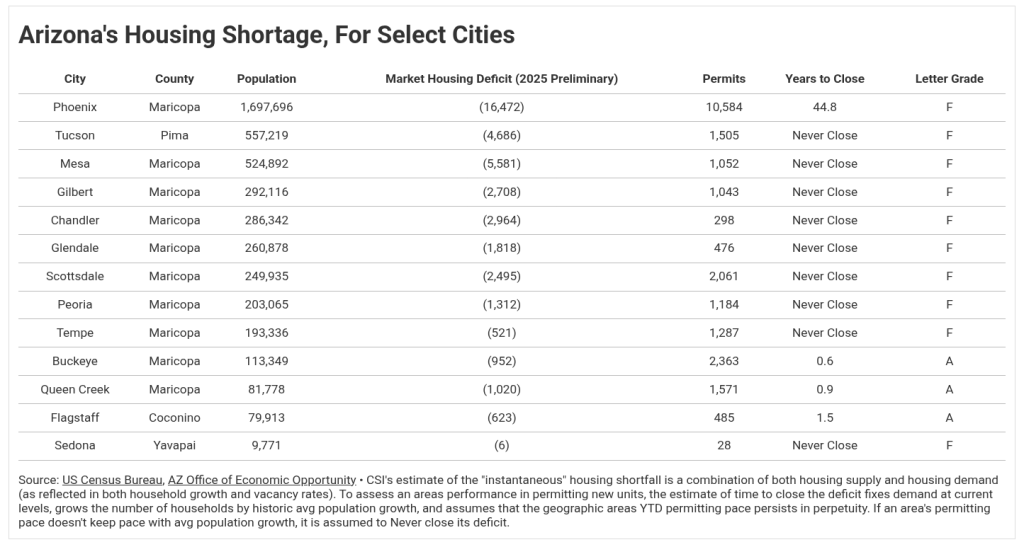
If trends continue, it will take Phoenix nearly half a lifetime — more than 44 years — to close the city’s 2025 housing deficit of 16,472 units. And Phoenix is doing relatively well. CSI found that several other Valley cities have no shot in hell of closing that gap.
The organization’s study found that Mesa, Gilbert, Chandler, Glendale, Scottsdale, Peoria and Tempe will “never close” their housing-deficit gaps because their permitting pace is outstripped by their projected population growth.
Why are things so slow? Milne cited a 2023 building moratorium imposed upon developments in Buckeye and Queen Creek by the Arizona Department of Water Resources after developers couldn’t prove they’d secured the statutorily required 100-year supply of water. This month, a Maricopa County Superior Court judge struck down those rulings, allowing building to resume. However, that moratorium affected only those outlying communities, not the heart of the Valley.
Milne also pointed to high interest rates in the housing construction sector, the cost of new housing materials, land-use restrictions and tariffs as factors. There’s also NIMBYism — particularly in Scottsdale, where residents have fought tooth and nail to prevent a planned headquarters development for the Taser and police camera company Axon, which will include large-scale residential developments.
“It’s hard to pin down what specifically is driving it,” he added. “There are a lot of factors that go into the costs of constructing new housing.”