
Clarissa Sosin

Audio By Carbonatix
Dago took a sip of his drink — a white chocolate mocha with whipped cream and extra shot from Stickler’s Cafe just outside Phoenix’s Municipal Court.
“It’s not better than Starbucks,” he said to the woman sitting next to him, Sophia Elicia.
“You got bad taste,” Elicia replied, chuckling. “That’s fine.”
The two were seated on a bench in courtroom 206 in Phoenix’s Municipal Court. It was just before 8:30 in the morning on Aug. 13 and they were waiting to be called into a courtroom. They sipped coffees and chatted quietly with an air of ease and familiarity. Dago was there for an arraignment hearing. Elicia had given him a lift and was there to support him. His charge: obstructing a highway or other public thorough fare, a misdemeanor.
A woman walked in from the hallway.
“Wilson?” she asked loudly, looking around the drab room expectantly at the smattering of people waiting on benches.
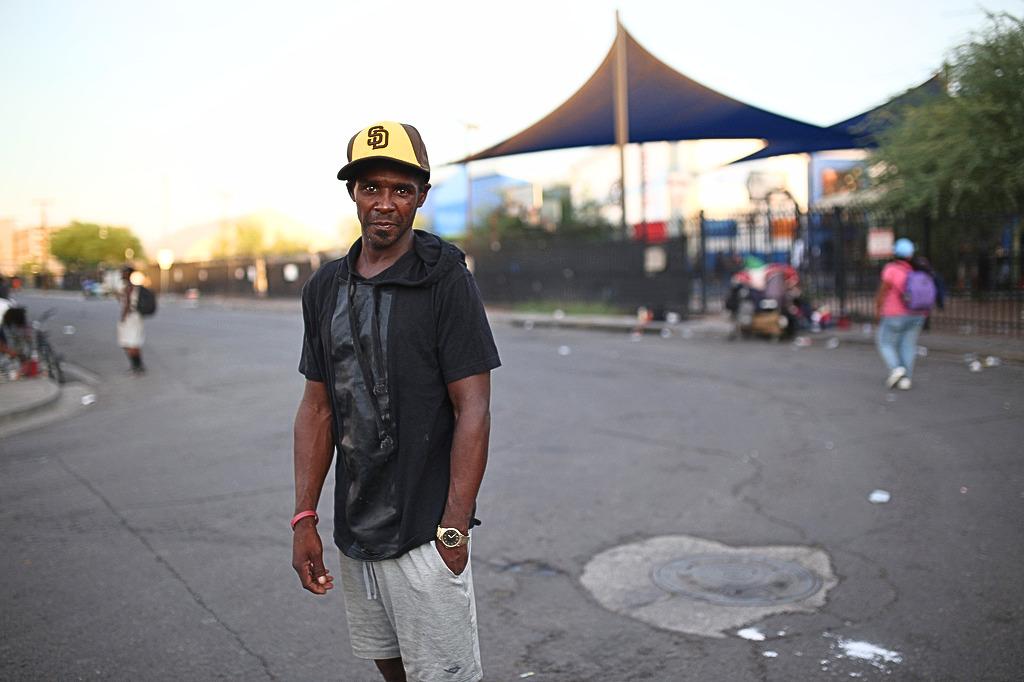
Dago perked up, straightening his slight frame dressed today in black and red. His full name is Faheem Wilson. Dago is short for San Diego, where he’s originally from. He has lived in Phoenix for about 12 years, the past few of which he has been homeless in the Zone, an encampment near downtown Phoenix. His friend Elicia is a homeless advocate who runs the Instagram account @unshelteredphx. She asked to be identified in this story by her first and middle names, out of fear of retaliation.
The two met a few years ago in the Zone — before a court ordered it cleared in 2023 — during an ice giveaway that Elicia and other advocates held. At its peak, around 1,000 people lived in the Zone, an area (roughly) bordered by Ninth Avenue and 15th Avenue between Jefferson and Jackson streets. To some it goes as far north as Washington Street and as far south as Grant Street. Today in the Zone you’ll find few tents and just a couple hundred people — including Dago.
“Do you want me to go with you?” Elicia asked. “I think this is the part where they ask you if you want to just plead.”
He declined and headed out to the hallway with the woman. A minute later he was back. The woman worked with the Community Court, a specialized court for homeless people. She’d wanted to know if he wanted to transfer his case there. He’d said no.
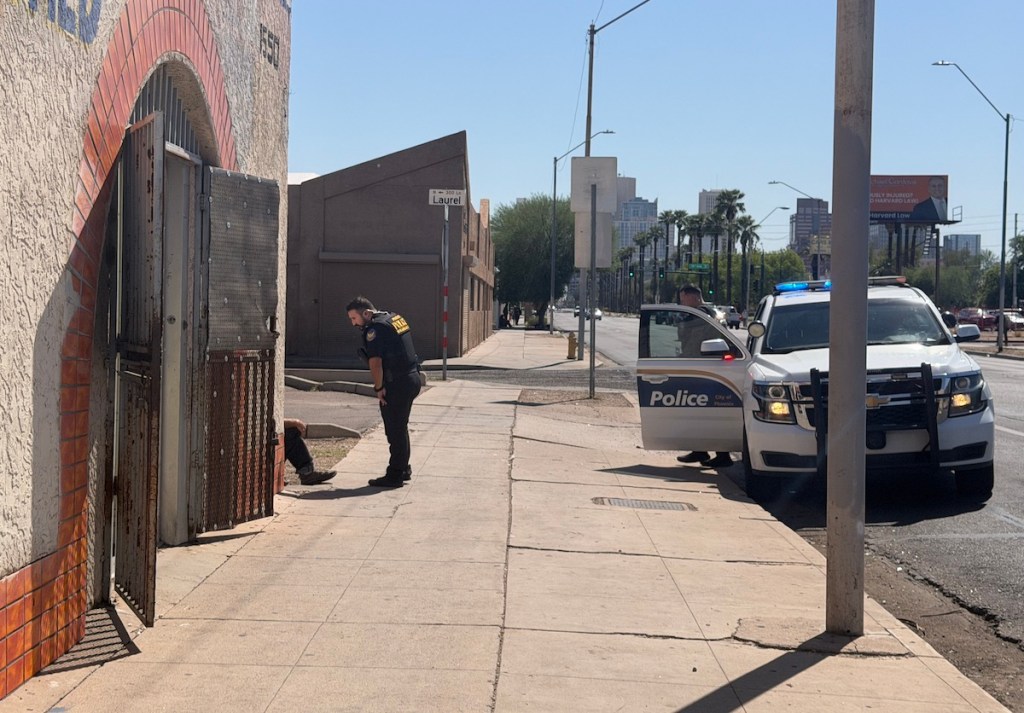
This was Dago’s second citation in less than a month. Routinely, often during early morning sweeps, Phoenix police cite people for camping, trespassing, or obstructing the roadway. The people cited, like Dago, wind up in familiar bureaucratic machinery being shuffled between hearings, between desks. If they miss a court date, they are issued a bench warrant and can wind up in jail. Dago is charged with a class 1 misdemeanor which could earn him a sentence of up to 180 days in jail, three years’ unsupervised probation and $2,500 in fines.
Clarissa Sosin
Ideally, he avoids jail and remains free. But what remains unmovable are the numbers that define homelessness in Arizona’s capital. Lawmakers have all but made homelessness illegal. Even if Dago wanted to sleep in a shelter, the likelihood of securing a bed or a cot or a tent space is small.
The stark reality is this: There simply is not enough shelter capacity for the city’s homeless residents. There are about 900 beds in the neighborhood where he stays. When those spots are filled each night, a couple of hundred people are left to fend on the street. And that’s just in the Zone. Occasionally the police cite them for being in the streets. Thus begins a journey into the court system, with its rules, its fines, its deadlines, its costs, and its potential for disaster if anything goes wrong.
A sweep without warnings
Dago received this specific citation on July 30 during a larger operation by the city to clear a curved stretch of road at the intersection of 11th Avenue and Jackson Street. This was near the Andre House of Hospitality, one of the area’s homeless services providers. At the time, the city said it did the sweep to remain in compliance with the 2023 court order.
Typically a sweep involves a couple of officers who warn people to move before they start issuing citations. But that morning, without warning, they targeted the curve and set up barricades. Officers arrested seven people for felonies and made 18 “contacts” for camping and trespassing. Dago was among those 18. He was issued a citation and given a court date.
“Usually,” he said, “they incarcerate you.”
In the courthouse, a woman yelled out Dago’s last name, this time from near the judge’s bench. She wanted him to fill out the application for a public defender. He went to the front, grabbed a pen from a red Solo cup full of them, filled out the forms and sat back down.
At 8:48 a.m. the judge, Alex Navidad, entered. He explained to the room how the morning’s proceedings would work. Then court began. The first case was a man with a DUI. He was followed by a woman with multiple civil and criminal traffic offenses. During a brief pause between the DUI and the traffic case, a middle-aged woman with braided pigtails walked in, clumsily carrying two bags down the aisle to a bench near the front. One bag had a sleeping pad poking out of the top. Dago stores his belongings in Elicia’s car when he has a court date. He’s down to just one backpack now.
The judge made his way through the cases. Dago was fifth on the docket. He walked calmly to the lectern. Navidad asked him if he still resided at the Peoria address listed in his file. No, Dago responded.
“Make sure you update that before you go,” the judge replied.
Would Dago be interested in working out an agreement with the prosecutor’s office and wrapping everything up today, the judge asked. Dago looked back uncertainly at Elicia. She shrugged. He turned to the judge and agreed to speak with the prosecutor.
Outside the courtroom Dago and Elicia wondered to each other what kind of deal might be on the table. They didn’t have high hopes. He only had one charge, so there wasn’t much room for negotiation.
They walked up to the arraignment prosecutor’s office at the end of a narrow hall on the far end of the second floor. A man wearing a gray suit with graying hair and black glasses sat in a window at the entrance like a bank teller. Was he there to plead guilty, he asked Dago. No, Dago replied.
“You’re not pleading guilty?” the man asked.
“Nope,” Dago repeated.
The prosecutor gave him his paperwork and sent him back to the judge.
The judge called the woman with the pigtails up while Dago waited. He read her offense: lighting a fire in the park.
“Smoking a cigarette in the park,” the woman replied, her bags stacked next to as she stood at the lectern.
They always get people with that, Elicia whispered.
Finally it was Dago’s turn again. Was he able to work something out with the prosecutor, Navidad asked. No, Dago replied. The judge appointed him a public defender and gave him the paperwork to drop off at their office on the fourth floor. He’d need to get fingerprinted before his next court date. The judge reminded him to bring his ID for that.
Outside the courthouse Elicia and Dago went through the paperwork, taking photos in case the physical copies got lost. He’d updated his address in the system with the public defender’s office. The old one was for a program in Peoria that he’d lived in for a while. This time he gave the address for the Central Arizona Shelter Services, widely known as CASS. He can get mail — including court notices — at CASS, by the intersection where he was issued the citation.
He was due back in court in early September. He’ll have to get a new ID though so he can get fingerprinted before then. Elicia chided him for not having replaced it yet. It was lost — or stolen — with some of his other belongings in early July when he was issued the other citation. The officers didn’t take him to jail but they did detain him and take him from the neighborhood, he said. When he got back, some of his belongings, including his ID, were gone.
Dago told one final story before he and Elicia walked back to her car. When he was filing his paperwork, the person behind the window at the public defender’s office asked if the two women waiting were with him.
“I told them you were my body guards,” he said with a laugh.