
Katie Jones-Weinert

Audio By Carbonatix
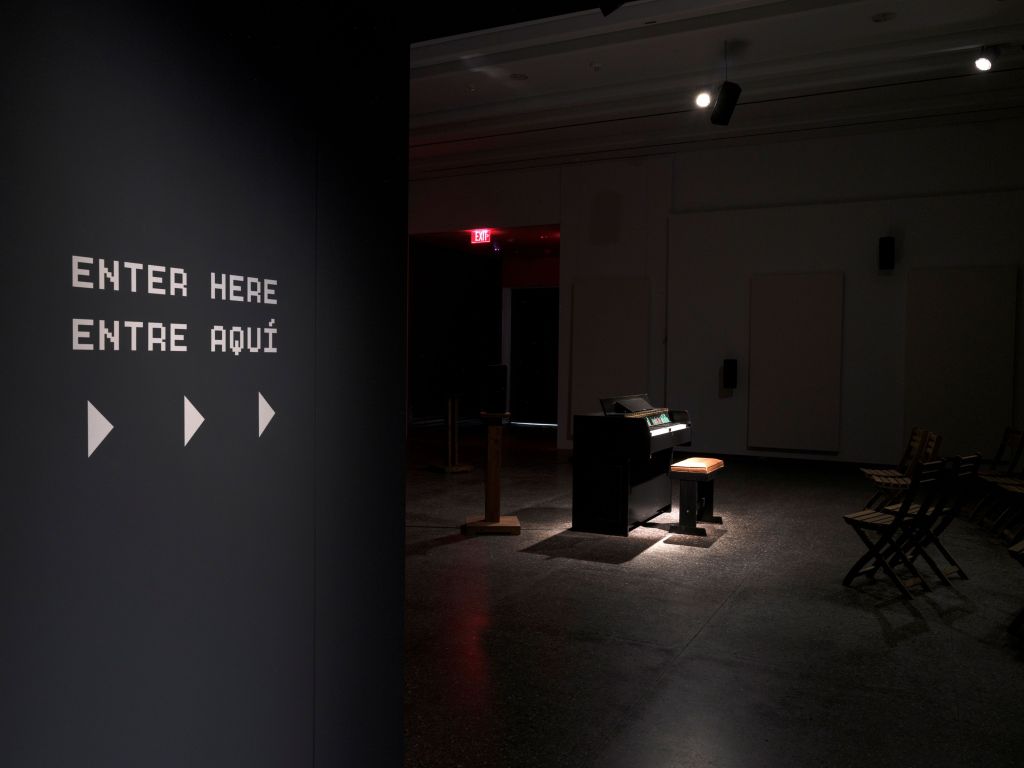
On the lower level of the Phoenix Art Museum, under the one light in an otherwise darkened room, sit an electric keyboard in a wooden housing, a small padded bench and 16 wooden chairs arranged in three rows. This is “The Instrument of Troubled Dreams,” an interactive sound installation created by Canadian artists Janet Cardiff and George Bures Miller. The piece, which is on loan from the Diane and Bruce Halle Collection, debuted at the museum in June.
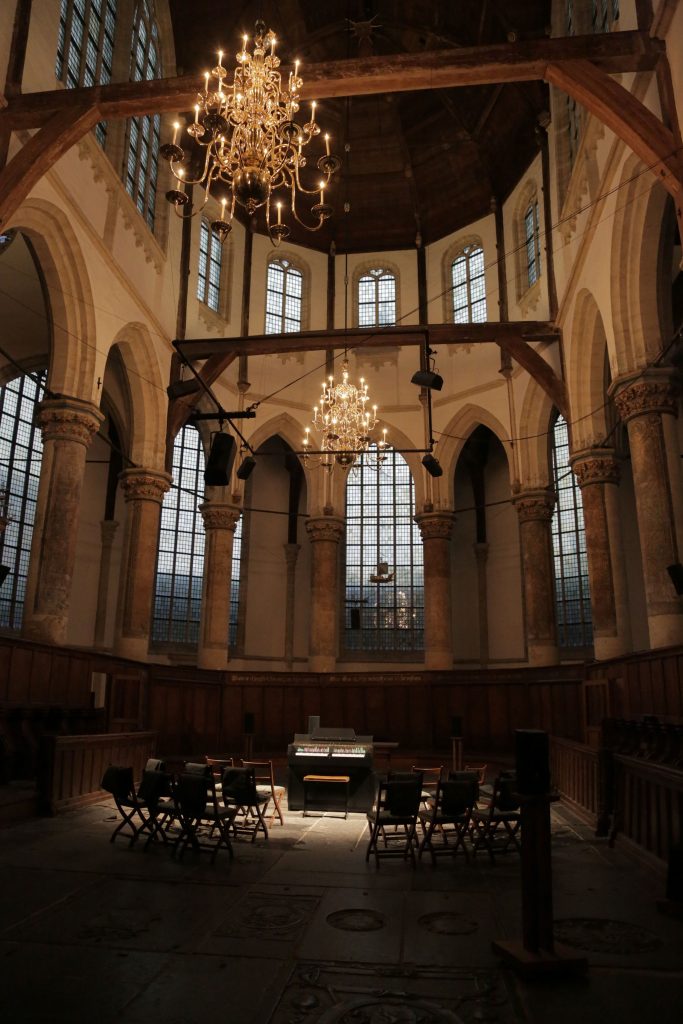
Cardiff and Bures Miller, who have been collaborating for over 35 years, premiered the work in 2018 at Amsterdam’s Oude Kerk, a grand church with nearly eight centuries of history, now the city’s oldest building and a space for sponsoring and presenting new art.
The keyboard instrument in the installation is a replica of a Mellotron, a kind of early electronic keyboard instrument invented in England in 1963, on which each of the 72 keys corresponds to a length of magnetic tape that moves across a playback head when the key is depressed; the instrument operates by playing previously recorded sounds rather than by synthesizing sound itself.
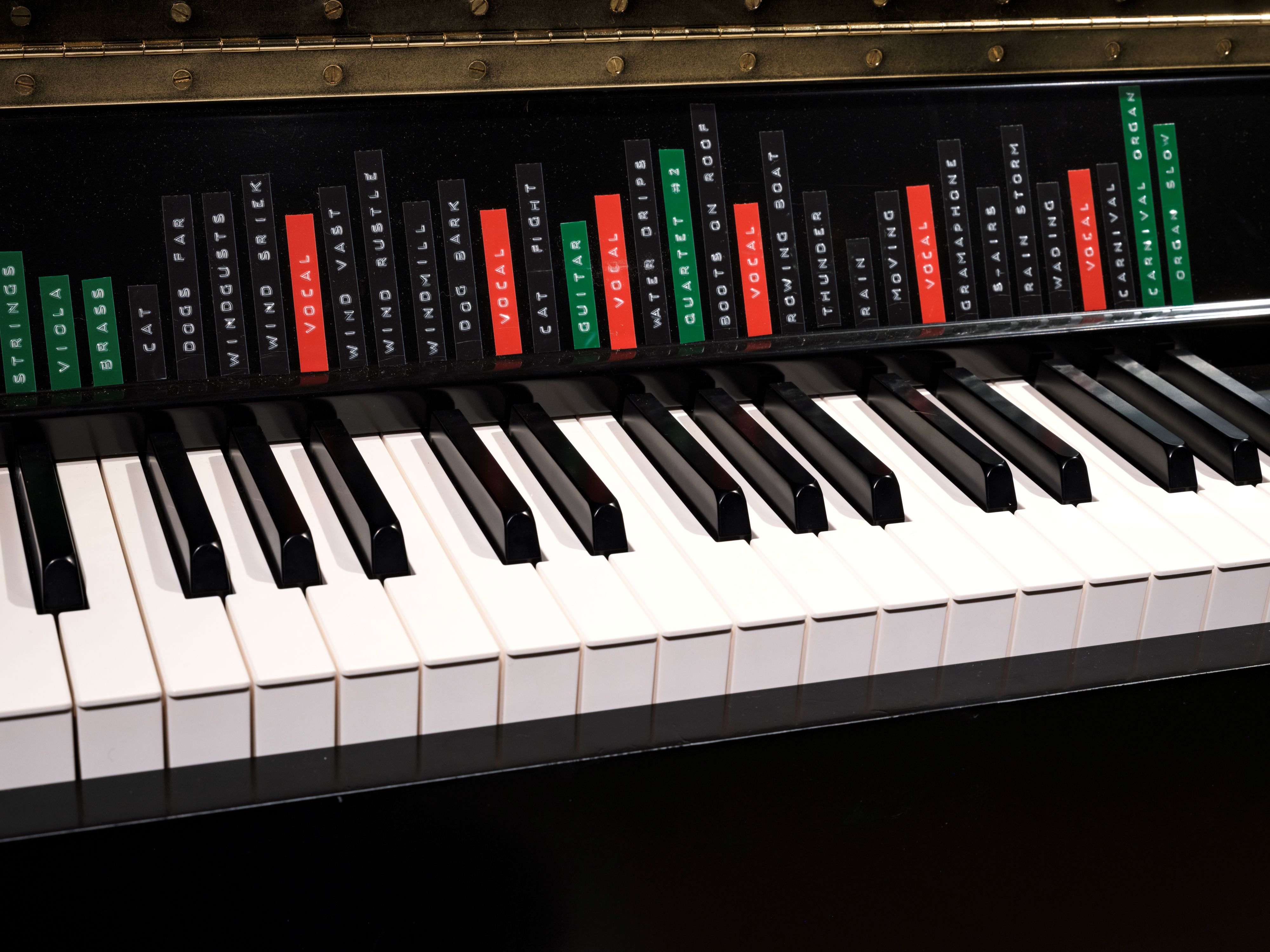
In a standard Mellotron, the keys correspond to notes on the 12-tone scale as on a piano, but for Cardiff and Bures Miller’s Mellotron replica, the keys instead correspond to sound effects, vocal tracks and short passages of music (in digital rather than tape form), with color-coded labels above each key to indicate its sound. The instrument has therefore, as Christian Ramírez, PAM’s Cohn Assistant Curator of Contemporary Art and Director of Engagement, says, been “transformed into a storytelling device.”
The instrument’s sound effects (marked with black labels over the keys and occupying the majority of the keyboard) run a wide gamut: mewing cats, barking dogs (in near and faraway variations), wading through water, rowing a boat, wind (in three variations: gusts, shrieks and deep low blowing), gunshots, police searching an apartment, food being prepared in a kitchen, steam escaping a valve and numerous others. About a third of the keyboard’s keys, color-coded green, play musical passages, several of which, such as “Theme for Troubled Dreams” (isolated into seven separate instrument tracks for bass, percussion, cello, strings, viola, brass and vocals) and “Bowed Metal 1 and 2,” were composed or improvised for this installation. Other musical selections include a choral setting of Psalm 138 by Dutch Renaissance composer Jan Peterszoon Sweelinck (who served as the Oude Kerk’s organist from about 1580 until his death in 1621) and Julius Fučík’s “Entry of the Gladiators” (a circus classic listeners will recognize at once).
Courtesy of Janet Cardiff and George Bures Miller
Amid the sound effects and passages of music, scattered along the length of the keyboard, sit 11 keys, all marked with red labels reading simply “vocal.” Each of these keys plays narration (by Janet Cardiff), about a minute or so long, connected as a collection of impressions or images, though without any linear or chronological progression that would make a certain sequence the correct or intended one.
Some of the tracks are ominous and portentous: “I lay still, flat on the ground. I could hear the dogs searching for me along the beach. I could see a large ship out at sea, fighting its way through the growing swells. Above my head, the arms of the windmill came crashing down towards me, over and over, louder and louder, as the storm clouds came closer.” Others suggest a frightening totalitarian world: “She hid behind a secret panel in the wall. When the police came, they searched the whole house. She could hear their loud voices and footsteps, staying hidden for days, slowly drinking her small supply of water and eating her decaying fruit and bread.”
Yet others partake of dreams’ strange logic (“Some nights, she hears the barking of a dog, but it may be just a log scraping a window.”) or evoke a journey into the subconscious (“She made her way down a circular stairway that led to the lower depths of the barge. Dank, cold air hit her in the face as she descended into the darkness. … She entered a dimly lit space filled with decaying machinery.”). And some seemingly prosaic pieces of narration describe the Oude Kerk: “On Sundays, I used to walk to the Oude Kerk in the snow. Services seemed so old-fashioned. Nothing’s really changed there. … After the service, they served tea and cookies, and I would try my best to make small talk.”
Katie Jones-Weinert
All these sounds emerge from 23 Passio speakers placed around the room to produce “an immersive experience,” one in which “you can feel the sound in your body as you play the instrument or sit in the audience,” Ramírez says. Indeed, the exhibit can get loud, though not in the way that’s felt in the ears so much as felt in the gut, a visceral sensation. The sounds “encircle you and place you in a dystopian-feeling setting and story of your own making,” she says, adding that the experience “mirrors that quality of troubled dreams, where you feel uneasy or uncomfortable because something’s just a little bit off and all-consuming.”
Musicians are likely to first approach the keyboard in terms of key centers, scales and modes, but these concepts do not apply here. Nor does the keyboard demand a linear progression from left to right (or right to left, for that matter), though one can play it that way. This keyboard’s sounds (musical, vocal and otherwise) are instead grouped into thematic clusters, according to actions and objects mentioned in the vocal track, with a few subtler correlations of far-apart keys that become apparent over time.
These thematic clusters are, however, more suggestions than imperatives. The installation is, as Ramírez puts it, “a storytelling instrument, with each key allowing visitors to create their own score or film.” Indeed, the instrument offers a range of expressive possibilities, and one experiences a different style, a different sonic atmosphere, a different version of the exhibit, with each person who plays (and more so when more than one player takes to the keyboard, greatly expanding the possibilities), such that the exhibit makes possible successive stages of discovery and creation, first with understanding its mechanics and identifying the thematic clusters, then seeing more and more possibilities for exploring this work of, as Ramírez describes it, “sculptural sound.”