
Tony Aguilera/Design by Dana Mackenzie

Audio By Carbonatix
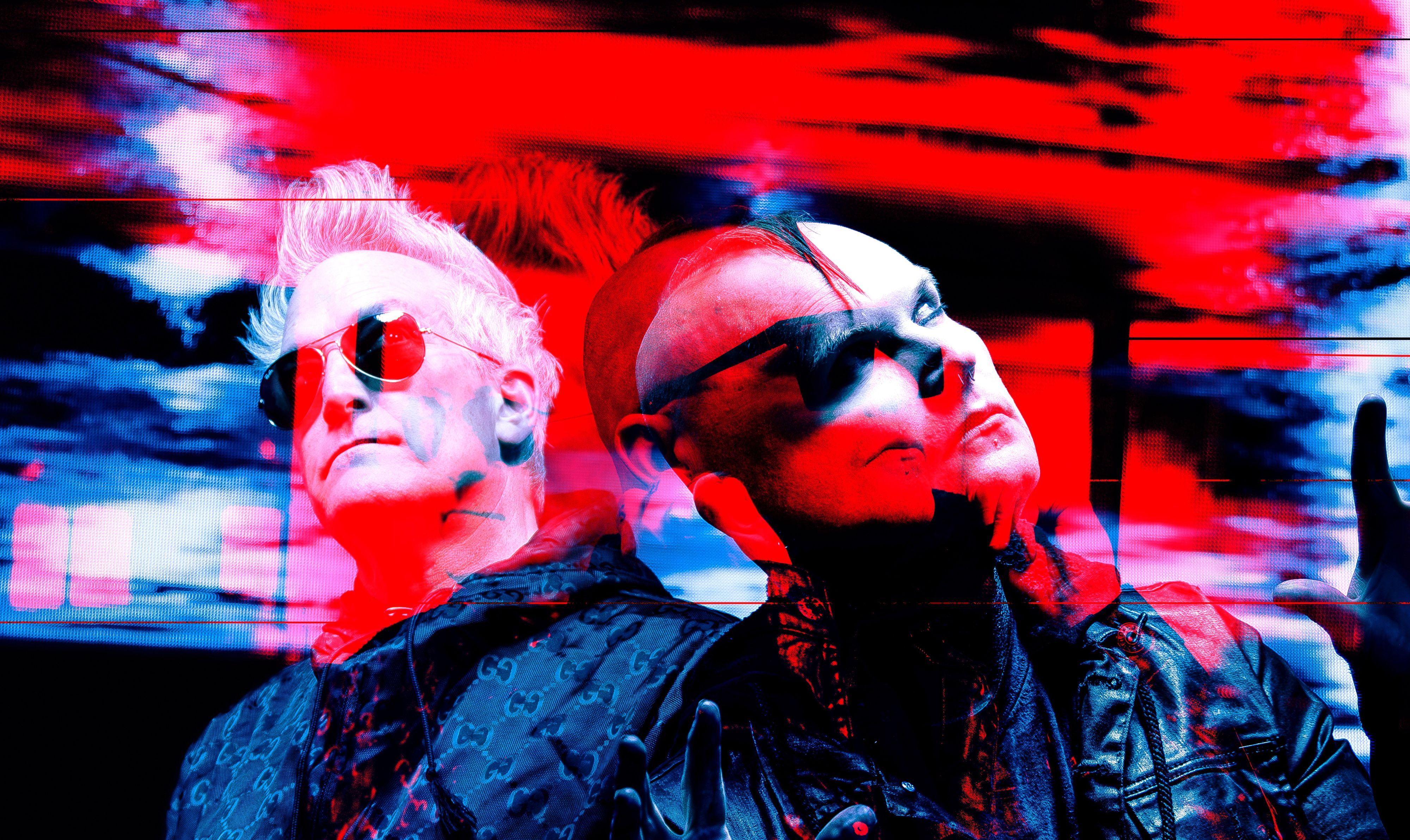
Some things begin with love, but A Place to Kill, the new project from Filter frontman Richard Patrick and Phoenix photographer and There Is No Us singer Jim Louvau, began with no love, or rather a song of that name.
Louvau first met Patrick in 2008 when interviewing him for an article, “and we’ve somehow stayed in each other’s orbit,” Louvau says, “because we do have a lot of mutual friends and industry peers and artists in general.”
“Plus he’s a photographer, so he’s always taking photos of the bands,” Patrick adds.
In addition to his musical work, Louvau has been photographing musicians and performances for over 20 years and in the last seven has directed music videos for Kerry King, Jerry Cantrell, and Poppy as well as shorts for Maynard James Keenan and Puscifer. Nine Inch Nails has licensed some of his work for their merchandise. He is a frequent Phoenix New Times contributor.
During a Filter performance, Patrick invited Louvau onstage to do the screaming parts in the chorus of “No Love.”
“I was shocked at how loud and how cool it sounded,” Patrick recalls.
In 2020, Patrick again called upon Louvau and his powerful scream when recording the Filter song “Murica,” which addresses the political turmoil of the time in its lyrics — “They got us right where they want us / At each other’s throats” — and video.
“I had to tuck (Louvau’s vocals) behind mine so that he wouldn’t overpower me,” Patrick recalls. “It’s pretty intimidating to hear this guy on a microphone. His voice is so insanely loud.” The volume of Louvau’s scream is such that only certain recording gear can handle it.
“I have this big, beautiful $6,000 mic, this amazing custom microphone,” Patrick says, “and there’s no way he could use it.” They instead use a broadcast microphone “that can take the abuse” of Louvau’s voice.
Around the same time as the recording of “Murica,” Patrick started buying synthesizers. “I started experimenting with different loops and different sounds,” he recalls. This interest in synthesizers was, in some ways, part of a return to an earlier way of making music.
“When I did the first Filter records,” Patrick says, “it was me and a computer.” As his career progressed, more people got involved with the music, and Patrick recalls “losing that interface between me and the computer” from using a lot of producers to make the records, a practice he describes as a bad habit. He began working to regain those chops because eventually, it became more fun to work on synthesized music and be more self-reliant.
He recorded and sang on some of these ideas, but decided he “wanted a super-screamer,” and reached out to Louvau. Both knew at the outset that this would be a new project, neither Filter nor There Is No Us.
Guitar-free zone
Part of this difference comes in how Patrick and Louvau compose for the new project.
“In both of our other projects, there is a lot more structure in the writing, a lot more verse, chorus, verse, bridge,” Louvau says. “A Place to Kill songs don’t follow any sort of standard structure.”
For APTK, Louvau says, “We’re not using a guitar as the writing tool of choice,” instead “making really heavy music with synths and keys and very little guitar.”
Case in point: “Jet Engine,” the single from the APTK EP, delivers a heavy sound without a single guitar. An unapologetically defiant song (“I’m the jet engine of fuck you / I live my life the way that I want to, so fuck you / Take now, all that I need to / Watch now as I bleed you”), “Jet Engine” takes its name from a remark by producer Sean Beavan referring to Louvau as “the jet engine of fuck you,” which Louvau considered “a great compliment” to his voice and music. The motif at the forefront of the mix is, Patrick says, “a handcrafted sound I created on the Sequential Pro-3,” a hybrid multi-filter synthesizer.
Although the EP is, in Louvau’s description, “one of the most aggressive industrial-related releases in years,” there are nonetheless moments of contrast. He describes the EP’s closing song, “Something Inside Me,” as “the most mellow track tempo-wise” with “a bit of a trip-hop vibe,” a song in which he wanted something “vocally and lyrically” aggressive (“Something inside me comes out at night / The edge of the blade keeps me alive”) but that would be “something that was also not for the boys.”
Of the overall sound of A Place to Kill, namely the choice to eschew guitars, Patrick says, “I want it to be as synthesized and digital as possible. For Filter, it starts with a guitar or a bass and the idea that this is going to be a Filter song. I can write with an acoustic, and it’s still going to come out a Filter song.” When composing for A Place to Kill, however, “it’s starting with a sample of someone crying or something.”
The song “What Feels Right,” the one track on the EP with guitar, presents the only exception. Louvau and Patrick were near the end of the sessions for the EP, Louvau recalls, “sort of figuring out what was missing.” Patrick had presented Louvau with an early version of the song with the only lyric at that point being, “Hey / You gotta do what feels right / Now.” Louvau suggested changing “Hey” to “Hate,” after which, Louvau recalls, “the song took flight,” and the two finished the lyrics together (including “It’s them against us, not you versus me / This hate and division is all that they breed”) and agreed to add guitar to the song.
When it came time to name the new project, Patrick originally settled on The Killing Fields, but, finding the name already taken by other groups, he modified the name to A Place to Kill.
“It just rings true to me for some reason,” Patrick says. “I don’t know specifically what it’s supposed to mean.”
Louvau says the name leaves room for interpretation and that there’s no wrong answer as to what the name signifies, but offers one option.
“Every time I go on stage, I’m looking to fucking crush and kill that stage,” he says. “That’s my place to kill.”
Tony Aguilera/Design by Dana Mackenzie
Songs for a new world
For Patrick, the name A Place to Kill evokes the fragmentation of our mediated world.
“It’s like flipping through channels on TV and seeing news and entertainment and scribbling it down on a piece of paper,” he muses, “and then screaming that into a microphone later.”
The usual practice is for Patrick to start by going to “different websites that have tons have of royalty-free sounds.” He’ll then experiment by manipulating the sample with various effects, adding sampled drum sounds, or bringing in “a string section from some scary movie or some old movie,” for instance, and quickly put together an instrumental track. “Usually, within three or four hours, it’s done,” Patrick says. “And that’s when I call Jim.”
“Rich puts things together so quickly,” Louvau says, “and when I get out there, we’re almost finishing an entire song in a day. We’re trying to be impulsive to some degree on purpose. And that shines through in the music.”
Part of the reason they prefer to move so quickly is so the songs can respond to current events.
“It would be nice to write something and immediately release it a week later,” Patrick says, “kind of like the way Bruce Springsteen wrote a song of protest.” (Springsteen’s “Streets of Minneapolis,” released in January, commented directly on the ICE violence happening there at the time.)
“I love that instant kind of release,” Patrick says. “I want to have the ability to do that with A Place to Kill where something happens, we write about it and then it’s out in a few days.”
Weird and getting weirder
Patrick and Louvau completed much of the EP’s material a few years ago but delayed the release, in part because of Patrick’s touring schedule with Filter.
“A lot of these songs were written and constructed in the middle of COVID,” Louvau says. “It was weird then, and it’s only gotten weirder.”
“Filter kind of came back to life with touring after COVID,” Patrick says. He had spent the previous few years working on film scores. That changed near the end of the pandemic. “All of a sudden, everybody wanted a Filter concert. We were rebuilding Filter on the road, and we kept moving A Place to Kill back in time.”
Louvau and Patrick thus waited until what seemed the proper time to release the EP, and, as Patrick remarks, “it just coincides with the end of civilization.”
“Some of the stuff we talk about lyrically in the songs has oddly enough taken more shape than when they were written,” Louvau says, citing in particular the lines “Heading for war, fighting the poor / The suits and the leeches are begging for more” in “What Feels Right.” “Now we’re actually at war. It’s almost like you saw it coming.”
There are, though, many kinds of war underway, Louvau adds, including “a lot of internal wars going on, within people. It’s a very hard time to be a human being for most people on the planet right now. People are really just struggling to survive.”
A Place to Kill’s lyrical themes are, Patrick says, “a reflection of what we’re seeing.” In his view, no other contemporary groups are doing the kind of social commentary he and Louvau are striving to make with A Place to Kill.
“The bands we’re inspired by have always stuck to their guns and said something socially, and nobody else seems to be doing that right now,” Patrick says.
“We’re not talking about choosing sides,” Louvau says of the band’s social and political stances. “We’re talking about not trusting anything and questioning everything. We understand that there is a lot of division in the world that is very manufactured.”
In addition to current events and the state of the world, Patrick finds inspiration in new music, especially electronic music made by younger people. He cites in particular Pixel Grip (“a bass synth with a drummer and a guy playing a little bit of computer, some sparse keyboards”), Scarlxrd (who has “someone spinning the record, and he’s just the main performer”), Rezz, Skrillex and Deadmau5.
“I think that is so punk,” Patrick says of electronic music and its general lack of conventional musical instruments. “It’s punk to buck the system. It’s amazing that these kids are getting away with it.”
“There are no rules in music anymore,” Louvau says. “We can do whatever the fuck we want. That’s the beautiful part of where the music industry is. No one can really tell us what we can and can’t do.”
Revolver Records
Music for the apocalypse
Louvau and Patrick intend to take A Place to Kill live when the time is right, and when they do, “it’s going to be me and a computer and a synthesizer and Jim onstage,” Patrick says. “And it should never go beyond that.”
And while Louvau and Patrick cite groups such as Skinny Puppy as early influences they continue to admire, they emphasize that they have made an effort for A Place to Kill “not to be a nostalgia trip,” because “industrial music can feel very nostalgic,” Louvau says.
“I’m in a band with a guy who is in Filter and was in Nine Inch Nails,” Louvau says of Patrick, who was a touring member of Nine Inch Nails in the “Pretty Hate Machine” era and left during the recording of “The Downward Spiral” to start Filter. “(Nine Inch Nails and Filter) are on Mount Rushmore for a lot of industrial people. For Richard Patrick to just make another industrial record with another guy isn’t exciting to him, and it wouldn’t be exciting to me.”
Patrick, for his part, also finds that what he wants to accomplish musically continues to change as he gets older.
“As I get older, I just feel like getting more and more crazy,” Patrick says. “The majority of the new music I’ve created in the last 10 years has been pretty heavy. A Place to Kill is without question the heaviest shit I’ve done.”
Patrick notes that “my compadres or my fellow writers out there, my fellow musicians,” are “getting mellow with age” even as “I’m getting angrier, and I want to make heavier music.”
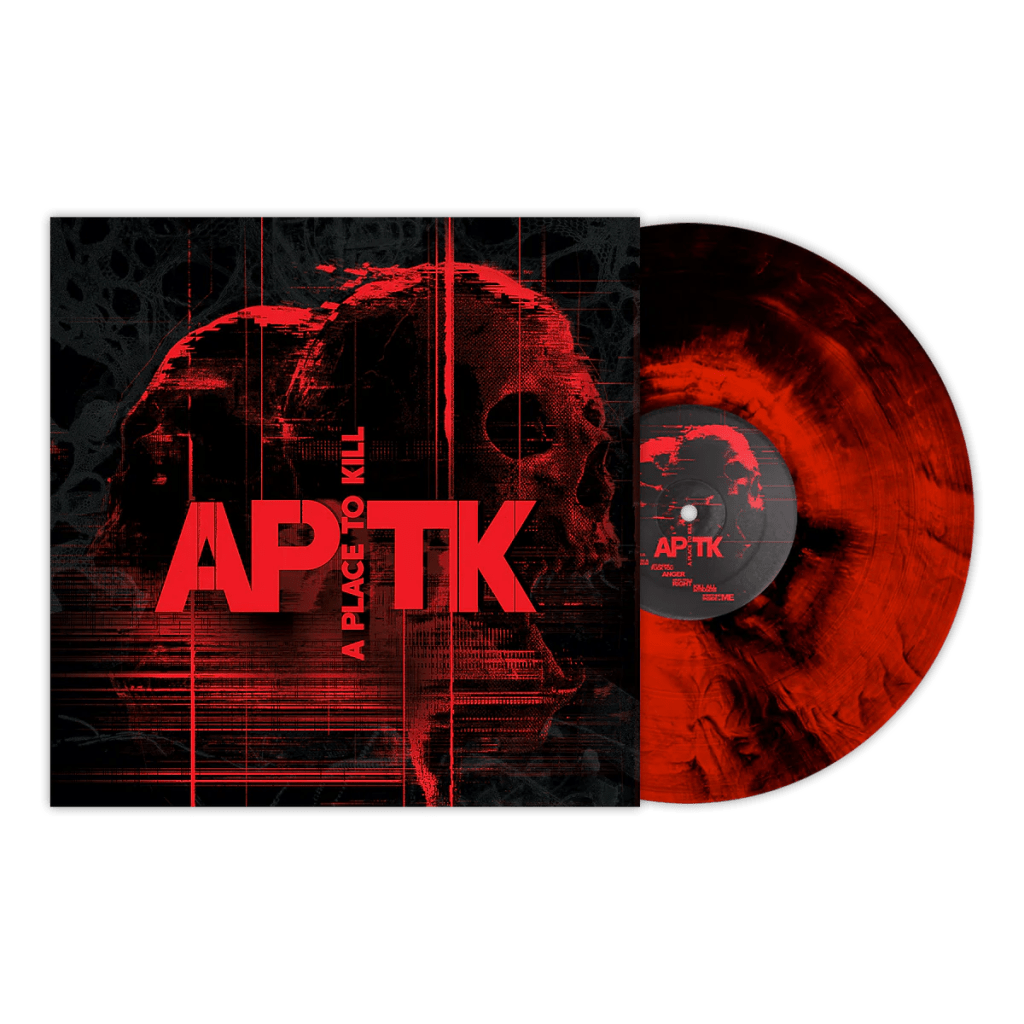
The APTK EP was released digitally on June 5, with a limited vinyl release of 500 copies from Revolver to follow on Aug. 14. The physical album is a striking visual work in a high-contrast palette of red and black (both the sleeve and the disc itself), with the EP on the A-side and an etching of a machine figure with a jet turbine head.
Although the EP has been out in digital form for just over two weeks, Louvau and Patrick are well underway on the next release.
“We’re already several songs into the next release,” Louvau says, “so it’s not going to be another three- or four-year wait.”
The two expect to complete recording the second release over the summer, and, if things go as planned, that music, Louvau says, “will start to surface in the fall.”
The upheaval of our uncertain times, dispiriting and dismaying as it may be, does nonetheless provide material for art.
“We’re at a point where you might find a lot of really great music comes out in the next four or five years,” Louvau says, “because people find inspiration from their surroundings and the world around them and the news and the media and the division between man and his own neighbor.”
“It is not hard to see the anger in society and write something that reflects that,” Patrick adds. “As musicians, it’s easy to make music for the apocalypse.”