

Illustration by Austin Ackert

Audio By Carbonatix
That mail-in ballot has been sitting on your kitchen counter for weeks now, and the primary is right around the corner. It will determine the matchups for a litany of prominent races — seats in Congress and the state legislature, as well as the high-profile jobs of governor, attorney general and secretary of state. Yet, when you look at that ballot, your head spins. How to make sense of it all?
Phoenix New Times is here to help. We’re not going to tell you how to vote, but we can demystify some of the bigger races on your ballot. Given that most incumbents in statewide office are Democrats, most of the interesting matchups are on the GOP ballot. But there are still some intriguing showdowns among the Dems.
This isn’t an exhaustive list — you should do your own careful research on state legislature races and others not listed here — but this should help you feel a bit more prepared to drop off that ballot or pop into a polling place.
Photos by Gage Skidmore/Flickr/CC BY-SA 2.0
Governor (GOP)
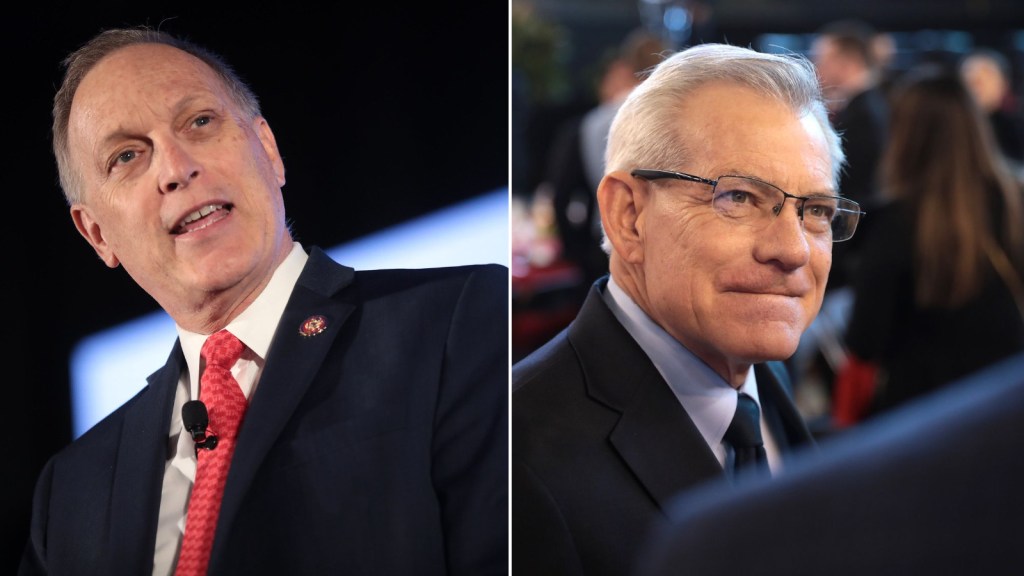
The candidates: Rep. Andy Biggs, Rep. David Schweikert, Ken Miceli, Scott Neely
All available evidence suggests that Biggs, the far-right congressman and former leader of the House Freedom Caucus, is going to run away with this race, teeing him up to take on Gov. Katie Hobbs in the general election. A recent poll had him claiming 60% support among likely primary voters. Biggs has spent most of his time campaigning against Hobbs rather than his primary rivals, correctly recognizing that they present little challenge to him. The Trump and Turning Point USA wing of the party coalesced around Biggs early on, and nobody else has really picked up any steam.
That includes Schweikert, whose campaign has been a curious one. A staunch conservative himself, if not an extra-Trumpy one like Biggs, Schweikert jumped into the race late, claiming that Biggs’ far-right connections made him unelectable in Arizona. Schweikert may be right about that, as the Cook Political Report recently changed its outlook on the governor’s race to Leans Democratic, but he never made a persuasive argument that primary voters should pick him instead. Even after lobbyist Karrin Taylor Robson dropped out of the race — despite having been the first to jump into it and despite having Trump’s endorsement — Schweikert has failed to show he’s a viable alternative to Biggs. At the end of the first quarter of 2026 — second-quarter reports came out after this story went to print — Biggs had $1.1 million in campaign cash on hand. Schweikert had just $86,000.
If Schweikert can’t slow down the Biggs juggernaut, local businessmen Miceli and Neely don’t have a shot, though Neely’s gotten some good shots in about Biggs’ record. Might as well go down swinging.
Photos by Gage Skidmore/Flickr/CC BY-SA 2.0
Attorney General (GOP)
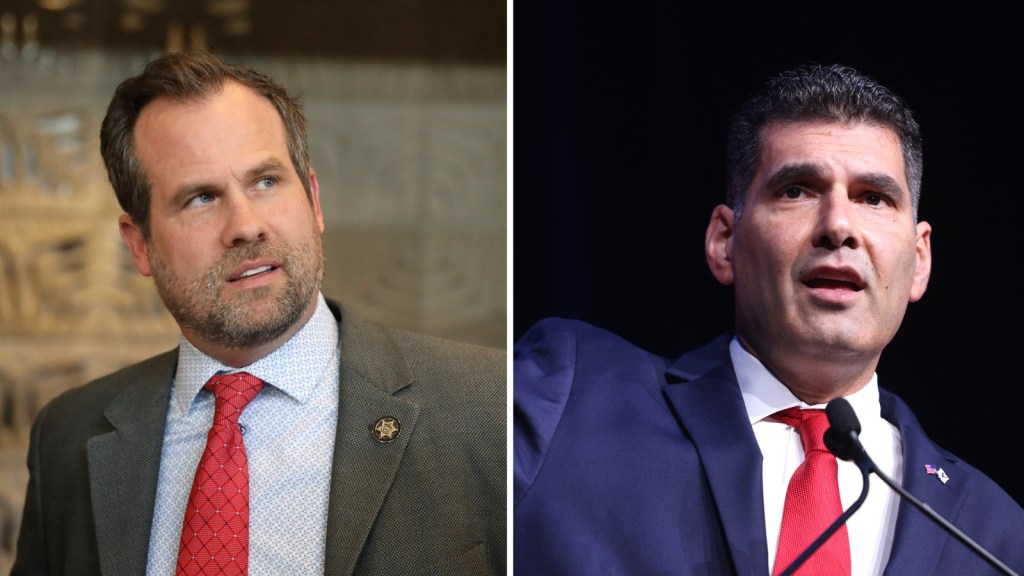
The candidates: state Sen. Warren Petersen, Rodney Glassman
Biggs may have the governor nomination all but sewn up at this point, but the GOP race for attorney general is anyone’s guess. It’s probably the messiest primary race on the slate, as the two candidates vying to unseat Democrat Kris Mayes have spent most of the campaign attacking each other and acting like children. See their televised debate, which went off the rails almost immediately.
Petersen is the president of the Arizona Senate and is a steady supporter of President Donald Trump — though, notably, he lacks an endorsement from Trump or Turning Point. He’s championed bathroom and sports bans for transgender girls, measures to mandate state and local cooperation with Immigration and Customs Enforcement, cumbersome elections reforms and more. All expected from a fairly MAGA member of the Arizona Legislature. What he hasn’t done is prosecute any cases as a lawyer. Petersen only graduated from law school in 2020 and wasn’t admitted into the State Bar of Arizona until 2023, though the Arizona Republic caught him fudging that timeline on his campaign website. Glassman has repeatedly hit Petersen for overstating his legal credentials.
Glassman has a longer history as a lawyer — and, interestingly, a long history as a Democrat. He’s a former member of the Tucson City Council and ran for Senate as a Democrat in 2010, ultimately getting pasted by incumbent Sen. John McCain. Glassman switched parties in 2015 and has run unsuccessfully for office multiple times since, including for attorney general four years ago. (He lost the nomination to Abe Hamadeh, who went on to narrowly lose to Mayes.) He comes from a rich family and seems to really, really want to get elected, since he keeps spending his own money on campaigns. Petersen has attacked him over that, and Petersen’s allies have also promoted unproven sexual assault claims about Glassman and his own brother, which both Glassman scions have denied.
That should give you a sense of how ugly things have gotten, and the race has become such a mess that it’s hard to predict the outcome. Both Glassman and Petersen have touted polls showing them in the lead, although in both cases, the number of undecided voters far outweighs the number of voters who have picked a side.
Photos by Gage Skidmore/Flickr/CC BY-SA 2.0
Secretary of State (GOP)
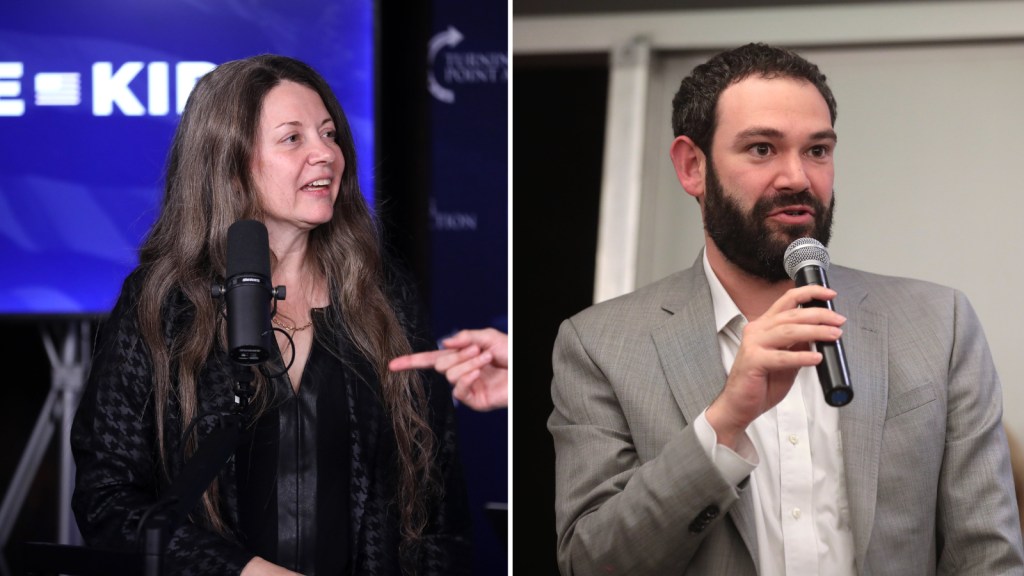
The candidates: Gina Swoboda, state Rep. Alexander Kolodin
This race probably presents the clearest contrast of the major GOP primary contests. On one side is Gina Swoboda, a former elections worker and the former chair of the Arizona Republican Party. Though she’s a fan of Trump and he’s a fan of her, she does not fit comfortably into a MAGA box. For one, she’s rejected the kind of election conspiracy lunacy that Trump and his extreme allies have constantly pushed. If you’re not a political junkie and you’ve seen her face before, it might be because of the videos she filmed as party chair to explain election procedures to laypeople. Though it’s not her purview, she’s also expressed a willingness to support guardrails on the state’s out-of-control school voucher program. All that has put Swoboda at odds with the Turning Point wing of the party, which she openly disdains.
The TPUSA crowd has instead lined up behind Kolodin, who has brought (and been censured for) election lawsuits and who is one of the most conservative members of the Arizona House of Representatives. Kolodin is of the opinion that Arizona’s elections are a laughingstock — evidence shows they actually run just fine and produce reliable results — and he’s made it a persistent mission to reform election laws in a way that many feel would make voting harder. This fall, in fact, Arizona voters will be asked to decide a ballot measure sponsored by Kolodin and referred by the legislature that would, in part, require showing ID to vote by mail. The ballot measure leaves it unclear as to how one would do that.
Arizona Clean Elections Commission
Superintendent of Public Instruction (GOP)
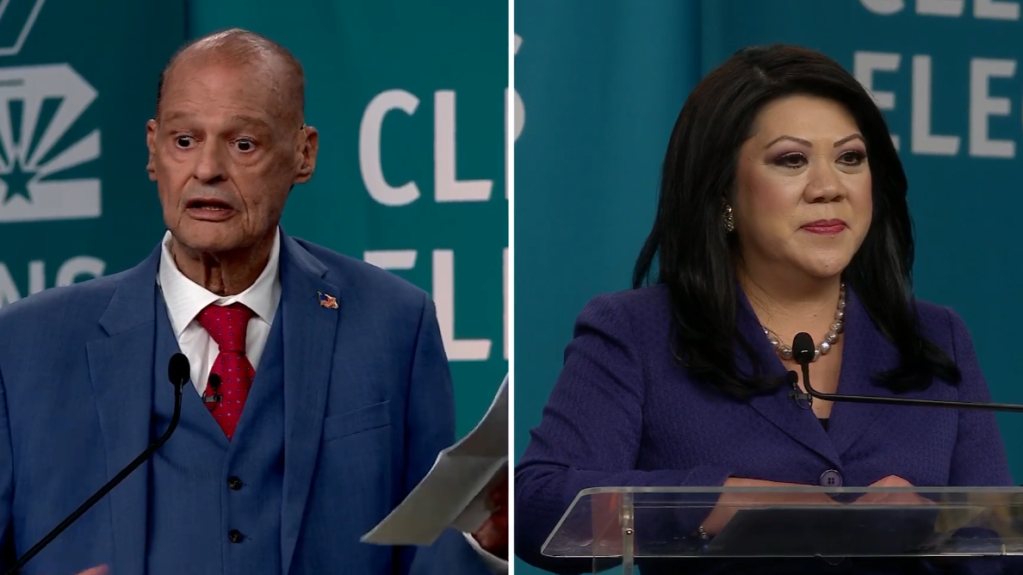
The candidates: Tom Horne (incumbent), Arizona Treasurer Kimberly Yee
This race is an interesting one — it features the only two Republicans to win major statewide office four years ago, and now they’re vying to take each other out. And they’re doing so despite seeming to agree on almost everything. The two big issues in the race have been DEI — that is, diversity, equity and inclusion programs and policies, the new bugaboo of the Trump right — and Arizona’s school vouchers program. Both Yee and Horne say they want to eliminate DEI in education. Both are big supporters of school choice. Yet you’d never know it from how they attack each other!
Yee, who was recruited by far-right state Sen. Jake Hoffman to take on Horne, has attacked Horne for daring to suggest that at least some guardrails should be placed on the state’s Empowerment Scholarship Account program, which is the name for school vouchers in Arizona. The program, which allows any student to use taxpayer money for private or home school expenses, has been a budget albatross with a price tag of more than $1 billion a year. A steady drumbeat of reporting has shown that the system allows bad actors to use ESA dollars to purchase things like lingerie, jewelry and gaming systems, among other items lacking educational value. A scathing report from the Arizona Auditor General found that the Arizona Department of Education under Horne had few viable systems in place to catch ESA cheats.
Horne, who has been at the center of a string of scandals throughout his long political life, has defended the program and disputed the idea that fraud regularly gets past his office. Yet he’s also suggested limits on what parents should be able to buy, making him an enemy of the hyper-partisan school choice crowd. On the other hand, Horne has attacked Yee for supposedly supporting DEI, offering evidence that she once chaired a DEI committee for a state treasurer’s organization. Yee, who is Asian American, has denied that while also facing racist attack ads featuring stereotypical Chinese music and fonts. The ads came from a PAC supporting Horne, though Horne denounced them as appealing to “ethnic bias.”
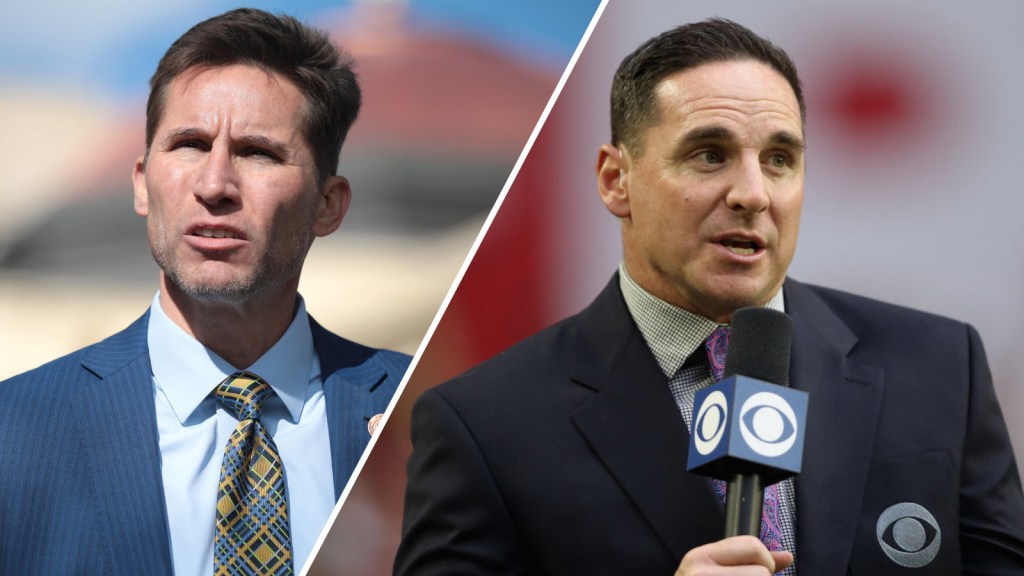
Photos by Gage Skidmore/Flickr/CC BY-SA 2.0 and Christian Petersen/Getty Images
Congressional District 1 (GOP)
The candidates: Jay Feely, Joseph Chaplik, John Trobough
This is a contest between Feely and Chaplik. Feely is the Trump-endorsed former NFL kicker who jumped into the race after getting elbowed out of the race in Congressional District 5, where he actually lives. Chaplik is a former state representative whose views much more closely align with the Trump wing of the party, and he’s bristled at Feely’s perceived frontrunner status.
Their race — to fill the seat that will be vacated by Schweikert — has gotten testy. Feely has faced accusations that he’s a Republican In Name Only because he’s done things like play golf with Democrats and isn’t as militantly anti-immigrant as Chaplik is. Chaplik has tried to score points against Feely by demonizing his philanthropic work in Haiti, including his efforts to help two young Haitian men build lives in the U.S. after the devastating earthquake in the island nation earlier this century. In the process, Chaplik has gotten pretty racist, playing on the bullshit claim from the 2024 election that Haitian immigrants in Ohio were eating people’s pets. They weren’t.
While Chaplik has been on the attack, Feely has struggled to appear more moderate while also toeing the MAGA company line. He’s defended his work in Haiti but stumbled through that defense by suggesting that Haitians might have a good reason to eat pets. (Again, no Haitians were eating pets!) At a televised debate in the race, Feely also promoted the false and racist notion that the country’s affordability crisis is the fault of undocumented immigrants. Multiple studies show that is not the case.
This is a seat Democrats have hoped to pick up for the last few cycles. Perhaps Chaplik can knock off Feely, but as the more explicitly MAGA-coded candidate, Chaplik would seem to have a tougher time in the general election.
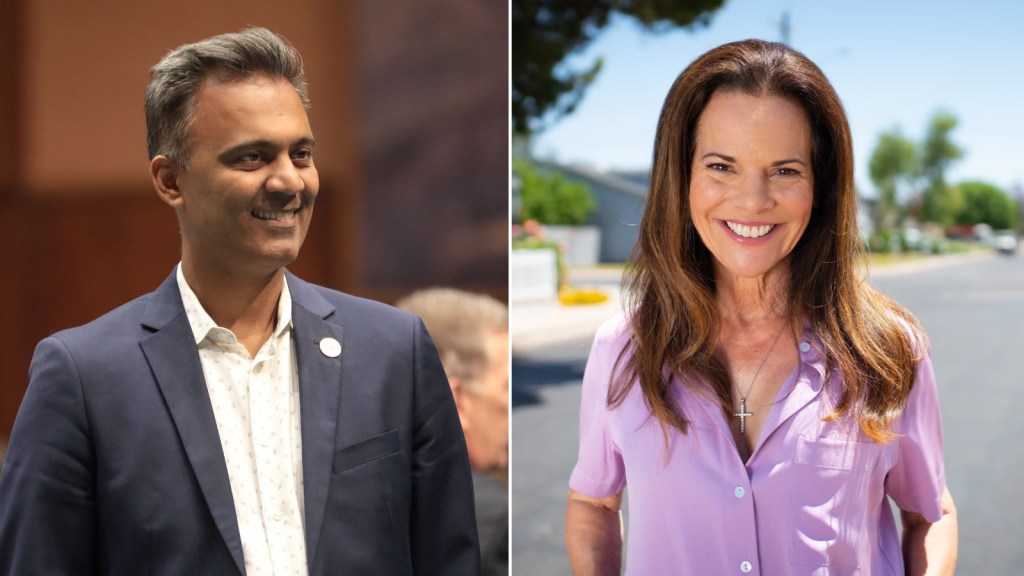
Photos by Gage Skidmore/Flickr/CC BY-SA 2.0 and Marlene for Congress
Congressional District 1 (Democrat)
The candidates: Marlene Galán Woods, Amish Shah, Rick McCartney, Jonathan Treble
This primary is particularly crowded, and is also a bit of a rehash of the same race two years ago. Both Galán-Woods and Shah ran in 2024 to represent the north Phoenix-Scottsdale district, with Shah winning the nomination by less than 2,000 votes. Galán-Woods finished a close third, roughly two percentage points behind Shah. Ultimately, Shah lost the general election to Schweikert, who held onto his seat by a wider margin than he had two years earlier.
Schweikert isn’t running for reelection this time around. (He’s running for governor. We just covered that. Did you forget?) That means Democrats feel it’s even more likely to pick up this seat. Perhaps it’s odd, then, to see them trying the same thing twice, with two of the top three candidates from 2024 making another run. But this time, the momentum seems to be behind Galán-Woods.
To the chagrin of Shah, a former state lawmaker and an emergency room physician, the Democratic Congressional Campaign Committee has put its thumb on the scale and thrown a bunch of money behind Galán-Woods, a former TV reporter and the widow of the late Republican attorney general Grant Woods. To counter that support, Shah has promoted himself as the only candidate with legislative experience, pointing to his time as a state representative. However, Shah was viewed with suspicion by fellow Democrats during his time in the legislature because he sometimes (they felt) undermined the caucus by working across the aisle.
Whoever wins — and it probably won’t be McCartney or Treble, two local businessmen — will probably do so by a narrow margin and with a plurality of votes rather than a majority. Just like two years ago.

Congressional District 5 (GOP)
The candidates: Mark Lamb, Daniel Keenan
This primary race to represent this far East Valley isn’t likely to be all that close. Lamb, the former Pinal County Sheriff, is endorsed by Trump and is by far the favorite. Neither is this race expected to be competitive in the general election — this is the seat Biggs is abandoning to run for governor, and Republicans far outnumber Democrats in the district.
Yet, how spicy this primary has been! That’s all thanks to some incisive reporting on Lamb from the Arizona Republic. In a series of articles, the Republic has dug into persistent rumors that Lamb and his wife lived a swinger lifestyle at odds with their family image and their association with the Church of Jesus Christ of Latter-day Saints. Everyone’s welcome to their kinks, of course, except texts and interviews with people who knew the Lambs revealed that Lamb pushed his friends into sexual encounters with his own wife, sent sexual texts to women and then threatened them with prosecution if they went public and was given cover during the whole saga by the Mormon church.
Wow, big sex scandal, huh? But wait, there’s more! The Republic has also revealed that Lamb seems to be spending a bunch of time in Tennessee, where he and his wife are opening a sort of ranch resort. We’re not cartographers, but we can say with at least 90% accuracy that Tennessee is not in Arizona’s 5th Congressional District, raising questions about whether Lamb plans to spend any time among his constituents.
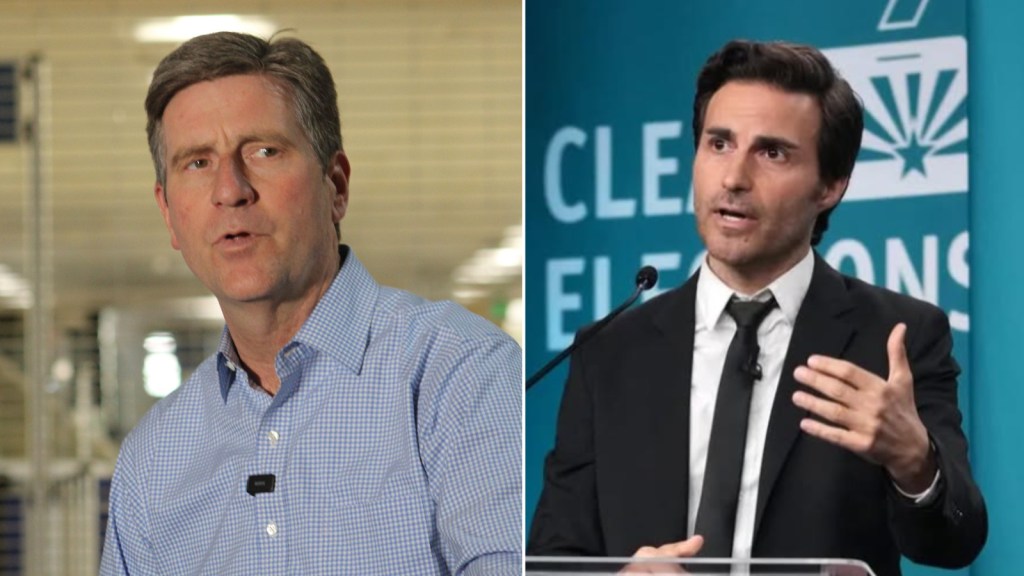
Photos by Morgan Fischer and Kai for Congress Instagram
Congressional District 4 (Democrat)
The candidates: Rep. Greg Stanton (incumbent), Kai Newkirk
Stanton, the former Phoenix mayor, probably doesn’t have much to worry about here. He’s out-fundraised Newkirk, his upstart progressive challenger, by a ton. Yet this race has received extra attention thanks to political goings-on elsewhere in the country.
After Democratic Socialist Zohran Mamdani won the mayorship in New York City, prognosticators have wondered whether the progressive wing of the Democratic Party might be ready to make some waves. That thesis gained a few more data points after three Mamdani-endorsed far-left candidates won primary races in New York, dethroning longtime incumbents. Will the same happen in Arizona, where Stanton is the lone prominent Democratic incumbent to face a primary challenge?
Probably not. Arizona’s 4th Congressional District, which covers parts of Phoenix, Tempe and Mesa, is not New York City. There are more Republicans and Independents in the district than Democrats — though some of those Independents lean left — and Stanton has comfortably won reelection each year with fairly standard Democratic views. To Newkirk, those views are the problem: He thinks Stanton needs to more forcefully fight against Trump and needs to more forcefully and loudly reject support for Israel and its military efforts in Gaza.
Whether that message hits home for primary voters remains to be seen. Newkirk, a political organizer who touts his more than 25 arrests for civil disobedience, has been losing some steam lately. Since he entered the fray, an old article has been making the rounds that casts an unflattering light on some of his behavior during organizing efforts back east. That article, from 2019, was taken down sometime prior to Newkirk launching a campaign, but it lives on in the Internet Archive. Newkirk has circulated a letter from its author, who disavows the article, but he’s lost support from left-leaning groups nonetheless. Among those to rescind an endorsement was Bobby Nichols, a Democratic Socialists of America-backed candidate who won a spot on the Tempe City Council.