
Benjamin Leatherman

Audio By Carbonatix
This article was originally published by Votebeat, a nonprofit news organization covering local election administration and voting access.
The U.S. Supreme Court’s decision to weaken a key section of the Voting Rights Act could change how election boundaries are drawn in Arizona — most immediately through a potential lawsuit to challenge its existing state legislative maps.
Several experts who spoke with Votebeat within hours of the high court’s decision said any such challenge would likely face an uphill legal battle. But the recent ruling, which affects Section 2 of the Civil Rights Era law, also stands to ripple into the battleground state’s next redistricting cycle. Its full implications for the state’s voting maps remain unclear.
Section 2 has long been used to require mapmakers to consider whether district lines give minority voters an equal opportunity to elect candidates of their choice. Under the court’s decision, the law still remains intact, but it now applies in significantly narrowed circumstances, making it much harder to challenge political maps for being racially discriminatory.
The decision is likely to result in quick, mid-decade redistricting action in certain GOP-led states where that process is controlled by politicians. In Arizona, where an independent commission conducts redistricting every decade, GOP leaders praised the decision, and one said he was likely to file a lawsuit to challenge the state’s legislative map.
But experts said the ruling is most likely to affect mapmaking at the end of the decade, when the Arizona Independent Redistricting Commission, or IRC, reconvenes to draft new congressional and legislative boundaries. In the meantime, it could also shape districts at the local level, which are controlled directly by city councils and county boards.
“They’ll have more free rein to draw lines, regardless of the impact on racial minority groups’ opportunity to elect representatives of their own choice,” said Bo Dul, a former state election official and lawyer who specializes in election and political litigation at Coppersmith Brockelman in Phoenix.
Gage Skidmore/Flickr/CC BY-SA 2.0
GOP legislators could challenge existing voting map
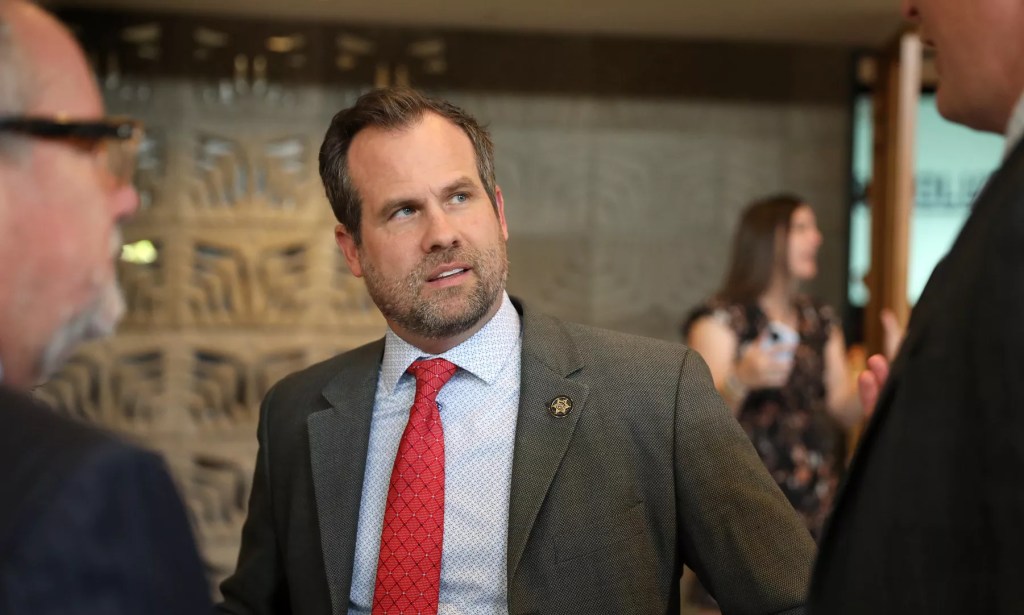
Arizona Senate President Warren Petersen, a Republican, said in a social media post on Wednesday that he was “very likely” to challenge the state’s existing legislative boundaries in the wake of the high court’s decision.
In a separate statement, he told Votebeat that he was reviewing options to challenge “any unconstitutionally drawn districts.”
“For years, Democrats have pushed racial gerrymandering under the (guise) of Voting Rights Act compliance,” he said. “Arizonans deserve maps based on communities of interest, not race.”
If Petersen brought a successful lawsuit, it could force mid-decade changes to the state’s voting map. But legal experts said he’d need to produce strong evidence that the mapmakers relied on race while drafting existing boundaries.
Otherwise, the IRC could easily defend its maps by pointing to other legally recognized factors, such as partisan competitiveness, jurisdictional boundaries, or communities of interest — all criteria it must consider while developing the state’s voting maps. Those maps, while not completely without controversy, are widely considered to be among the fairest in the country.
“The legislative leaders who bring that suit would have to show that those districts were in fact drawn with a motivation that is unconstitutional,” said Tom Collins, a former assistant attorney general and executive director of the Arizona Citizens Clean Elections Commission. “The IRC would defend that by saying something like, ‘We have these other reasons for doing it.’”
Collins added that it would be “very difficult” for any lawsuit to change the state’s maps before the upcoming midterm election.
“It’s very hard to get these things resolved within an existing cycle,” he said.
Experts did say that local elected seats, which aren’t drawn by the IRC, could be redrawn before the end of the decade if there was political will to do so.
“They perhaps might be a little more vulnerable on a sooner timeline,” said DJ Quinlan, a political consultant with Radar Strategies. He led the Arizona Democratic Party’s redistricting efforts in 2011 and 2012.
Dul said county boards of supervisors could feel the biggest impact. Those bodies are partisan, which means they could lean on arguments for partisan competitiveness to draw lines during redistricting that split minority groups’ voting power. They also aren’t subject to the IRC’s criteria in the state constitution, which directs that its mapmaking should comply with the Voting Rights Act and take communities of interest into account when practicable.
“There’s a reasonable argument that basically all of the guardrails have come down in that context,” Dul said.
But she said racial discrimination claims might be easier to prove regarding city seats. In Arizona, almost all city councils are nonpartisan, making it harder for them to claim they were considering partisan competitiveness while drawing their maps.
“I think it’ll still be hard,” she said. “But at least map drawers in those contexts won’t be able to lean entirely on partisan motives to justify what they did.”
Quinlan said he suspects the biggest impacts of the ruling will come at the turn of the decade.
“At the end of the day, this is going to be a really big story for Arizona in 2031,” he said.

Gage Skidmore/Flickr/CC BY-SA 2.0
What does the court’s decision mean for future maps?
All of the experts who spoke to Votebeat said the high court’s decision is likely to affect how maps are drawn in Arizona, but were less aligned on how far-reaching the impact could be and exactly which districts could see changes.
“I think there’s a lot that remains to be seen about what that actually looks like, and it will definitely be dependent on what the composition of the commission looks like at that point,” Quinlan said. The IRC will next meet at the turn of the decade. Barring a court order, it cannot convene earlier.
Danny Ortega, a longtime attorney and community activist in Phoenix, said the future “does not look good for people of color being able to have maps drawn that would give them an opportunity to elect members of their community.”
He specifically referenced Arizona’s two minority-majority congressional districts — the 3rd Congressional District, which encompasses south and west Phoenix, and the 7th Congressional District, which spans from Tucson to Yuma. The former is currently represented by Democratic Rep. Yassamin Ansari, and the latter by Democratic Rep. Adelita Grijalva.
“Now, that district, when redistricting starts, can literally be done away with,” said Ortega, who is known for his work with farmworker, immigrant, and Spanish-speaking clients. “So, Arizona’s going to be affected.”
But Collins pointed out that having a minority-majority district isn’t necessarily unconstitutional under the court’s ruling. Rather, the question is whether the district was drawn in a way where race predominated over other considerations.
He questioned whether either of these two districts would look dramatically different if mapmakers were “trying to account for competitiveness and trying to account for the other factors that are there.” He said the same of the state’s 6th legislative district, where more than 60% of residents are Native American. The district covers nine distinct tribal communities, including Navajo Nation.
“I’m not a demographic expert, but I’d be surprised if you ended up with a situation where there was no Native American community representation in the legislature,” Collins said.
Some Republicans said the high court’s decision might offer upshots for Democrats in Arizona, too. Brian Murray, a political consultant with Cornerstone Public Affairs and former executive director of the Arizona GOP, said in a social media post that Section 2 had long “worked to GOP advantage” in the state’s congressional maps by packing heavily Democratic areas into the 3rd and 7th districts, rather than dividing portions of them into other surrounding districts that are more closely split along partisan lines.
Dul added that the ruling could have been worse in terms of how it might upend redistricting Arizona. She said it is effectively “the final nail in the coffin” of Section 2 and will have “devastating” effects nationally. But if the Supreme Court had outright held that the section was unconstitutional, she said it could have put the entire framework of the IRC at risk, because the state constitution directly says the body must comply with the Voting Rights Act.
“I think from the perspective of Arizona, it could have been worse,” she said.
Still, Dul said the ruling effectively means that the IRC will face tighter limits on when it can consider race while drawing lines. And Collins said there will be more pressure on the system to be partisan as redistricting becomes “more zero-sum than it ever has been” nationwide.
In Arizona, that pressure quickly emerged on Wednesday as political leaders digested the court’s decision.
State Senate Democratic Leader Priya Sundareshan said in a statement that the ruling would have “real consequences” and limit the IRC’s ability to “draw maps that truly reflect our state’s diversity and risks diminishing minority and tribal representation at every level of government.”
“Fair maps are the foundation of a healthy democracy, and this decision moves us in the wrong direction,” she said. “Arizona Senate Democrats remain committed to fighting for fair maps, free elections, and a democracy that truly represents all people. The right to vote is fundamental and we will not stop working to protect it.”
Meanwhile, Arizona GOP Chair Sergio Arellano said in a social media post that the court’s decision sent a clear message to the IRC.
“Maps should not be drawn to engineer outcomes, but to reflect fair, constitutional principles where every voter counts the same,” he said, adding that the ruling was about “restoring trust.”
Sasha Hupka is a reporter for Votebeat based in Arizona. Contact Sasha at shupka@votebeat.org. Votebeat is a nonprofit news organization covering local election integrity and voting access. Sign up for their newsletters here.