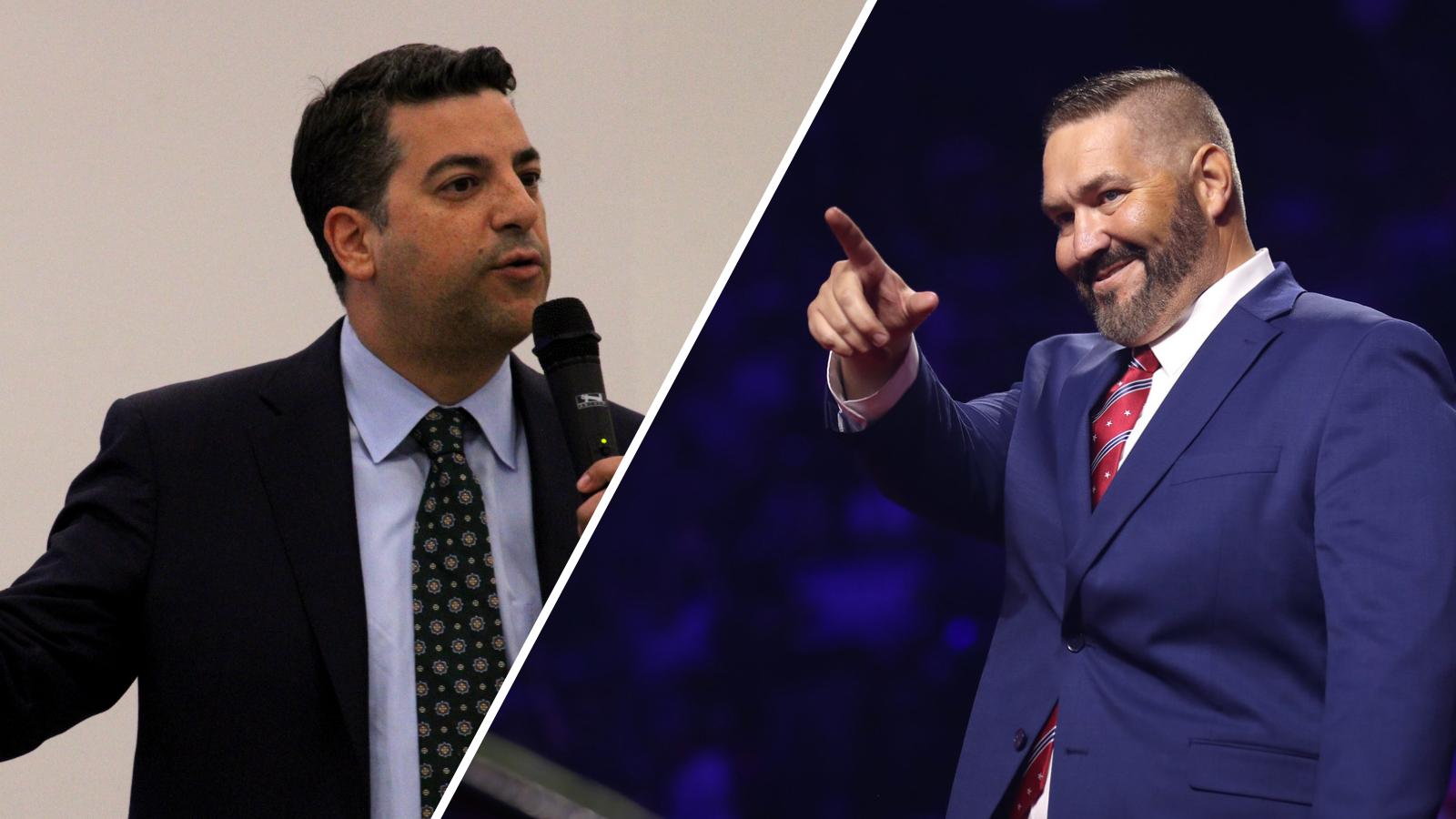
Photos by Morgan Fischer and Gage Skidmore/Flickr/CC BY-SA 2.0

Audio By Carbonatix
This article was originally published by Votebeat, a nonprofit news organization covering local election administration and voting access. Sign up for Votebeat Arizona’s free newsletter here.
Maricopa County Superior Court Judge Scott Blaney appeared somewhat exasperated with the parties sitting before him in a drab courtroom in Phoenix on Feb. 11.
He was presiding over a civil case that centered on a messy battle between mostly-GOP county leaders over election control. Maricopa County Recorder Justin Heap contended that the county board of supervisors had usurped much of his power in a deal they struck with his predecessor months before he took office. Supervisors said the changes were limited in scope and argued that Heap wasn’t negotiating in good faith.
After nearly nine months, the case was testing the court’s patience. Blaney acknowledged that there was “a lot of vitriol and a lot of emotion” in the dispute, but he urged the two sides to find agreement.
“As I’ve stressed all the way through this case, courts don’t like stepping into political cases like this and placing themselves in between political elected officials,” he said, adding that county leaders needed to “just resolve this thing.”
They never did. Heap refused to drop his legal challenge, even as the board handed him control over early, in-person voting, which was previously administered by their staff.
Meanwhile, supervisors flexed their statutory muscle, forcing Heap to testify under oath at a special meeting under the provisions of a state law that gave them the option to remove him from office if he didn’t comply.
The dispute — this chapter of it, anyway — came to a close late last week when Blaney finally picked a side: Heap’s. On Friday, he issued a judgment ordering the supervisors to return control of several election-related functions and information technology staffers to the recorder’s office.
But this may not be the final word. The board is considering an appeal, which could drag the feud on through the general election.
As both sides seek to defend themselves amid the messy and increasingly public saga, Heap and the board have each suggested that the other has disenfranchised voters, sparking counterclaims of political gamesmanship, lies, and hypocrisy.
But Votebeat examined those criticisms and found that they appeared false or lacked significant context.
Two high-level staffers in the recorder’s office said during a court hearing in January that the supervisors’ refusal to purchase a ballot sorter and scanner had prevented a small number of eligible voters’ provisional ballots from being counted in the 2024 election. But county records reviewed by Votebeat showed no evidence to support those claims, which Heap has since partly walked back.
Multiple supervisors have also questioned whether a new approach Heap took to verifying signatures on mail-ballot envelopes prevented eligible ballots from being counted in the 2025 election. But while a significantly higher share of ballots were indeed rejected for signature issues in that election, ballot rejection rates have generally been on the rise over the last several election cycles.
The continuing fight between Heap and the supervisors raises questions about how effectively election officials will be able to administer the upcoming midterm election in the county, a key political battleground where past recorders and supervisors largely kept their disagreements under wraps and stood unified against external scrutiny.
What’s more, the back-and-forth could exacerbate voters’ fears of election malfeasance, contributing to an already toxic environment as President Donald Trump’s administration attempts to relitigate the outcome of the 2020 presidential race and the state braces for another contentious election cycle.
“It compounds the problem in the public’s eye when a recorder is accusing the board, and the board is accusing the recorder, of each doing things that one side of the political spectrum thinks is terrible and the other side of the political spectrum thinks is appropriate,” said Ken Bennett, a Republican who previously served as a state lawmaker and Arizona secretary of state.
Tammy Patrick, a former election official in Maricopa County and chief programs officer at The Election Center, a nonprofit association of election officials, said county leaders should be “dialing down the rhetoric,” rather than “turning it up.” She added that Maricopa County was long viewed nationally as “a bellwether of how we should trust our election outcomes and their legitimacy.”
“In this moment, it’s just really important that level heads prevail,” she said.
Nonetheless, both Heap and the supervisors have repeatedly defended their actions.
Board of Supervisors Chair Kate Brophy McGee, a Republican, said she and her colleagues chose to air their concerns publicly only after Heap refused to answer their questions about the voters whose ballots were rejected in the November 2025 election.
Speaking before Blaney’s decision, she noted the board is charged with setting the county budget, canvassing election results, and overseeing county functions, and that it routinely asks questions of its own staff in the elections department.
“We needed information about lots and lots of things,” Brophy McGee said when asked why the board chose to compel Heap to testify. “It did, in fact, work. He came, he testified.”
Meanwhile, Judy Keane, a spokeswoman for Heap, said in a statement that his office “stands fully behind the testimony of its employees.” She declined to answer specific questions about the staffers’ disenfranchisement claims and Votebeat’s findings, citing pending litigation.
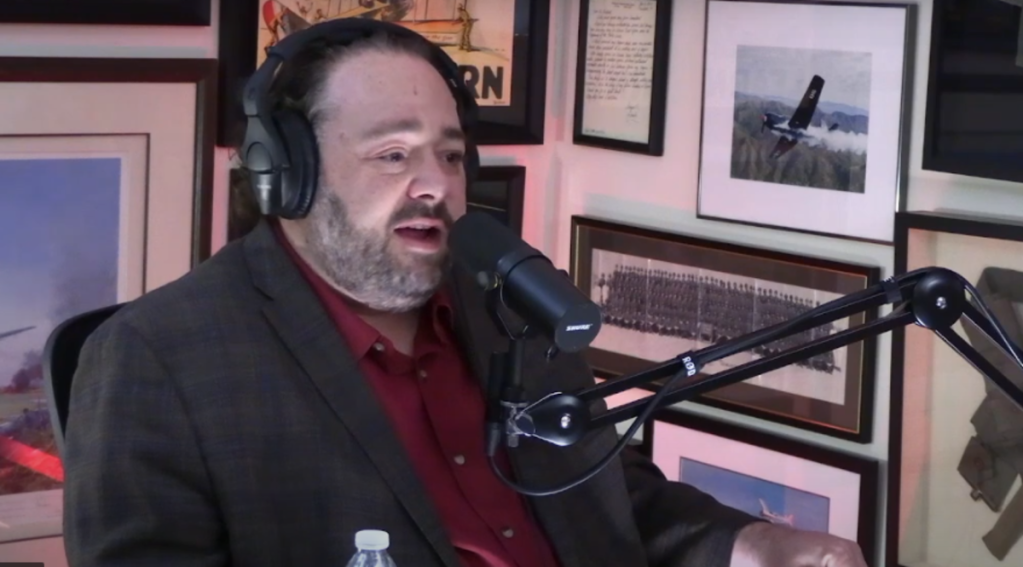
Screenshot via YouTube
Records suggest provisional ballot voters aren’t being disenfranchised
During a court hearing on Jan. 26, two recorder’s office employees — Chief of Staff Sam Stone and Director of Voter Registration Janine Petty — testified under oath that some provisional ballot voters had been disenfranchised in Maricopa County.
That type of ballot is used when there is a question about a voter’s eligibility, acting as a safeguard to ensure that no one is wrongly turned away from a polling location. Officials later research provisional voters’ eligibility to determine whether their ballot should be counted.
Often, voters cast provisional ballots as a result of Arizona’s unique, bifurcated registration system. In order to vote full ballots that include state and local races, the state requires voters to provide documents proving their citizenship and residency. If they don’t, they’re allowed to vote only in federal races.
In 2024, a new state law extended the period for voters to submit documentation and have their provisional ballots counted. Accordingly, Petty said many voters provided passports, birth certificates, and other documents, and her team struggled to meet the deadline to review them. As a result, she said, voters who should have been allowed to vote full ballots in the 2024 election only had their federal-race votes counted.
Petty said supervisors were preventing her office from fulfilling its statutory duties by refusing to purchase a specific ballot scanning and sorting machine to address the problem. Heap has repeatedly requested that county supervisors pay for that machine, built by Runbeck Election Services, during the annual budgeting period. It would cost at least $325,000, plus about $40,000 each year to pay its mandatory licensing fee.
Currently, Petty said her team has to scan provisional ballots by hand, one at a time, a process she likened to “looking for a needle in a haystack.” She said the machine that the recorder’s office is seeking to purchase could sort and scan about 18,000 ballots in an hour.
Stone also testified that the machine was needed to ensure eligible voters’ ballots were counted, and framed it as a persistent issue, saying disenfranchisement was “happening now.”
But Votebeat couldn’t substantiate the claims. A records request for emails and texts between Petty and leaders in the recorder’s office at the time — including former Recorder Stephen Richer, former Chief of Staff Abby Raddatz, and former Chief Deputy Recorder Darron Moffatt — didn’t turn up any that referenced issues with scanning provisional ballots.
The recorder’s office’s 2025 requests to the board for funding for the machine also don’t mention voters having been disenfranchised without it. Furthermore, emails between Petty and top staffers in the recorder’s office and election department show that she confirmed that her team was done processing provisional ballots on Nov. 13, 2024 — two days before the deadline.
“In other news, we have processed all conditional provisionals that can be cured,” Petty wrote. “We are done!”
The share of provisional ballots rejected in the 2024 election did rise significantly. That year, Maricopa County rejected 22,411 provisional ballots in the general election — about 86% of provisional ballots cast. That’s up from a 62% rejection rate in 2022 and a 66% rejection rate in 2020.
That higher rate held roughly steady in the 2025 jurisdictional election, with the county rejecting 238 ballots — about 82% of provisional ballots cast.
But that doesn’t necessarily support Petty’s claim. The same law that created more work for Petty’s team also required voters to prove their address before casting their vote. Richer told Votebeat that resulted in more provisional ballots than usual, ultimately leading to higher rejection rates across the state. Pima County, the second-most populous in the state, saw a similar increase in its provisional ballot rejection rate in 2024 compared to the 2022 election, according to data tracked by the U.S. Election Assistance Commission.
Later, in a Jan. 28 meeting, Heap partly walked back his staffers’ claims. He said that disenfranchisement was not happening under his administration, as Stone had suggested.
“We didn’t say that any voters have been disenfranchised since I took office,” said Heap, whose term began in 2025. “If there were any voters disenfranchised, it was under the previous administration.”
Richer pushed back on that allegation and told Votebeat that Petty never brought any such problem to his attention.
“I’d certainly never heard of this before,” he said, adding that the idea that he would have ignored any disenfranchisement was “so silly.” He noted that no one at the recorder’s office had mentioned any voters getting disenfranchised until the office started feuding with the board of supervisors.
Keane, the spokesperson for the recorder’s office, defended Petty’s testimony. Votebeat also reached out to Petty and Stone but did not receive a response.
“Janine Petty is the leading expert in the state of Arizona on voter registration and election procedures,” Keane said. “Her professionalism and service in our office has been exemplary.”
During a press gaggle in February, Votebeat asked Heap whether he had identified any specific voters who were disenfranchised in 2024.
“We have looked into the issue — I can’t say specifically a number, but she identified that we have a serious problem,” Heap responded, referring to Petty’s testimony. “We will continue to look into that.”
Gage Skidmore/Flickr/CC BY-SA 2.0
Supervisors’ concerns about new signature verification process ignore context
Heap and his staff haven’t been the only ones questioning the administration of past elections in Maricopa County.
Supervisors have voiced concern that a new approach Heap took to signature verification prevented eligible voters from having their mail ballots counted in an election last year.
Trained staff in the recorder’s office have long compared the signature on the outside of a voter’s ballot envelope to their prior signatures as a safeguard against fraud. When a voter’s signature doesn’t match, election officials attempt to contact the voter to fix their signature, a process known as ballot curing.
After taking office, Heap added additional layers of review to the signature verification process. Previously, one person reviewed a batch of ballots, then rechecked their own work before sending questionable signatures to a manager to determine whether the ballot needed to be cured. Signatures marked as good went into an audit queue, and a manager would perform a spot check on a smaller sample.
Under the new process, bipartisan teams examine each signature simultaneously. A questionable signature goes to a manager, who then determines if it needs to go to a third level of examination.
A low-turnout, all-mail election held on Nov. 4, 2025, was the first test of Heap’s new system. His office ultimately rejected 5,903 mail ballots over mismatched signatures — roughly 838 for every 100,000 ballots cast, more than double the rate of the 2024 general election.
That prompted alarm from supervisors, who questioned the rejections during the certification of the election. Later, Brophy McGee said she was concerned that Heap had opted to test the new process in a live election, rather than running a mock one “as is normal practice.”
“Our voters were your first test sample,” she wrote in a letter to Heap on Jan. 22. “It is important to ensure no qualified voters were unnecessarily rejected by your new process.”
During a heated budget meeting on Jan. 28, Supervisor Tom Galvin called Heap’s new signature verification process a “looming disaster.”
But it’s difficult to know whether Heap’s new process wrongly rejected any voters, and it’s unlikely that it was the sole contributing factor in the increased rejection rate. In fact, ballot rejection rates have been on the rise in Maricopa County for years.
In 2020, Democratic Recorder Adrian Fontes rejected about 30 mail ballots for every 100,000 cast.
When Richer, a Republican, took office, he implemented a stricter signature verification process in response to false claims of voter fraud and pressure from his own party. In the 2021 election, the county’s rejection rate increased to roughly 190 mail ballots for every 100,000 cast.
Then, in 2024, a state law shortened the period for voters to cure their ballots. With Richer still at the helm, the county’s rejection rate in that year’s general election was about 400 for every 100,000 mail ballots cast.
Richer told Votebeat that it was “hard to say” exactly what might be causing the increased rejection rate under Heap. He said it could have been because the new signature verification process flagged more ballots as needing to be cured, but it also could have been because fewer voters actually stepped forward to cure them.
In larger elections, political parties typically assist with the curing process by contacting registered Democrats and Republicans to urge them to cure their ballot. But the parties don’t usually mount such ballot-chasing operations during smaller elections unless races are particularly tight.
Patti O’Neil, chair of the Maricopa County Democratic Party, told Votebeat her party didn’t do any ballot-chasing in 2025. Craig Berland, chair of the Maricopa County Republican Committee, did not respond when posed the same question.
The fact that the election was entirely conducted by mail may have also contributed to the higher rejection rate. Heap theorized last year that the all-mail election may have brought out voters who hadn’t voted by mail in several cycles, or even decades, and who have only one signature on file to compare.
“I think it’s the nature of this type of election compared to a regular election,” he said at the time.
Even if Heap’s new process did contribute to the higher rejection rate, it does not appear that it did so with any partisan bias. A Votebeat analysis of curing data from last year’s election showed the partisan breakdown of voters whose ballots were sent to curing was roughly in line with party registration numbers in the county at the time, as was the partisan breakdown of voters who confirmed or fixed the signatures on their ballots.
Additionally, training materials obtained from the recorder’s office showed no indication of reviewers being incentivized to flag questionable signatures.
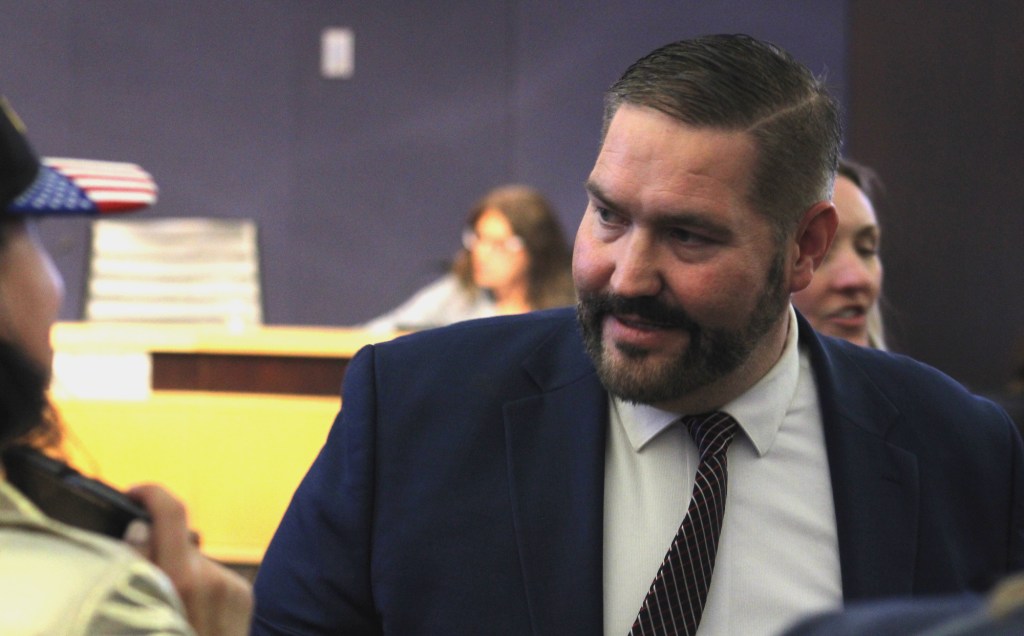
Morgan Fischer
Feud between Heap and supervisors could spill over into the 2026 election
As county supervisors prepared to compel testimony from Heap in February, an unusual video appeared on two of the county’s social media platforms.
It contained footage of supervisors blasting Heap for refusing to answer their questions. In one particularly spicy clip, Galvin accused Heap of playing “political games” and “lying” to the public, as dramatic music played in the background.
It concluded with a taunt: “It ends on Wednesday. See you there, Justin Heap.”
Heap has made similar statements about the board. In January, he accused supervisors of throwing a “juvenile temper tantrum” after a raucous budget meeting in which supervisors criticized his new signature verification process and read aloud partisan social media posts from Stone, including one which referenced picking sides in “the coming civil war.” More recently, Heap said the board was “lying to voters yet again” amid bickering over an early voting plan for the upcoming primary election.
The board, though, has appeared to back off publicly criticizing Heap in recent weeks. Brophy McGee said Heap still hasn’t answered all of her questions but has provided enough information to allow county officials to “muddle through” the budget process and election preparations.
These days, she said, county officials are focused on working together to prepare for the upcoming election. There’s a “disparity,” she said, between “what’s happening on the ground with staff working together and social media.”
Even so, the bad-mouthing — and the apparently false and misleading remarks that it’s based on — has already caught on outside the walls of the Maricopa County Administration Building.
Days after the board posted its video on social media, the Maricopa County Democratic Party accused Heap of “working hand-in-glove with the White House to steal the 2026 election.” It tagged the county board’s account in its post.
Later, as supervisors forced testimony from Heap, the local party released a statement in support of the move. It said Heap’s “erratic behavior” suggested that he had succumbed to “pressures from within his own party, rather than uphold his duty to administer elections impartially and fairly,” and added that voters deserved elections free from “chicanery.”
Meanwhile, dozens of people showed up to support Heap as he appeared before the board. Many wore pins or carried signs declaring, “We ♥️ courageous election workers,” an apparent reference to recorder’s office staffers’ testimony in court. The swag was provided by Strong Communities Action, a nonprofit run by local conservative activist Merissa Caldwell, who is married to one of Heap’s senior staffers.
During the meeting, the crowd occasionally jeered and booed county supervisors. Afterward, they gathered to shake hands, hug, and take photos with Heap.
Outside observers fear the effect the heightened rhetoric could have on the 2026 midterm election.
“When the recorder and the board are throwing rocks at each other, people are going to line up behind the ones that they think they’ve heard the right thing about, and join in the rock throwing,” said Bennett, the former secretary of state.
He added that he’s certain the battle won’t “end pretty.”
“It does not end by instilling confidence, increasing confidence, or maintaining confidence in our elections,” he said. “It ends by destroying confidence in the minds of American and Arizonan voters who are left to pick one side or the other.”
Sasha Hupka is a reporter for Votebeat based in Arizona. Contact Sasha at shupka@votebeat.org.