Grant Johnson

Audio By Carbonatix
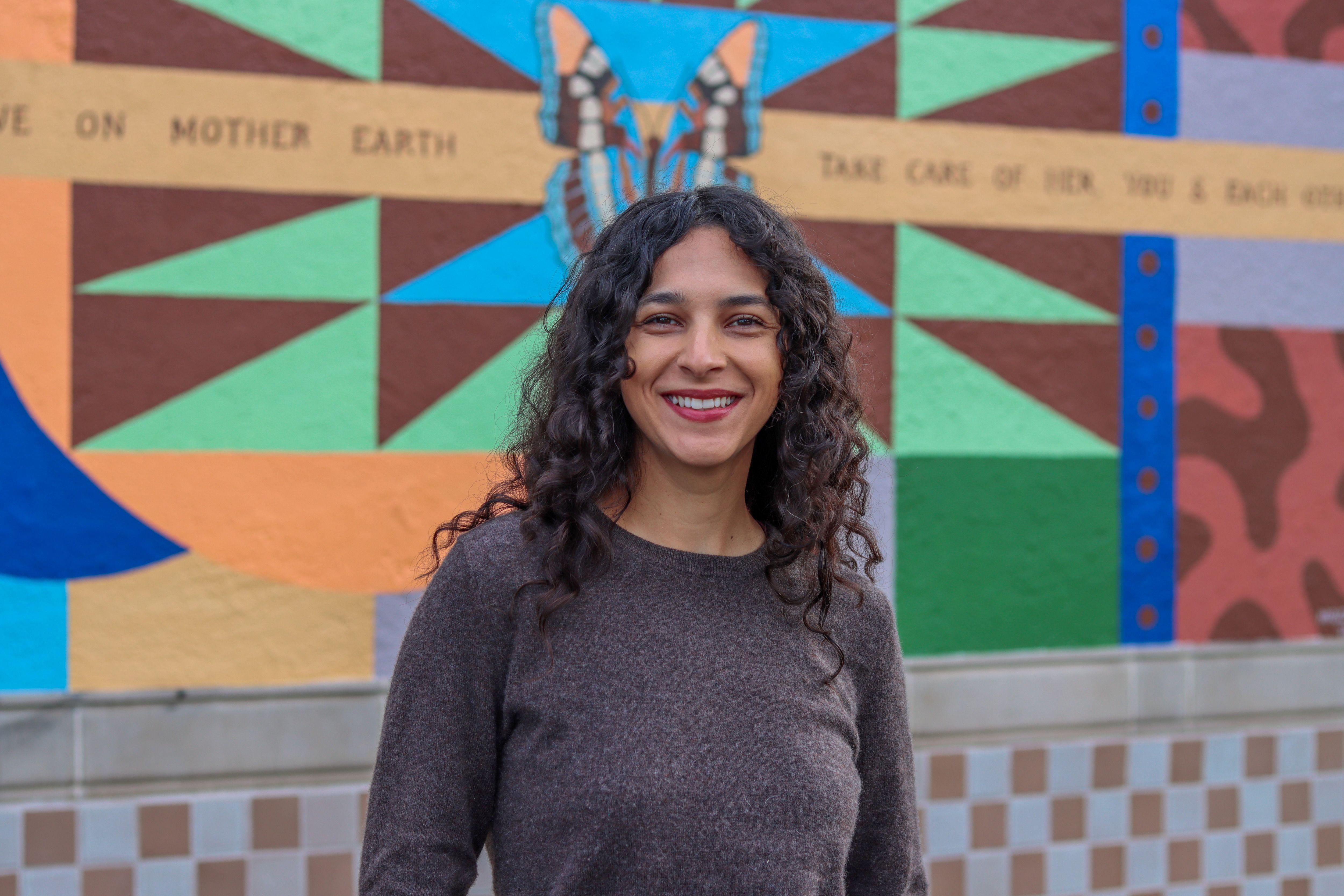
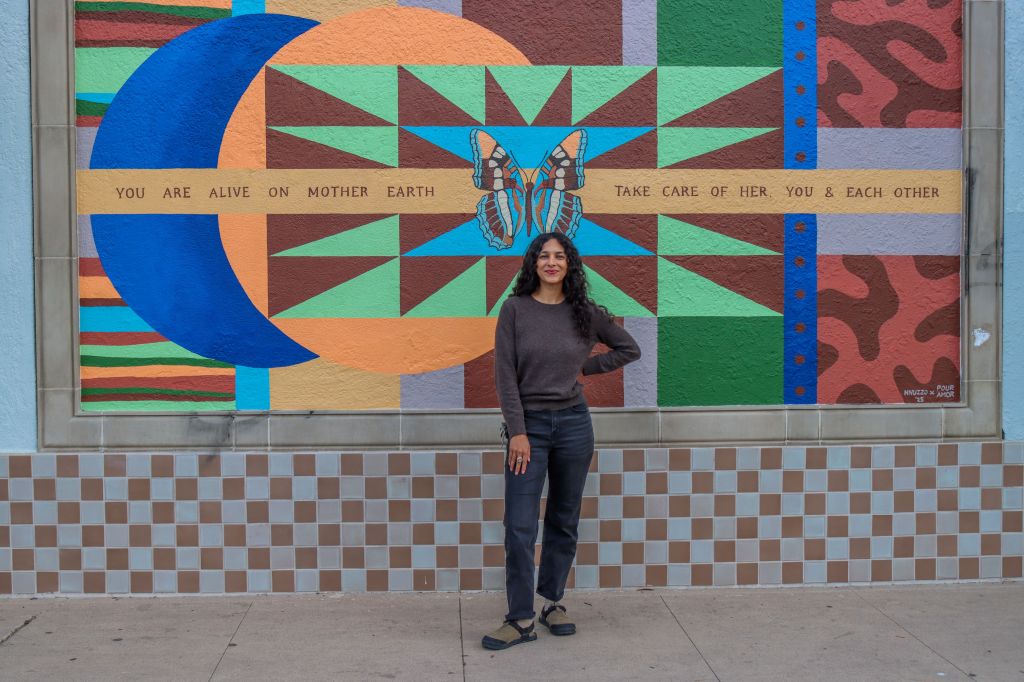
The late afternoon sun cast long shadows across the storefront as Nicole Poppell stood on a ladder with a paintbrush in hand, adding the final details to a butterfly’s wing. It was October in Phoenix, cooler than the brutal summer months, but still hot enough to make the work demanding. Mosquitos swarmed around her as she painted, leaving her arms dotted with bites she’d discover later. But Poppell barely noticed. She was focused on getting the asymmetry just right.
The mural, which spread across the side of Buena Vida Bodega in Phoenix’s Garfield neighborhood, wasn’t like her typical work. Where her other pieces often featured clean symmetry and bold geometric patterns, this one deliberately broke Poppell’s own rules. A butterfly sits at the center against a backdrop of earth tones, browns, greens and muted oranges that felt more grounded than her earlier bright pinks and sherbet color palette. Across the middle, a phrase her friend Jackie Garay had written: “You are alive on Mother Earth. Take care of her, you and each other.”
Poppell chose the Arizona sister butterfly specifically because Garay, her best friend from college and the bodega’s owner, was like a sister to her. And this mural, painted just before Garay sold the business, would remain as a testament to their friendship, and to something else Poppell was still figuring out about herself.
At 30-something, Nicole Poppell has become one of Phoenix’s most recognizable muralists. Her abstract patterns and organic shapes appear on the sides of offices, homes and, most recently, on the Waymo autonomous vehicles that started cruising through Phoenix in 2020 and are now rapidly expanding to many other cities nationwide. But behind the vibrant public art and growing business success lies a deeper journey, one of an artist discovering her own identity while helping transform Phoenix into the art city she believes it can become.
Poppell never intended to be an artist. Growing up, she doodled constantly in her notebooks, influenced by her father, a graphic designer. But like many creatives of her generation, she internalized the message that you couldn’t make money as an artist.
“That wasn’t really big when I was younger,” Poppell says. “I feel like I was told often that you can’t make money as an artist. You can see how true that is now.”
So she took what seemed like the practical path, studying graphic design and then interior design at Arizona State University. After an internship at the architecture firm Gensler in San Francisco, she was offered a job right out of college. She moved to the Bay Area, ready to launch her career.
“I realized as soon as I started how intense just sitting at a computer all day was,” she says. “The lifestyle was really hard.”
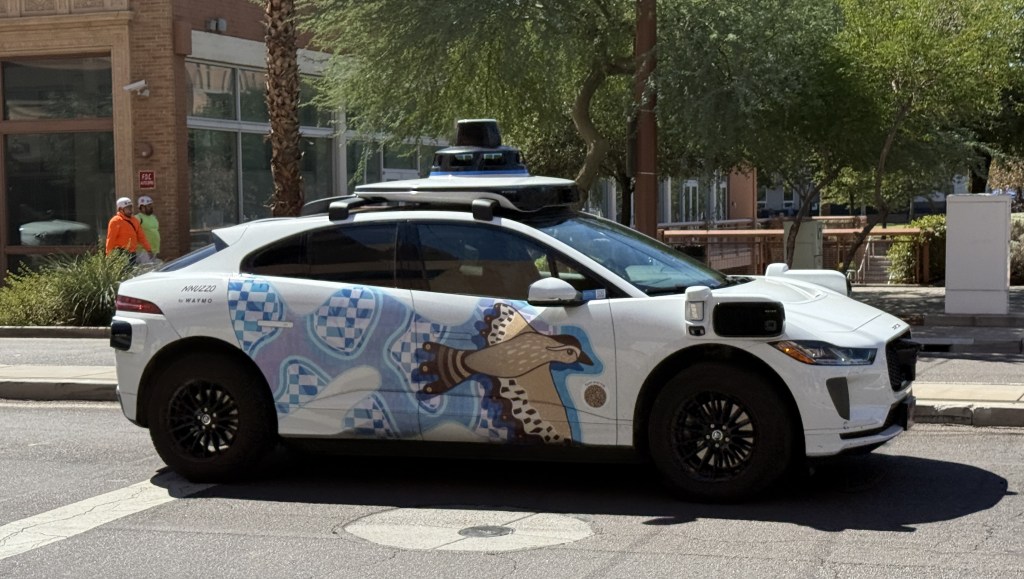
One of Poppell’s Waymo designs.
Courtesy of Grant Johnson
Her husband, Christian Poppell, an architect who met Nicole at a Gensler company party, watched as she navigated the corporate world.
“For her, being in corporate America was not the right fit,” he says. “I think for many people, going from the corporate world to out of that, it’s kind of like going from a safe place to an uneasy place. But I think for her, her safe space is outside the corporate setting.”
After Gensler, she moved to a company that created large-scale sculptural pieces. Then came COVID-19 in 2020, and with it, the push Poppell needed. In 2021, she and Christian moved back to Phoenix, and she officially launched Mural Mates, her mural business.
“Phoenix is a much easier place to start a business,” she says. “It’s a more affordable place to live, compared to San Francisco, so it felt less scary to start a business here.”
To understand Poppell’s approach to art, you have to go back to her first year at ASU and a notoriously demanding professor named Andy Weed. In the design program, Weed is something of a legend for being a difficult professor. Poppell, characteristically, sought him out.
Weed’s teaching philosophy centers on simplicity and precision. He had students paint squares that had to be exact within a millimeter. It sounds straightforward, but as Poppell discovered during countless all-nighters, it was anything but.
“It was incredibly hard,” she says. “But it was the most fun I think I’ve ever had learning.”
For Weed, the exercise was never about precision for its own sake.
“It’s about being simple,” Weed says. “The opposite of simple isn’t complex, which a lot of people think it is. When you’re making something simple, the slightest anomaly is going to be visible.”
Fifteen years later, Weed still sees those lessons in Poppell’s work, particularly in her sophisticated understanding of color theory.
“That’s what strikes me, is that she’s still aware of those things we worked on a long time ago,” he says.
Courtesy of Waymo
What distinguishes Poppell in Phoenix’s growing art scene isn’t just her talent, it’s her ability to bridge the worlds of art and business. Her background in design means she can speak the language of corporate clients, translating their brand identity into clean, modern murals.
“I’m able to communicate and translate their specific vision,” she says. “There aren’t a lot of artists that specifically do that, and I think that’s what might make me ideal for businesses.”
Most of her clients find her through her website or by seeing her work around the city. Word spreads organically. Garay notes that Poppell moves through the world with a “quiet confidence” letting her work speak for itself, rather than constantly self-promoting.
Nicole’s artistic presence is “iconic around the city,” says Garay, who owned Buena Vida Bodega until the end of October. “She lets the work speak for itself, truly. And I just really admire her.”
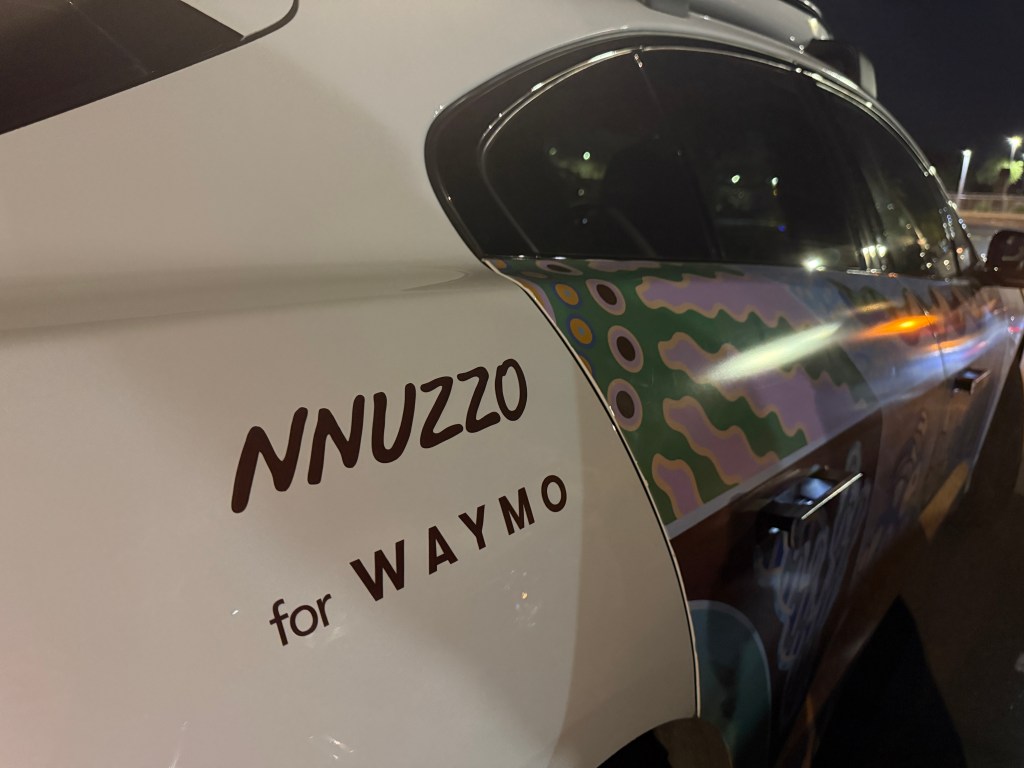
When Muros, a Chicago-based curation company, reached out last year about designing wraps for Waymo’s autonomous vehicles, Poppell hesitated. She’d built her reputation by carefully choosing clients whose values aligned with her own. Robots in cars made her think.
“I think all of us have reservations around robots in general, and so I had to really think about it,” she says.
Her conclusion?
“At the core, I see nothing wrong with Waymos if it’s well-intentioned,” she says. As an avid cyclist, she said she feels safer around the autonomous vehicles than human drivers in Phoenix.
Courtesy of Grant Johnson
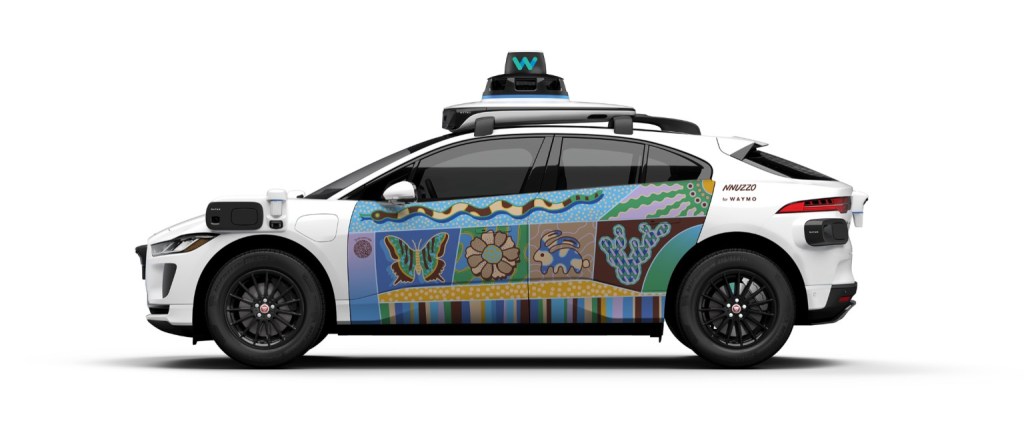
For the project, she created two designs focused on the feelings of riding in a Waymo. One featured a bird, representing the freedom to daydream and zone out. The other, a collage of Arizona wildlife and patterns, captured being the observer, watching the world pass by without the stress of driving. She wanted viewers to discover new details with each look.
The first time she spotted her design on a car in the wild felt magical. Friends across multiple cities like San Francisco, Austin and Los Angeles began sending her photos.
While Poppell excels at client work, she’s increasingly drawn to exploring her personal artistic voice. This past year marked a turning point.
“I never really understood where I felt like I fit in,” she says. “I think I just never fully felt like I fit in. A lot of that history just didn’t get passed down, and no fault to my parents.”
A DNA test two years ago revealed Indigenous ancestry Poppell hadn’t known about. Growing up in Phoenix with brown skin, raised in a white suburb and never learning Spanish, she’d always felt caught between worlds.
“There’s something interesting about knowing her background, how she says she’s finding her identity, because it just feels more rooted in the natural landscape and those Southwest tones,” Garay says.
Despite her success, Poppell wrestles with questions many artists face. She’s begun incorporating more of her personal style into client work, curious to see how it might shift her clientele. Most importantly, she’s thinking about sustainability and scale.
“My brain is wired half loving business and half loving art, and that creates a perfect combination to have an art business,” she says. “But not everyone has that.”
She’s passionate about educating other artists on running businesses, protecting themselves from exploitation, and understanding their worth. Lately, she’s been pushing herself to bring more of her own identity into her work, curious how that shift might change the kinds of projects and clients she attracts. That means continuing to bring public art to Phoenix through grant projects, painting new murals in neighborhoods like Sunnyslope, and letting her personal voice show up more clearly in everything she makes.
Poppell’s art can be seen around Phoenix.
Grant Johnson
Back at Buena Vida Bodega, Poppell finally climbed down from her ladder, the butterfly complete. The mural will outlast Garay’s ownership of the space, remaining as a permanent marker of their friendship and this moment in Poppell’s artistic evolution.
“It’s like this childlike curiosity just lightens up with both of us,” Garay says about spending time with Poppell. “My favorite time ever is just really hanging out and sharing space with her and being able to witness her and her talents, and then be able to just play alongside her, like two kids in the playground would.”
For Poppell, art has always been about more than aesthetics. It’s about breaking up the mundane, inspiring thought, creating moments of joy and whimsy when you turn a corner. But increasingly, it’s also about something more personal. It’s about finding belonging, understanding her roots, and expressing an identity she’s still discovering with each brushstroke.
“I feel like for once I’m not really planning 20 years down the line,” she said. “I am happy with where I am right now, and I think you can learn so much about yourself when you just take that jump.”