
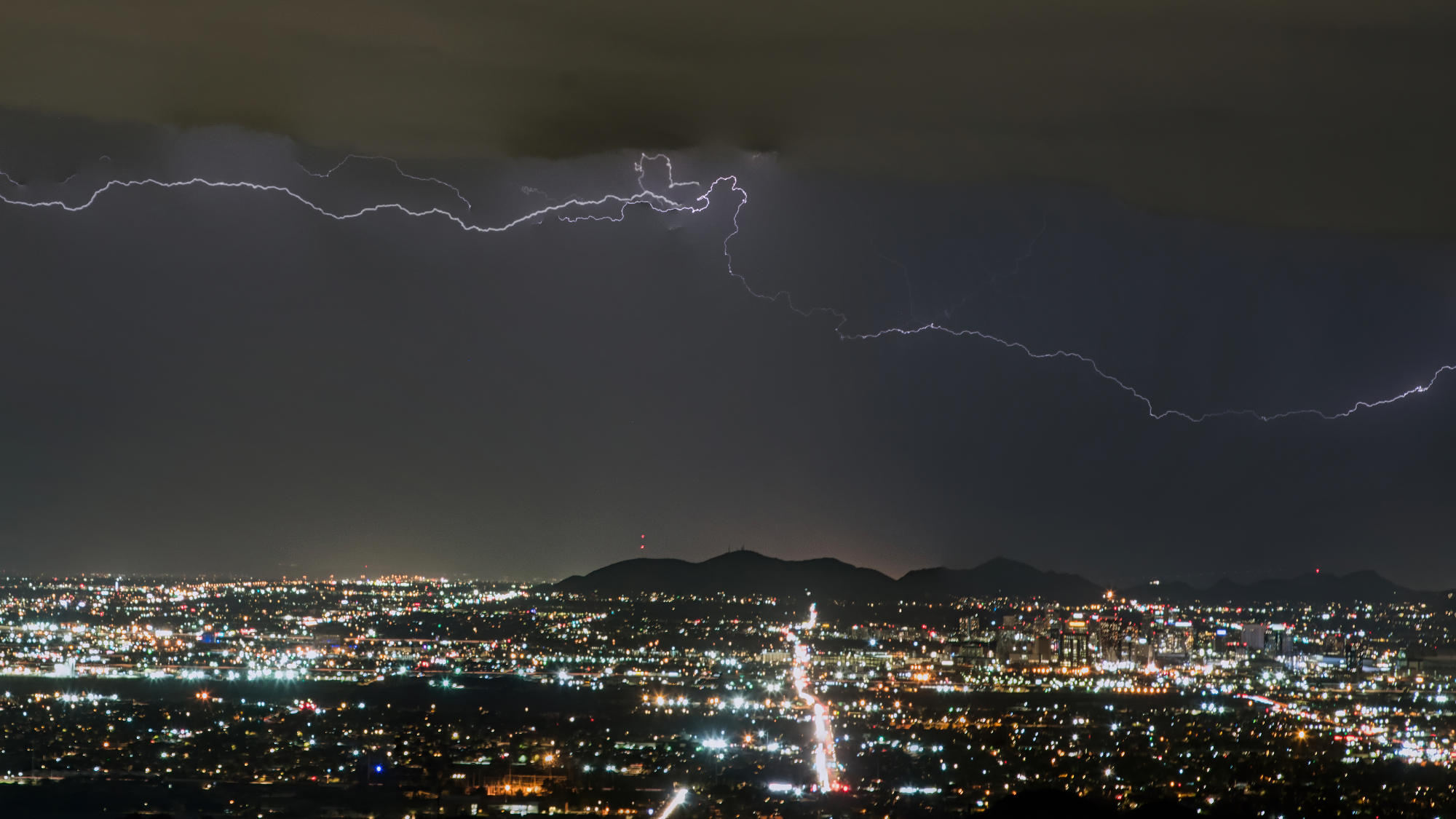
Brent_1/Getty Images

Audio By Carbonatix
If you’ve lived in Arizona during monsoon season, you can smell it. As rainstorms descend on the Valley, kicking up dirt and forming haboobs — those are dust storms, for any newbies — a distinctive scent fills the air.
That smell is courtesy of the creosote plant, a desert bush that emits a particular fragrance in the rain. When you catch a whiff, it means one thing: A storm’s coming.
Welcome to monsoon season.
When is monsoon season in Arizona?
Every summer, it arrives. Officially, the National Weather Service defines Arizona’s monsoon season as the period between June 15 and Sept. 30. More broadly, monsoon season spans the hottest months of the Arizona summer, during which time the Phoenix area receives roughly half of its yearly rain. The season’s frequent storms also take the edge off the glaring summer heat, making the persistent haboob-alert texts everyone in the state receives almost worth it.
The actual start of monsoon season varies each year according to weather conditions within the state and beyond. Whether you’re waiting for that first waft of creosote, or whether rain is beating down on your roof — and especially if you’re confronting a haboob for the first time — here’s what you should know about monsoon season in Arizona.
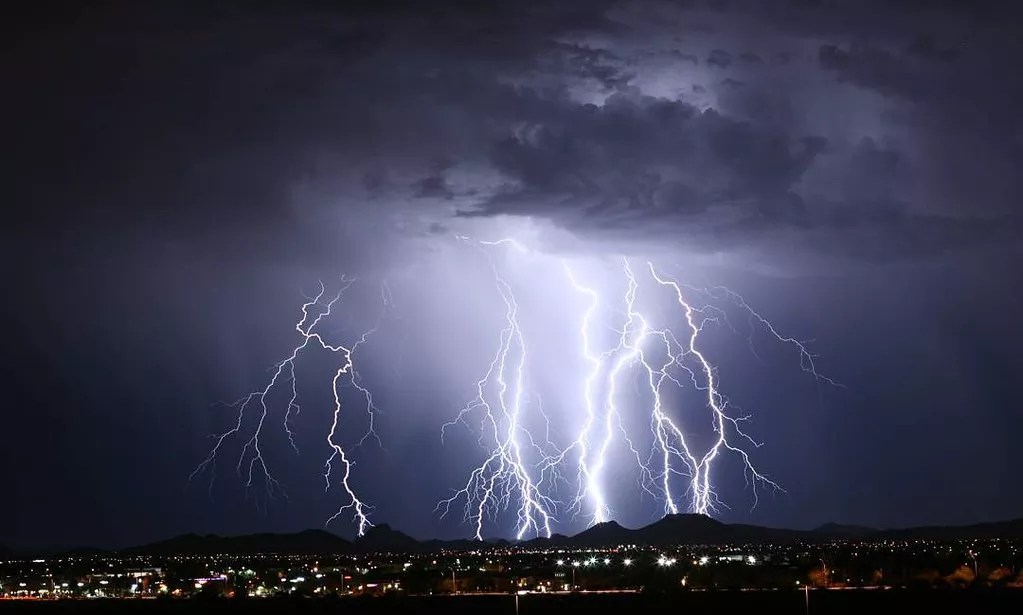
Abbee Day/Flickr/CC BY-NC-ND 2.0
What is a monsoon?
A monsoon is not an individual storm. The word comes from the Arabic “mausim,“ which means “season.” So yes, by saying “monsoon season,” we’re all being a bit redundant.
We get the term from Arabic because of the centuries-old weather patterns that historically have brought torrential rain to the Arabian Peninsula and the Indian subcontinent. In Arizona, a monsoon occurs when winds shift from generally eastward, coming from California and Nevada, to a southerly direction. As a result, moisture is pushed northward from Mexico.
It all results in frequent thunderstorms dropping loads of rain over the state. Tucson and southern Arizona get most of it — roughly two-thirds of their yearly rainfall — while the central and northern parts of the state fill up their figurative tanks halfway.
Because the rainfall sometimes comes down faster than the ground can absorb it, the storms can cause flooding. And while the rain Arizona receives during monsoon season does not affect the state’s water supply, it is important for vegetation growth. The precipitation also helps limit the severity of fire season, when hot and dry conditions make wildfires more likely across the state.
Oh, and about those haboobs. Their name also comes from Arabic — specifically “habb,” which means “wind.” Haboobs are lens-shaped walls of dust that thunderstorms kick up ahead of their paths. They can reach 3,000 feet in height and speeds of 30 miles per hour. So, stay inside and don’t try driving in one.
What year was Arizona’s wettest monsoon season?
Well, it wasn’t any year in recent memory.
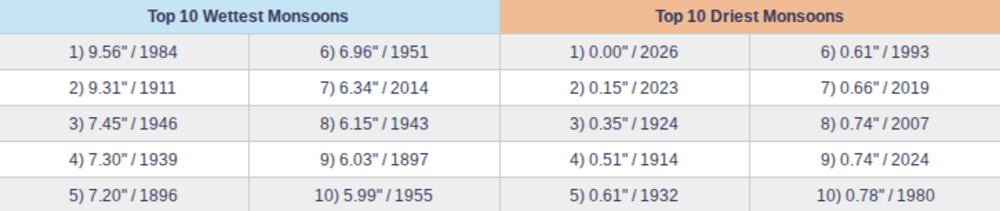
Last year’s monsoon brought 2.76 inches of rain to the Valley, which is a bit above the average of 2.43 inches. Before that, Phoenix had two remarkably dry monsoons. Phoenix got only 0.74 inches of monsoon rain in 2024, the eighth-driest monsoon in Phoenix history. (Records go back to 1895.)
The driest came a year earlier, in 2023. Phoenix received only 0.15 inches of rain that year, according to the NWS. The previous record holder was the 1924 monsoon season, during which Phoenix received more than double the amount of rain the city received in the summer of 2023.
The wettest on record occurred in 1984. That year’s monsoon brought more than 9.5 inches of rain.
National Weather Service
What’s the 2026 monsoon season forecast?
Praise the rain gods — this year’s monsoon could be a sopping wet one.
This year could see a “super” El Niño weather pattern, which generally means wetter summer conditions for Phoenix. As such, the Valley has a 40% chance of above-normal precipitation from July through September, compared to a 33% chance of near-normal precipitation and a 27% chance of below-normal precipitation.
Just when that rain will hit remains harder to predict. Last year’s above-average rainfall came almost exclusively in September. Given how hot the summer is before then — and how a good monsoon storm will cool things off for a bit — a rainy monsoon season can’t get here monsoon enough.