

Gage Skidmore/Flickr/CC-By-SA 2.0

Audio By Carbonatix
Former state Rep. Joseph Chaplik is in the midst of a heated primary race for the GOP nomination in Arizona’s 1st Congressional District, with less than a week left until Election Day. And in the waning days of his primary campaign for what is expected to be one of the most competitive congressional contests in the country, Chaplik is going to court.
On July 9, just 12 days before the July 21 primary election, the far-right Republican candidate filed a lawsuit against a conservative super PAC, claiming it defamed him with factually incorrect attack ads about his involvement with a child pornography bill and also violated recently updated state laws about the use of AI-generated images in political advertisements.
Chaplik named Conservatives for Effective Government, a Virginia-based super PAC, and its treasurer, Chris Marston, as defendants. Neither responded to a request for comment from Phoenix New Times.
“They communicated provably false factual implications or direct facts about Mr. Chaplik’s official conduct, moral character, integrity, and fitness for public office, and attempted to portray him falsely as a job killer, union sympathizer and someone against or not interested in protecting children,” the lawsuit reads. “All assertions Defendants knew would harm his campaign unfairly.”
Beginning in early June, Conservatives for Effective Government began running a short, 19-second attack ad claiming that Chaplik “failed to protect our kids” because he voted against “combating child sexual abuse images,” according to Google’s Ads Transparency Center. The ad references a 2025 Chaplik vote on House Bill 2678, which aimed to amend the existing sexual exploitation of children statute to crack down on AI-generated images. Google metrics show the ad has been shown more than 420,000 times.
As Chaplik’s lawsuit notes, the ad leaves out a heap of context. Chaplik initially voted against the bill during a roll call vote along with 17 other members of the Arizona House of Representatives, including many Democrats and a few Republicans, such as fellow Arizona Freedom Caucus member Rep. Alex Kolodin. According to his lawsuit, Chaplik initially voted against the bill because its language was “defective, incomplete, overbroad, or otherwise legally problematic.”
When the bill came back to the House for final passage, however, Chaplik voted for it. The bill passed with 44 votes in favor and only 11 against — with five absentions — and Gov. Katie Hobbs signed it into law six days later. Chaplik’s lawsuit said he ultimately supported the bill after its language was “corrected through the legislative process.” Chaplik’s lawsuit said the ad omitted this “crucial fact,” claiming that his vote history was “selectively and falsely portrayed” to sway voters on this “hot-button issue.”
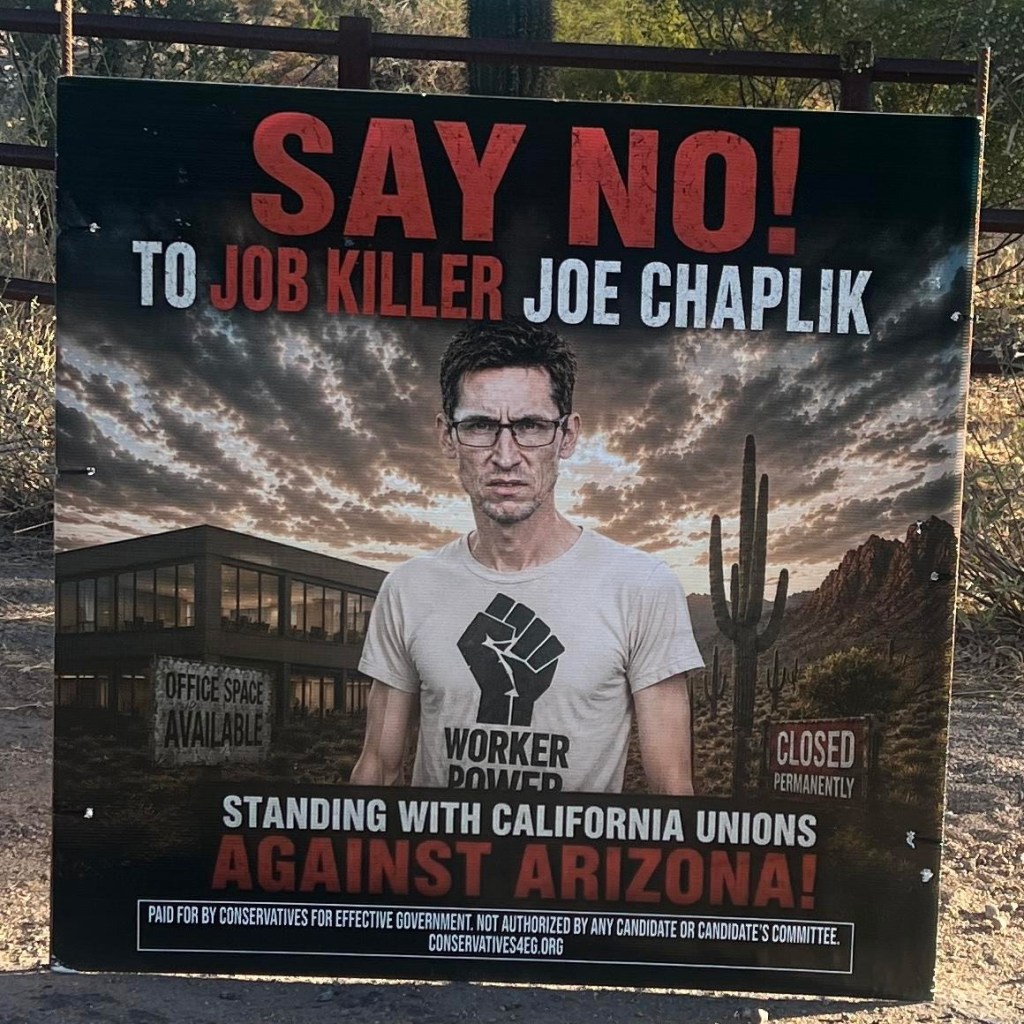
The lawsuit also takes issue with the PAC’s advertisements on billboards and street signs that feature “unflattering AI-generated images” of Chaplik. The ads show Chaplik in a “Worker Power” t-shirt with a black fist in front of an empty office building. “Say No! To Job Killer Joe Chaplik,” it reads, in an apparent reference to Chaplik’s opposition to a 2025 bill that preempted the ability of Scottsdale residents to vote on zoning approval for a new headquarters for Taser and body-cam maker Axon.
Chaplik previously mentioned the signs during the Clean Elections debate for the race in late June, claiming opponent Jay Feely — a former NFL kicker who has Trump’s endorsement but is arguably more moderate than Chaplik — “supports” the signs, which he called “identity theft” and “shady business.” Feely denied that the PAC had anything to do with his campaign, and the signs explicitly say that no other campaign was consulted. However, the signs do not disclose that the image of Chaplik is AI-generated, which is required by law.
Federal Election Commission records show that Conservatives for Effective Government paid Red Eagle Media Group $60,000 in mid-June for digital advertising opposing Chaplik’s campaign. The PAC brought in $350,000 between April 1 and June 30, most of which came from a dark-money nonprofit historically backed by tech billionaire Peter Thiel as well as a Virginia-based nonprofit called American Potential. It also received $50,000 from a Florida medical device executive named Daniel Grant, who has also spent in support of a Republican congressional candidate in that state.
The anti-Chaplik materials aren’t the first time Conservatives for Effective Government have stirred up controversy. The same group drew backlash for targeting GOP state superintendent candidate and current state treasurer Kimberly Yee in a racist TV ad that used stereotypically Asian fonts and music to declare her the “Empress of DEI.” The ad, which both Yee and her primary opponent decried as racist, was paid for by Arizonans for Election Integrity, though Conservatives for Effective Government provided the majority of its funding. FEC records show Conservatives for Effective Government gave $200,000 to the Arizona PAC on June 25.
Conservatives for Effective Government also meddled in Tempe’s runoff city council elections, paying for mailers calling liberal challengers Bobby Nichols and Brooke St. George socialists and painting a grim future for the city if they won. The PAC donated a large sum of money to the PAC that paid for the mailers with 100% out-of-state funds. Both Nichols and St. George won a seat on the city council anyway.
In an email to New Times, attorney Dennis Wilenchik, who is representing Chaplik in the lawsuit, called the PAC’s ad activity “pure garbage” that seems “to have become the norm for these types of PACs” because their backers “think they can say anything without accountability.”
“This is what our political landscape has become,” Wilenchik wrote. “All nonsense with no substance and all smoke and mirrors with rich PACs pushing people with no experience to be their pawns. Very sad state of affairs, frankly.”
Provided by Dennis Wilenchik
Is it free speech?
The anti-Chaplik video ad certainly is factually incorrect, but successfully arguing defamation against a public figure like Chaplik will be a high bar to clear, said Gregg Leslie, the executive director of Arizona State University’s First Amendment Clinic. First Amendment protections are “at their greatest” when it comes to political attack ads due to the nature of feisty political campaigns.
“It’s a pretty powerful thing because it’s saying we want you to order this group to stop speaking during election season,” Leslie said. “That’s a pretty powerful remedy, and it’s got to be closely watched.”
Chaplik’s lawsuit seems to anticipate that challenge. The complaint seeks to show that the PAC acted with “actual malice,” a legal standard that public officials must meet by proving the other party knew their claims were false or acted with a reckless disregard for the truth. The complaint also argued that the PAC’s claim was not a matter of opinion and therefore not protected speech.
No hearings have occurred or have been scheduled in the case.
“They’re ready for a challenge,” Leslie said. “They realize they have to show that the PAC either knew it was false or recklessly disregarded the truth. They’re trying to cover all their bases.”
Chaplik is seeking a preliminary injunction from a judge to force the PAC to stop the distribution of the ads, which “should be very rare in speech cases to say that you don’t get to speak going forward,” Leslie said. A judge actually granting such a request is “rare,” Leslie said. Prior to the discovery phase of the suit, Chaplik would need proof that the defendants knew the information they were spreading was false, such as internal PAC emails showing intent.
It’s possible the lawsuit is aimed more at getting the word about the false statements in order to counteract their narrative, rather than “actually trying to wind up in a libel case,” Leslie said. These cases are a “common tactic,” he added, and “it’s hard to say whether it’s a part of the election strategy or whether it’s truly a request for damages caused, but usually it’s just always part of the game.” However, while Wilenchik responded to a request for comment from New Times, Chaplik’s campaign did not. Nor has Chaplik or his campaign publicized the filing of the lawsuit.
The AI-related claims in Chaplik’s lawsuit are more difficult to project. The suit dives into a previously untested or unlitigated area of Arizona law, citing two relatively new statutes regarding the use of “digital impersonations” and “fraudulent deepfake(s)” in political communications, such as campaign signs. Neither New Times nor Leslie could find another case in which those Arizona laws have been cited.
The first statute, ARS 16-1023, allows a candidate for public office to bring legal action for preliminary and permanent relief against the payee of the digital impersonation if it’s not made clear that the image wasn’t authentic and it “would not be obvious to a reasonable person” that the image was an impersonation. The lawsuit claims reasonable viewers would believe the AI image on Conservative for Effective Government’s signs “actually represented” Chaplik’s likeness.
The second statute, ARS 16-1024, prohibits someone from distributing a “synthetic media message” that they know to be a “fraudulent deepfake” of a candidate on the ballot 90 days before the election, unless it’s made clear that it was created by artificial intelligence. The signs in question contain no such disclosure.
Chaplik’s lawsuit alleges the PAC violated both statutes because the street-sign AI image was “not an actual likeness” of Chaplik and was “not disclosed as AI-generated,” as required by law. The lawsuit alleges it was “intended to deceive Arizona voters” by putting Chaplik in a “false light” by implying he’s in favor of unions and “job killing.” The lawsuit claims that both ads caused Chaplik to suffer damages, including reputational harm, loss of political support and loss of donor support. He is asking for a variety of damages in addition to a ruling barring the ads from being disseminated further.
The lawsuit also attempts to tie Feely to the PAC’s ads. While Feely has denied any connection to the PAC, Chaplik’s lawsuit says Feely could be added as a defendant if “discovery provides” that he had involvement. Wilenchik told New Times that “we do not have direct evidence without discovery on whether (Feely’s) campaign was involved but it has done nothing to provide evidence (that disproves) it either. We will see how it affects the race given the short time frame and proceed from there.”
Feely’s campaign didn’t respond to a request for comment.
The lawsuit also alleges the advertisements were potentially funded by Axon and its employees, who “expressed anger at Chaplik’s position and votes while in the legislature.” Axon didn’t immediately respond to New Times’ request for comment.