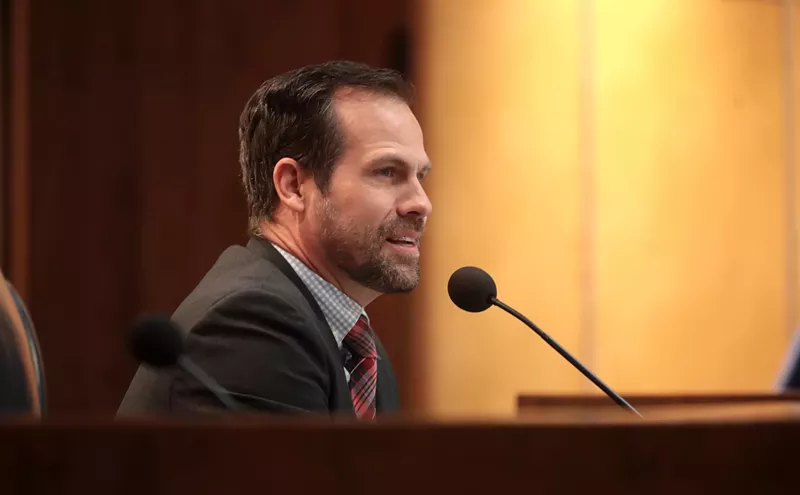


Not because he doesn't want to talk. Magedson loves talking, especially when the subject is his beloved Web site.
It's just that he's so incredibly particular. Arranging one simple meeting is an exercise that captures, perfectly, why Magedson is so good at getting results — and why he's infuriated the CEOs of several midsize companies to the point that they accuse him, flatly, of extortion. He overthinks every detail. And it would never occur to him to stop pushing before he gets what he wants, even if he's not sure what that is.
First there's where to meet. It has to be a public place. A dog park? A restaurant? Even after Magedson decides on lunch at Chompie's, he calls back with instructions about which bank of booths to pick. He's planning to park in the handicapped spot, he says, and from the right booth, he'll be able to keep an eye on his dog.
After discussing that issue for 15 minutes, he calls back to clarify: It can't be just any booth near the window. It has to be the one closest to the servers' station, to allow both dog-seeing and laptop use.
In the end, the dog is basically ignored, and Magedson doesn't even bring his laptop into the restaurant. (Yes, he parks in the handicapped spot. And, no, he's not disabled. He has a handicapped sticker, but it belonged to his late father. "I'm not perfect," he says.)
But he does get his booth of choice. It opens up just as he walks in the door.
"Things like this always happen to me," he says, beaming.
Throughout a three-hour meal of bagels, lox, and whitefish salad, Magedson runs his servers ragged. He needs butter, which doesn't come with his order, and another container of cream cheese, even though he isn't done with the one he has. Then, despite a bowl of creamers on the table, he asks two different waiters to bring him more, only to seem confused when the table ends up with three bowls' worth. And only after the bill arrives does he remember that he needs hamburger for his dog. After that bill arrives, as it turns out, he needs orange juice. And when the juice arrives, it's too small, so a waitress is dispatched to bring him a second one.
He's relentless — and he's not even out of sorts. On the contrary, Ed Magedson is enjoying himself immensely. It's just that he's so used to agitating, to throwing everything he can at the wall, just in case something needs to stick. He doesn't know how else to behave.
He's the postmodern Columbo, a shambling figure who eventually gets his way not because he's slick or charming, but because he wears people down. He is a nitpicker, a fighter, a squeaky wheel who's mastered the art of getting grease.
He's exactly what you'd expect of a self-titled consumer advocate, with one key difference.
Thanks to the Internet, people actually have to pay attention to him.
Before the rise of the Web, the powerful could write off gadflies such as Ed Magedson. But the Internet provides a bully pulpit that Magedson has harnessed with startling success — and woe to the business owner who tries to ignore him.
The Rip-Off Report has become a boon to the disgruntled, who've posted complaints taking on everything from poor business practices to deadbeat dads, ofen without a shred of proof. For Ed Magedson, it's been an even bigger gift. It's made him powerful, and it's made him money — although certainly not a dot-com millionaire.
Magedson won't remove posts. He's not interested in evidence that would offer vindication.
But if you're willing to pay, Ed Magedson just might be willing to talk.
Magedson guards his privacy maniacally. His business address is a post office box. The house where he lived until recently was owned by one of his limited liability companies — and he had to move, he says, when his enemies figured out his location, despite his precautions. Even his car and utilities are registered in a way that renders them untraceable.
To Magedson's credit, people only know how hard he's worked to hide because they've tried just as hard to find him. He says they want to kill him. (They say they only want to serve him with lawsuits . . . although they're certainly not above posting information about him on the Internet while they're at it.)
But despite his efforts to live off the public-records grid, there's plenty you can know about Ed Magedson without even talking to him: the legal battles, the allegations of extortion, even his parents' death certificates and the paperwork from that old 1970s pot bust.
That's the Internet for you. And if Magedson is virtually anonymous in Maricopa County, where he's lived for almost two decades, he's famous on the Internet.
Before the Internet became ubiquitous, you could only humiliate someone if you had connections, if you could get the attention of a newspaper reporter or were willing to picket in front of an office. Today, you can get revenge with just a few keystrokes — and face revenge just as easily.
Magedson (pronounced MAJ-id-sen) has been on both sides.
He claims that it doesn't bother him. "When people stop suing me, and stop talking about me, and stop threatening me, that's when I'll have to worry," he says during an early conversation. In the course of being interviewed for the story, he'll repeat the statement no fewer than three times.
Magedson came late to computers, and he's still not, by any means, a techie. But he latched on to a successful Internet game plan in the mid-'90s, even before the dot-com frenzy began, and he never wavered. In its eight years of operation, his Web site has managed to do what so few Web sites have done: It found readers. Today, it's even making money.
The site is called the Rip-Off Report. A clearinghouse for customer complaints, it boasts 8 billion hits, more than 225,000 user-written "reports" on various companies, and enough unsubstantiated allegations to make a CEO contemplate suicide.
The Rip-Off Report's power comes from its technical mastery. Before many people had even heard of Google, the Rip-Off Report had figured out how to land at the top of its searches. In other words, Google a company's name, and almost immediately you get a report trashing the business — far more interesting than a corporate Web site.
Companies that haven't spent millions on marketing or on a major Web presence are particularly susceptible: Zazou Model Management, the Rebate Processing Center. But even Primerica, the well-known financial services division of Citigroup, hasn't been immune. Google the company, and the Rip-Off Report is in the top three links.
And so customers who couldn't get a return call from a service rep, much less a TV station, suddenly have the online equivalent of a megaphone.
But www.RipOffReport.com isn't just a place to vent: Class-action lawyers, government investigators and reporters all use it to find victims. Not coincidentally, it's been credited with torpedoing more than one lousy business — and given Magedson a national reputation as a consumer advocate and a First Amendment warrior.
He relishes that role. Talking about his work, he tends to slip into the third person, as if he's dreaming aloud about how his story should be told.
"Ed knows it's sweeps week when he gets calls from reporters around the country looking for scams," he says, then repeats it later for good measure. Or, "Ed was formulating what he wanted to do . . ."
For all his self-aggrandizement, Magedson is well aware that his advocacy persona has lately come under fire. (Initially, he urged New Times to check out the threats he's faced and the lawsuits against him, only to e-mail later how "disappointed" he is that his worst critic has been interviewed.)
Just as Magedson has spent his life dogging people in power, now people are dogging him. More than a dozen companies have sued him. And, though he initially denies it, court records show that he's sued at least one business owner, too.
He revels in his role as a true-blue advocate. But with at least 30 companies now paying him to mitigate bad reports on his Web site, Magedson is facing sticky ethical questions.
Critics ask how he can accept payment from the same companies that he claims to be fighting — especially when he used to be so critical of the Better Business Bureau for the same thing.
And if he's using reports with dubious accuracy to pad his own pockets, does that make him a First Amendment champion — or an extortionist?
Fifty-five years old, raised on Long Island, Magedson has the nasal voice of a movie sidekick — think Bruno Kirby in When Harry Met Sally . . . , whom he somewhat resembles. But his hair is pure "Weird Al" Yankovic: Almost entirely bald on top, he wears it long and curly everywhere else.
This isn't vanity, a middle-aged man posing as a kid. Instead, it's the remnant of a hippie past, Magedson's way of clinging to his outsider status even today.
Magedson had his run-in with City Hall when, as a college drop-out in the '70s, he started a coast-to-coast network of street-corner flower stands. He found himself embattled in every town, and at every turn: "I was dealing with all these government agencies, and the lies that the bureaucracy would tell you. The city would have staff members, so-called staff members — most of the time, they're a bunch of liars."
Even though city bureaucrats caused his flower business to fail, he says, he was left with a small fortune. So he moved to upstate New York and invested in HUD housing.
Once again, the town fathers used every trick in the book to stop him, he says. They redrew the regulations for low-income housing; people called him a slumlord; the police harassed him.
He sued them, but he lost.
Wanting to be near his elderly parents, Magedson moved to Mesa. He started an indoor swap meet at a strip mall at Gilbert and Main. Again, he says, city inspectors did all they could to drive him out.
Again, he sued; again, court records show, he lost. The appeals court refused even to hear his case. And when Magedson's landlord sued him for back rent, court records show, he ended up owing more than a few grand.
It was only after that fiasco that he met Mesa attorney Dale Thorson — and discovered his second act as a consumer advocate and Internet entrepreneur.
Thorson was doing estate planning for Magedson's parents, and got to chatting with Magedson. Thorson was impressed with tax work Magedson had done for another family member and told him so. "The kid is brilliant," Thorson says. "Just very, very intelligent."
Magedson asked Thorson if he had any clients who needed help. Living with his parents, his expenses provided for, he wanted to use his skills to get justice for people who needed it.
Thorson asked him to take a look at a case involving an elderly couple who'd been screwed by a rug cleaner. Magedson ended up recouping their entire investment, Thorson says, and the couple was grateful to have avoided a court case.
As for Thorson, he was thrilled by the energy Magedson devoted to his task — and that the fledgling advocate refused to charge the people anything for his services when he was done.
In no time, Thorson says, he was asking Magedson to assist a number of people who'd come to him needing help. "He's not this slick guy," he says. "He's the Columbo guy" — like the TV detective played by Peter Falk, whose awkward manner can conceal a sharp mind and an uncommon persistence.
"There isn't a challenge he didn't take on," Thorson continues. "I can't think of one where he didn't get positive results. Sometimes the client didn't want to keep going on the case, and they'd drop it. But it was never because Ed wanted to give up."
Magedson began distributing a flier, promising, for $250, to help people fight against a corrupt City Hall or companies that had screwed them. He says he never actually charged the fee; instead, he used it to weed out people who weren't serious about pursuing their claims.
He began to hone a process of just how to fight The Man, to develop a formula that really worked. He was planning to write a book. (Today he sells that book, a slim paperback, from the Rip-Off Report for $21.95. Not to give away a trade secret, but the formula basically comes down to threats to picket, and then picketing.)
One day in the mid-'90s, visiting a shop owned by some of his former swap-meet tenants, he says, he met a woman who designed Web sites. Hearing about his unusual line of work, she asked him, "Why don't you make a Web site?"
And that was the start. Before that, Magedson says, "I didn't even know how to turn a computer on." But the site, a simple ad for his advocacy services, took off: "I got people to call me. I thought, 'Gee whiz!' Because I didn't believe in the Internet."
From Magedson's initial foray into online advertising, the Rip-Off Report may seem like an obvious outgrowth today, with everyone doing business on the Web.
But Magedson was ahead of the curve. In 1998, when the Monica Lewinsky scandal first became public on a Web site called the Drudge Report, many Americans didn't even know how to access the Internet, much less use it to their advantage.
But that's the year Magedson registered the Rip-Off Report Web site. And like the Drudge Report, another early online juggernaut, www.RipOffReport.com wasn't just a static presentation hawking a business. It was the business.
Today, the Rip-Off Report seems old-fashioned next to even the simplest blog. It has none of the clean functionality that Google has perfected; it's a mad jumble, plagued with technical problems. More than half of New Times' searches on any given day ended in futility; the site lacks the technical capability to handle its own content. (Magedson says a long-awaited redesign should be online within the month.)
One reason for the tech problems is the site's massive volume: On top of the 225,000 initial complaints, the site has layer after layer of businesses' rebuttals and readers chiming in. And though it would probably increase the site's user-friendliness if posts of a certain age were deleted, Magedson doesn't like to get rid of anything. You can still get complaints dating back at least six years.
It doesn't help that the Rip-Off Report has a fairly low standard of relevance. An entire category has sprung up with people complaining about adulterous partners. At last count, it had 207 entries.
Magedson pays a team of stay-at-home moms to vet posts for obscenities and social security numbers. But beyond that, he admittedly finds few things too scurrilous for publication.
For example. Consider this post about a man who's identified by first and last name and hometown. The man is, "Lindsey" complains, "nothing but a loser. He steels [sic] from everybody including his own family. Not to mention he beats his own mother. . . . He spends all his time and money on drugs. No wonder he has no life."
Or, less personal but no less toxic, the Maryland hospital where nurses are alleged to "cut bodies open after they kill people" and steal organs. Or the Scottsdale communications company that's alleged to have "scammed millions of dollars from honest people."
For someone so smart, Magedson is curiously accepting of even the most off-the-wall allegations. He estimates that 98 percent of the site's complaints are true, which seems ridiculous after perusing numerous comments in which people accuse each other of everything from spreading sexually transmitted diseases to grand larceny.
"If you ask Ed the question, 'Ed, do you think there are phony reports?', of course there are going to be," he says. "'Are some of them exaggerated?' Probably so.
"But," he concludes, blithely, "if you're a business being complained about, you probably deserve what you're getting."
For business owners who Google themselves and are startled to discover they're actually scam artists, cheapskates, or even child abusers, the Rip-Off Report can be shocking. After all, if a newspaper printed such unsubstantiated allegations, it would be bankrupted in no time by lawyers with libel claims — some far from frivolous.
The Internet, as Magedson's victims soon learn, is different.
Newspapers are on the hook for libel if they merely publish a damaging untruth without proper vetting. So long as a story is about a private citizen, the standard is mere negligence: If a paper thinks something is true, but doesn't bother to verify, it can be held liable.
A Web site, however, can publish even those claims that writers know to be false: an ex-husband's rant that his saintly wife has herpes, an allegation that a hated city councilman is a pedophile. Forget mere negligence — online reports can be downright malicious.
For that, you can thank Congress, says Eric Goldman, an assistant professor at the Santa Clara University School of Law and director of the High Tech Law Institute. (And, oddly enough, you can thank porn, too.)
Before 1996, Goldman explains, Web sites were treated more like newspapers. If their operators edited or monitored content from their users, they could be considered a publisher. In a few cases, they were held responsible for publishing without verification.
But then came congressional concern about online porn. And Web operators argued that they were caught in a Catch-22: If they removed porn, they'd be on the hook for anything they left up that proved libelous.
So the Communications Decency Act, passed in 1996, attempted to restrict Internet porn — and, at the same time, give Web sites special immunity. Under the act, Goldman says, "you can be aware of bad content, do nothing about it, and still not be liable for it."
Ironically, the Supreme Court struck down the porn part of the law soon after it was passed. But the exemption for Internet publishers stands. The U.S. Supreme Court has shown zero interest in entertaining a challenge to it, Goldman says, much less overturning it.
Goldman believes Congress made a good decision. "It's very hard to put online service providers in the role of judge," he says. "If we asked online service providers to do this, they'd take the path of least resistance. They'd take the content down. And if they did that, we would see a chilling extinction of negative feedback about products and services in the marketplace."
And so Web publishers today have the freedom to publish real, uncensored customer reports — and, while they're at it, to publish false information.
This is not just true of Ed Magedson.
Take, say, America Online. After the Oklahoma City bombings, a guy named Kenneth Zeran was shocked to see that someone smeared him all over AOL message boards, claiming that he was selling tee shirts glorifying the bombings. The messages included his telephone number.
When radio stations picked up on the story, Goldman says, Zeran started receiving a dozen nasty phone calls a day. Hard to blame the guy for suing.
"If you wanted a sympathetic plaintiff, you got him," Goldman says. "This guy got screwed." But the court was emphatic, Goldman says: AOL was not responsible.
"And since then, we've had three dozen cases, all of them saying Zeran was right," Goldman says. "The person who wrote the words is liable. The online service is not."
There's one good reason the darker corners of the Internet are so nuts: because they can be. And the legal immunity granted to online publishers also explains the continued existence of the Rip-Off Report.
Companies suing Magedson for libel all learn, soon enough, that the law isn't on their side. It may irritate them, or even hurt their businesses and reputations, but they simply can't force him to take down even the nastiest posts.
"It's extremely frustrating for a company to have their number-one search result be a Rip-Off Report," explains Magedson's attorney, Maria Crimi Speth. "And because it's legal, and because the posts are often anonymous, they have no one to take it out on but Ed."
Magedson says he's spent at least $1 million on legal bills. Judging by the volume of suits he's fought — and the size of the case files — he's not exaggerating.
But for Magedson, the blowback he gets is clearly a great part of the fun.
During his interview at Chompie's, he's interrupted when one of his four cell phones starts ringing. (All have numbers ending in 4357, he notes, which spells "HELP.") To his delight, it's a business owner calling to ask him to remove a report on the Web site.
It's an exercise bound to end in frustration for the business owner, but Ed Magedson is enjoying himself immensely.
First he explains that he can't take down any report, even if it's demonstrably false. Then he asks the guy to send him an e-mail.
And then he's off on a 10-minute monologue. Since 2000, he tells the man, more than 800 businesses have called to thank him. Several companies have been so grateful for his Web site, he says, that they've sent him money at Christmas.
"Let me just say, we're all going to be blogged," he is saying. "Right or wrong, good or bad, we're all going to be blogged today. Um, if you're not, your children definitely will be. And if they even mention something on some blog somewhere, your last name will come up when you're doing a Google search . . .
"If you drive too fast going down the street in your neighborhood, some neighbor's going to blog you and say, 'That dirty SOB, he drives too fast going down the street, and he should learn how to drive.' . . . It's just the way our system is today. Everything's changed."
At the end of the call, Magedson notes, optimistically, that "the truth will set you free." But he makes no offer to investigate the truth of the report, or take it down if it's phony.
The companies that sued Magedson for libel, despite the Communications Decency Act, initially seemed surprised to learn they didn't have much of a case.
But the word is getting out, and lawyers who've challenged the Rip-Off Report lately have made stronger legal claims. They allege that Magedson isn't just passively posting the information. He writes reports, or uses surrogates to do it, they say.
They claim he also writes headlines, and that it's the headlines that are libelous.
Magedson denies those claims emphatically. But he can't deny the site reflects his unique obsessions — and that he tends to play up certain reports based on his personal preferences.
Even today, the City of Mesa is listed as one of the report's "Top Rip-Offs," with a link to Magedson's tale of swap-meet woe.
And then there's the Better Business Bureau. For years, the organization has been a Magedson target. In his self-published book, Do-It-Yourself Guide: How to Get Rip-Off Revenge, he spends an entire page railing against the Bureau's system of sorting out complaints before announcing them to the public.
"In our opinion, the Better Business Bureau (and their inaccurate files) is a bust, because they solicit membership in exchange for favorable status," he writes.
The site goes much further. It calls the bureau a "racketeering enterprise."
Magedson himself chooses the "Top Rip-Offs." And, as he once admitted under oath, he doesn't exactly have a scientific selection system.
The questioning came during a lawsuit from a guy named Steve Miller. Miller, who owns a Fort Lauderdale credit-counseling company, has become Magedson's sworn enemy after the two men battled over reports about Miller's company.
Miller is the only person, to date, who's been able to get Magedson to give a deposition in a court case. By hiding his whereabouts, Magedson has been able to personally evade service.
(Even Magedson's corporate agent is pretty tricky to find. Ever heard of Reeves Mountain, Arizona? According to Magedson, it's somewhere northeast of Phoenix, and close to just about nothing. Mapquest doesn't have a listing. Neither does Google Maps. And if you haven't heard of it, imagine some lawyer from Wisconsin trying to find the guy, much less serve him with papers.)
The deposition in Miller's case was supposed to be limited strictly to issues of jurisdiction: Could Miller sue the Rip-Off Report in Florida when the company is based in Arizona?
But things got extraordinarily testy. For five hours, Magedson and Miller's attorney, Christopher Whitelock, sparred over just about everything they could possibly spar over. Even Magedson's own attorney, Speth, seemed exhausted by the contentiousness of the debate. "Ed, please, let me handle this," she says at one point, according to the transcript, while Magedson and Whitelock argue over her.
Near the end of the long day of questioning, though, Magedson answered some questions about why he'd chosen Miller's company as a "Top Rip-Off." And he admitted it wasn't because there were numerous complaints about the company.
It was because Steve Miller had been playing hardball. Miller had called him, Magedson said, threatened him, and posted stuff online that embarrassed him.
"And I have no other way to retaliate to him," Magedson said, according to the transcripts. "You know, or to respond to him, so . . ."
Miller's attorney, Whitelock, pressed him: "You put it up there a week or so ago to retaliate against him, correct?"
Magedson tried to backtrack. "Well, I guess that's the wrong word."
"Well, you used it, not me," Whitelock pointed out.
"Yeah, I take it back," Magedson said. "It was the wrong word."
Even with that admission, Magedson ought to be covered by the Communications Decency Act. He's allowed to edit. He's allowed to move content around.
But Goldman, the professor in California, notes that Magedson recently lost two motions to dismiss libel claims based on the merits of the law. In each case, the business that is suing the Rip-Off Report has been given the judge's permission to continue.
"The Rip-Off Report cases are some of the very few exceptions to an otherwise uniform application of the law in a defendant's favor," Goldman says.
And that's probably not because judges are rethinking the Communications Decency Act, or because Speth doesn't know what she's doing. (An attorney with the respected Phoenix firm Jaburg & Wilk, she clearly does.)
It's because, as the number of lawsuits against Magedson has increased, lawyers have learned about Magedson's willingness to take money from companies to mitigate bad complaints. He calls it his "corporate advocacy program."
Here's how it works: Businesses pay Magedson a fee, plus a monthly retainer. And in exchange, Magedson makes "EDitor's comments" next to complaints — generally saying that the claims are false.
Business owners are already allowed to post rebuttals to complaints. But Magedson weighing in has a much stronger effect.
It's not "he said versus she said." It's an impartial arbiter of truth declaring that one side is right and another side is wrong. And, though Magedson says he investigates every report and would never support a company that wasn't in the right, his comments come without a clear disclosure that he's now on the company's payroll.
But it's hard to blame a business for ponying up.
Take Chandler Hill Partners. The Tucson firm, which specializes in job searches and outplacement, was getting dogged by complaints on the Rip-Off Report. CEO Sarah Hightower Hill was convinced the posts came from competitors, but she knew that no one would believe that coming from the company's CEO.
Making it clear that she is not speaking specifically about Magedson's site, Hill says that online bashing is "one of the biggest dilemmas facing American business today."
"All of us," she says, "are at the mercy of what people might write about us online, even if those people wish us ill will or have nothing to do with our business. It's a very damaging thing."
And so Chandler Hill paid to join Magedson's corporate advocacy program. Today, if you look up the company on Magedson's site, you get a four-page editorial, written by Magedson himself.
Just the headline, written in Magedson's typically unedited style, makes it clear: "[M]ost complaints posted are verified untrue, competitors making false claims to hurt companys reputation, Most complaints not from real clients, evil work of a competitor."
For Hill, it's been a blessed relief. She says she's pleased with the program.
But some businesses question why they should have to pay tens of thousands of dollars just to clear their names from complaints that are false in the first place.
Indeed, the program is not cheap. Speth says there's a sliding scale, depending on the number of complaints, and that it can be as cheap as a few hundred dollars. But documents in court files, and several business owners who spoke to New Times, suggest that joining the program was offered to some at more than $50,000. And there's a monthly fee on top of that.
Of course, the program is still much, much cheaper — and more effective — than litigation.
Israel Kushnir, CEO of the Illinois-based George S. May International Company, says his consulting firm was tarred by "heinous" complaints on the Rip-Off Report, including one report alleging that the company's founder was a pedophile who inflicted porn on his staff at recent staff meetings. Since the founder has been dead since the 1960s, the complaint was ludicrous.
The online allegations were infuriating — not just to him, he says, but to the founder's daughter and granddaughter, who currently own the company.
So, in 2004, George S. May sued. But Kushnir says he met with Magedson earlier this month and told him he's decided to drop the case.
"I realized Ed Magedson and George S. May were simply accidental enemies," Kushnir says. "He didn't start his site to attack George S. May. He didn't even know George S. May. Rather than continue to spend an enormous amount of money and energy and litigation, I thought, there's got to be a better way to deal with things like that."
The George S. May Company is going to join Magedson's corporate advocacy program. (Kushnir declined to say how much he's paying.) Basically, Kushnir will pay Magedson to reveal the complainants against the company, and then Kushnir can do what he would have wanted to do all along — address them.
Good news for Magedson. But not such good news for the people who had anonymously blasted George S. May. After all, Magedson will be giving them up. And if they're current employees, they're probably going to be in trouble with a capital T.
Kushnir says he won't sue anybody — he's learned his lesson — but if it's a disgruntled secretary who called the founder a pedophile, it's hard to imagine things will end happily for her.
Kushnir says he's happy with how things ended. But the incident does raise some ethical questions.
It would be one thing if businesses were paying for public relations, which is how Magedson tries to frame it. But, really, what businesses are paying for is a chance to fight back against a negative.
And you only get to fight back if you pay.
Magedson's critics believe it's clearly extortion — a point they've hammered hard in recent lawsuits.
"If it was just a bulletin board where he's posting complaints without editing or embellishing them, then he'd have a defense," says Christopher Sharp, a Florida-based attorney who is suing Magedson's company on behalf of a Colorado company that provides training courses in finance, real estate, and the stock market. (Sharp's claim recently survived Magedson's attempt at dismissal thanks to an appeals-court decision based on the Communications Decency Act.)
"But it's pretty clear that he writes posts himself," Sharp says, a point Magedson denies. "And if you ask him to take them down, he says, 'Just join my corporate advocacy program.'
"I have to tip my hat to him," Sharp says. "He knows how to run an extortion scheme."
Magedson's critics will tell you that he's only in it for the money, and public records offer some evidence that finances matter more to Magedson than he likes to admit.
There's an e-mail Magedson wrote to a class-action attorney several years ago. The attorney had contacted him about working together to help the clients on the site — but walked away when Magedson asked him for $800,000.
There's the fact that, despite Magedson's posturing, neither of his two corporations has ever been a not-for-profit, which is the case with the Better Business Bureau, his chief competition. He sells his book for $21.95, he gets paid by attorneys for "advertising" after he finds them clients, and his site has plenty of advertisers — yet he's still asking for donations via PayPal.
And then there's the case of a pizza deliveryman named John Unger. New Times profiled Unger in 2001 after he sued Pizza Hut over a host of allegations. He even claimed that his bosses made him pick up crystal meth while on the job.
As it turns out, Magedson had helped Unger tell his story to the media. Magedson also hooked Unger up with his own lawyer, Maria Crimi Speth.
The case eventually settled. But not before some damaging facts came to light — facts that, even today, are in the court file in Pinal County.
And it's not just the transcripts of Magedson's calls to a Pizza Hut executive threatening him with media coverage and a fat class-action lawsuit if he didn't give Unger $200,000. Those don't paint Magedson in the best light, but threatening businesses is an admitted part of his shtick.
Taking a victim's settlement money is not. But as the court records show, Unger told his psychiatrist that he'd signed a contract with Magedson, promising him 50 percent of any settlement he got in the case. (Magedson denies the 50 percent figure, although he admits that he did stand to take a percentage.)
Reports from the psychiatrist, filed as evidence in the case, show that the situation between Magedson and Unger got ugly as the case dragged on.
"There was a lengthy discussion about the threats Ed has made," the psychiatrist reported. "[Unger] reported he has been up and e-mailing back and forth with Ed."
The psychiatrist suggested to Unger that he should just turn off the computer every night at 9. "There was a conversation about cult behavior, of how the person in power gets his followers tired by keeping them from getting enough sleep and then the person is too tired to be thinking for themselves." Unger agreed, the shrink wrote, that "this is what has been happening." He decided to have no more contact with Magedson.
In Magedson's defense, even the angry John Unger admitted that he had first suggested upping Magedson's fee because he'd been so happy at the way Magedson had championed his case. And Magedson's attorney, Speth, says that she believes Magedson is only interested in money because he needs it to keep fighting for his cause.
From his appearance, he's clearly a guy who doesn't care about expensive things. His beloved dog is a mutt. He drives a Chevy Malibu. It would clearly be an upgrade for him to shop at the Gap.
"I laugh when people say he's an extortionist, and he's money-hungry," Speth says. "He wants to make enough to keep the Web site going. He cares about what it's doing — not what it's making."
Speth admits, however, that Magedson's willingness to take money from companies is not a simple matter. "I agree it complicates the issue," she says. "I absolutely and completely disagree that it's extortion — or that there's anything wrong with it."
The trouble with making sense of the riddle that is Ed Magedson is that he's not obsessed with truth; — he's obsessed with winning arguments. And so his story changes. Or there are exceptions. Or caveats.
One of the biggest caveats is Steve Miller, Magedson's sworn enemy. Magedson will tell you he's never sued anyone, but he did sue Miller in Maricopa County Superior Court. (He dropped the suit two months later.) He will also say that he never blocks a business owner from posting a rebuttal to a complaint, but he admits he made an exception in Miller's case.
Magedson says Miller has threatened his life, and he has a tape to prove it, which he's dying to play. Miller says Magedson has done things just as bad: For one, Magedson somehow obtained his social security number, and gave it to another consumer advocate who wanted to sue him. (In his deposition, Magedson admitted to passing on the information, although he claimed, somewhat disingenuously, that there was "no evil intent.")
Miller, clearly, has gotten under Magedson's skin. And one reason, even beyond the whole death-threat controversy, is that he's built, by far, the most damning case against Magedson.
Two years ago, Miller put up a Web site devoted entirely to bashing Magedson. It included his mug shot for a 1970s pot bust (the charges were later dropped) and the fact he'd been arrested for passing bad checks. (Those charges were dropped, too.) It also claims he's a wanted criminal, a slur that would certainly be at home on the Rip-Off Report, but which seems to have little basis in reality.
But beyond the rhetoric, there's that deposition, the one time Ed Magedson's talked under oath about the Rip-Off Report. And, under questioning from Miller's attorney, Magedson seems to admit the allegation that he still denies most vehemently: that, for money, he's deleted reports from his site.
Under oath, Magedson first said that no, he didn't remove complaints for the businesses that were paying him. Then he changed his tune.
When Magedson was first developing his corporate advocacy program, he was working with a company called Mini Vacations. And when someone posted something about Mini Vacations that was clearly false, Magedson seemed to admit under oath that he'd removed the complaint.
He said it was "a test," though he didn't explain what he meant. "And we did it for a very good reason," he added, "and we never did it again."
"What was the very good reason?" Miller's attorney asked.
"It was a company that was on the program," Magedson said. "And this company has like — if every company was like them . . . I wouldn't even have as much jobs. This company is an excellent company."
When the attorney prodded him, Magedson tried to backtrack.
"I don't know if I ended up doing it or not," Magedson concluded. "I had offered it. Or either I changed the reports that they were bogus, or I removed some of the reports. But that was — excuse me, one time that I did that, if I did not. And I honestly could not remember.
"If you offered me a million dollars right now, 'Ed, could you tell me absolute, either yes or no,' . . . I could not tell if you if I ended up deleting the — some of the reports."
In a telephone followup with New Times last week, Magedson denied saying that. He agrees that, initially, when he was working with Mini Vacations to develop the corporate advocacy program, he discussed deleting reports for companies. But that idea was scrapped.
He e-mails later to say that the deposition is wrong, that the court reporter screwed up. He's now certain he never removed a report.
But Steve Miller is sure he's got him — and under oath, no less.
He sees Magedson as a sophisticated scammer who happened to approach the wrong guy.
"When he gets somebody like me contacting him, that's when he starts licking his chops," Miller says. "He has a mark. He wanted me to pay him. I told him to screw off."
Miller ultimately dropped his lawsuit: "I got him in deposition, which was my goal all along. I wanted to show the world he's a liar and a loser."
If nothing else, Miller's Web site is proof that Magedson's warning to the business owner who contacted him at Chompie's is correct: We're all going to end up tarred online by someone.
Especially if we prove as controversial as Ed Magedson.
These days, if you Google "Ed Magedson," you don't get Steve Miller's Web site in your top hits, but if you want the dirt on Magedson, you still have plenty of options. The second link is to a site put up by an entirely different critic. It proclaims that "Ed Magedson is a wanted criminal that extorts individuals." And the third link, www.goodbusinessbureau.com, claims that "Ed Magedson founder of ripoffreport.com is a wanted criminal that extorts individuals and legitimate companies for money."
This is how things work in the age of the Internet.
Want to out-shout Ed Magedson? You may not need his corporate advocacy program. You just need to build a better Web site.
Magedson, of course, has his mantra. Though he's initially chagrined to be asked about the specifics that guys like Miller have uncovered, he calls later to make it clear he understands how the process works. He knows that he suggested New Times look into the controversy around him. He's a big boy.
"I know when people stop suing me, and stop talking about me, and stop threatening me, that's when I'll have to worry," he says, for the fourth time.
But he's not above doing some damage control.
These days, when you Google Ed Magedson, the top hit isn't an attack on his methods and isn't even the Rip-Off Report. It's www.EdMagedson.com, a site devoted to defending Magedson and his advocacy.
"This site was posted by friends of Ed Magedson as a way to let victims know, Ed is real, he is human, and he does stand up for what he believes in," the Web site explains. "We will not fight the anti-Ed sites, we embrace them. Publicity on Ed (Good or Bad) helps expose people to the power of free speech and in the end, more people benefit from sites like RipoffReport.com."
There's only one problem: those "friends" of Ed Magedson.
The Internet, as it turns out, is not just filled with slurs and complaints and unverified information. Out there in cyberspace is a registry that shows who owns Web sites and who maintains them.
When it comes to EdMagedson.com, the answers are Ed Magedson . . . and Ed Magedson.
Even after being confronted with this evidence, Magedson denies writing the words on the site. But he also won't say who did.
In the end, it's hard not to conclude that no one is better than Magedson at framing his own biography.
The site refers to his "appealingly eccentric personality." And it offers this summary, littered with his typical typos, the Ed Magedson story told in the way Ed Magedson would tell it:
"Ed Magedson created a great thing. He dedicated his life to it, and now gets threats every week. Why? Because he is not afraid to stand up to corruption, he fights for his rights and ours to freedom of speech. That double-edge sword means other may speak freely about Ed as well. Some truth some fiction, but in the end, you may judge.
"That is the beauty about free speech. You get to hear it all."