
Isaac Torres

Audio By Carbonatix
Five years ago, Travis Taylor stood outside the acclaimed Lewis Barbecue in Charleston, wondering why his friend had dragged him there. About 50 people stretched from inside the cheerful blue restaurant out into a muggy afternoon. The line moved forward at a crawl. Even worse, when Taylor finally stepped up to the meat-cutting counter, he froze.
“I had no clue how to order,” Taylor recalls.
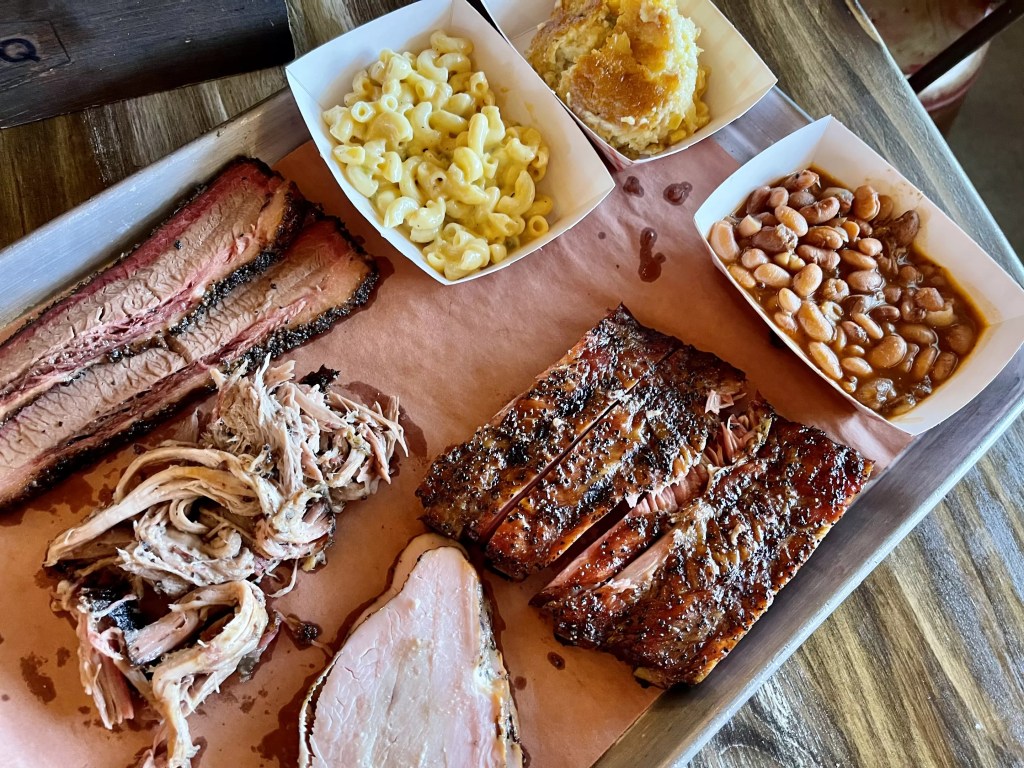
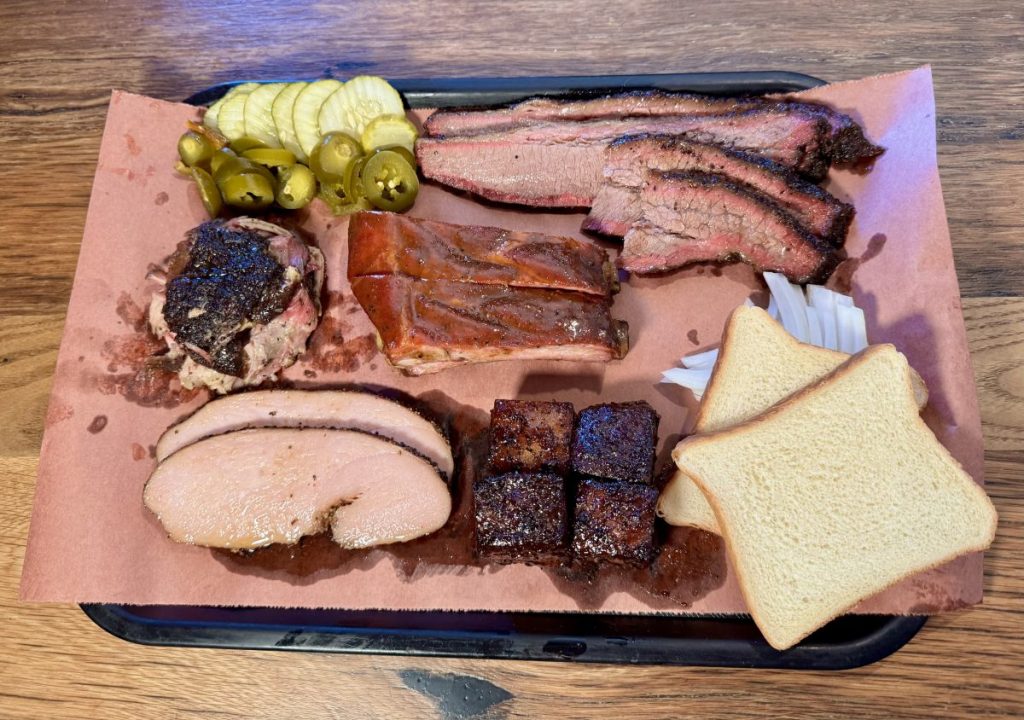
He’d only seen meat listed for sale by the pound at a grocery store. His friend rescued him, stepping in to order slices of fatty brisket, ribs and pulled pork, paired with a few slices of Wonder Bread, pickles, onions and pickled jalapenos.
One hour before, as he was standing in the sun-beaten lunch hour line, bored and irritated, Taylor had no idea that a single mouthful of beef would change his life forever.
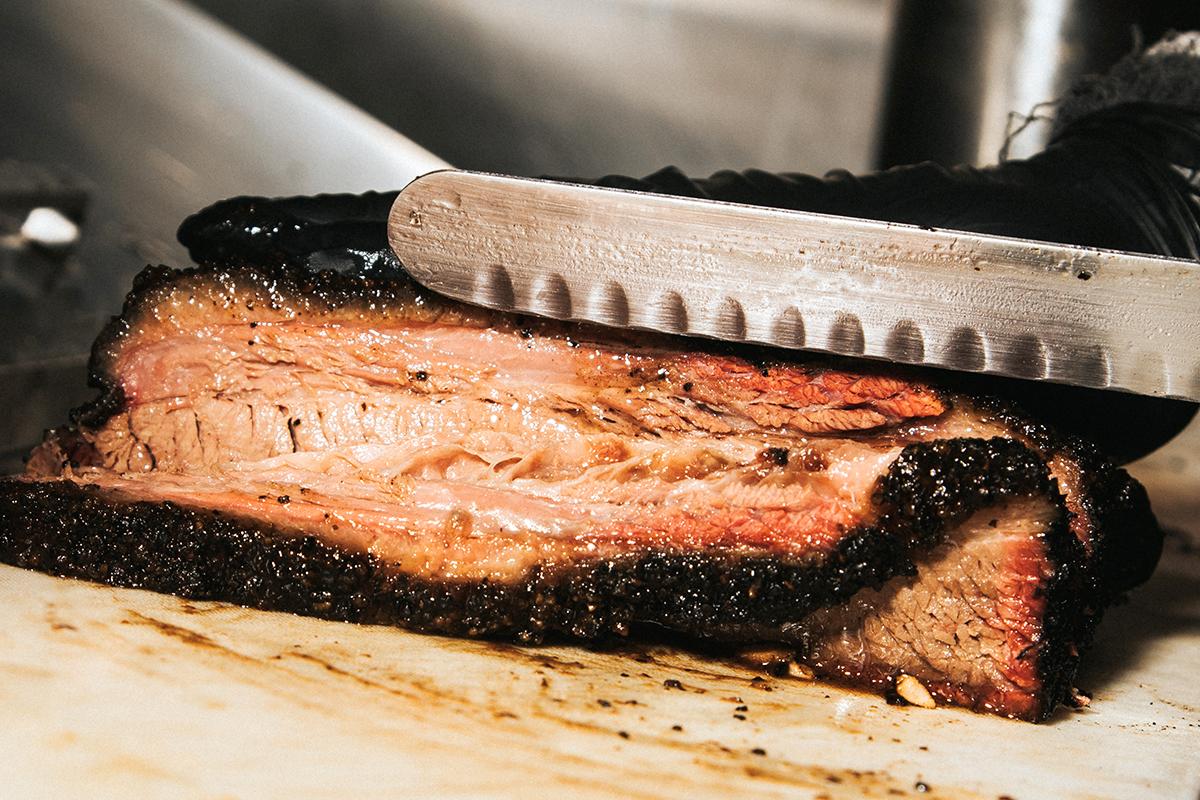
Growing up, Taylor knew barbecue as grilling hamburgers and dogs. At the time, he didn’t understand the difference between the backyard pastime and the offset smoking technique that could, after hours, render a fibrous slab of meat riddled with connective tissue into meltingly tender bites of beef.
“That first bite of brisket was just life-altering for me,” Taylor says, “and started this craving that I wanted to keep going back for more.”
Sara Crocker
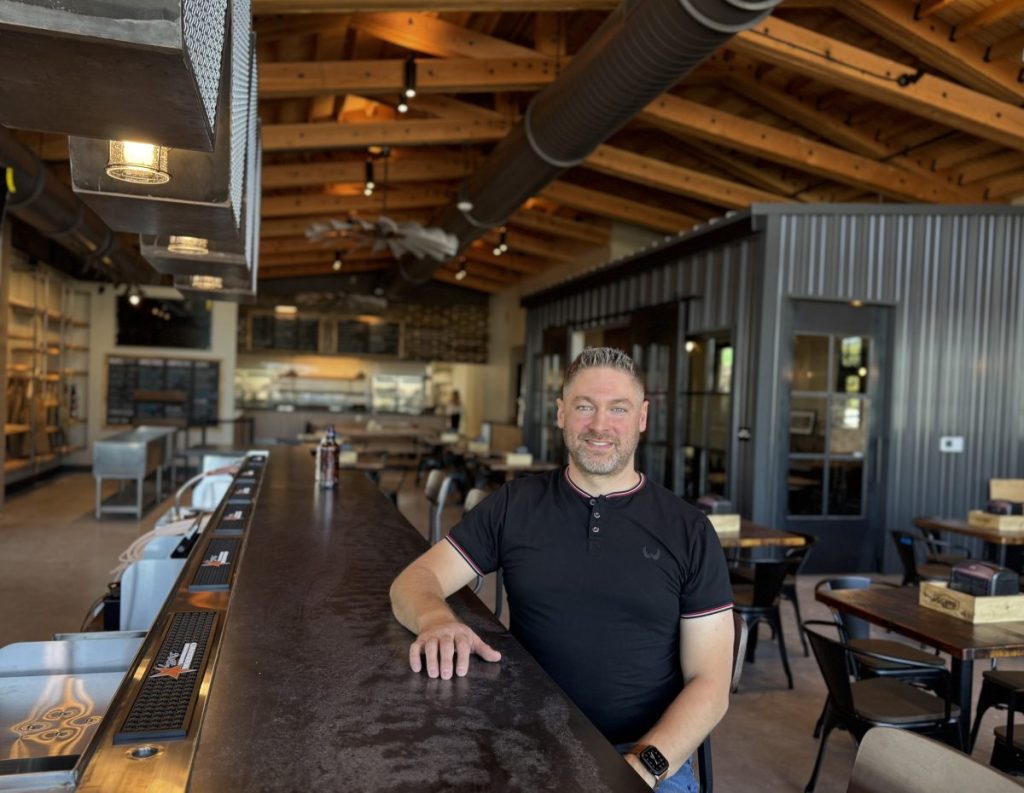
Taylor set about spreading the gospel of brisket with the zeal of the newly converted. Now CEO of Caldwell County BBQ — a burgeoning Valley institution with four locations and counting — he has made up for lost time. In 2022, he bought into the barbecue business founded by Clay Caldwell, a Snowflake pig farmer turned pitmaster.
Caldwell opened Waldo’s BBQ in Mesa in 1993 and planned to ride off into retirement when he sold his stake in 2014. During a trip to Austin, Caldwell experienced his own come-to-Jesus moment over a slice of brisket from Franklin Barbecue. Owner Aaron Franklin built the modern standard for Central Texas-style barbecue, won a James Beard Award for his craft and has hosted countless pitmasters who would go on to build their own notable smokehouses, like Lewis in Charleston.
When the Caldwell family founded their barbecue joint in east Gilbert in 2018, they cast it in the image of Franklin’s, adding subtle nods to Arizona through mesquite and chiles.
A place like Arizona has the ingredients to be a barbecue powerhouse. Ranchers have long raised cattle here, and an abundance of hardwoods, ideal for low-and-slow smoking, grows throughout the state.
But oddly there’s virtually no such thing as “Arizona barbecue.” The best barbecue chefs in the Valley are importing other styles from other states. The question endures even as some Valley barbecue is hailed among the best anywhere in America. Have we, in this most red-blooded state, actually made this staple of American food ours?
Taylor and a half-dozen other barbecue experts and enthusiasts I spoke with all discovered their taste for smoked meat in some faraway place. I did, too. As a kid visiting family in Lockhart, Texas, there’s not much else to do than to eat barbecue, which happens to be some of the best on Earth. I was raised at the meat altars of Smitty’s, Kruez and Black’s, taking communion of brisket and white bread throughout my childhood.
When I moved to Arizona, I was horrified to find places where I didn’t see people cutting the meat right in front of me or asking for my preference of lean or fatty brisket. Some of the first barbecue restaurants I visited here felt more like Cracker Barrel than craft barbecue.
Since then, in smokehouses big and small throughout the Valley, I’ve also seen people sweating in front of tank smokers radiating heat. These folks are putting in the hours, grinding to put Arizona on the map for barbecue.
If they fail, it won’t be for lack of creativity. Local pitmasters are testing many options: Master another place’s style but mix in Arizona flavor. Make it distinct to the state’s culinary heritage. Add your own experience to the platter. Without generations of tradition to box you in, why not experiment?
“Because Arizona is still developing as a barbecue state,” Taylor says, “I think we’re not locked into all the same rules or stereotypes you might have for barbecue.”
Purists, look away. You’re in Arizona now.
Tirion Boan
How the fires started
The United States owes its melding of cultures and foods less to the proverbial melting pot and more to a smoking-hot pit.
Barbecue’s cooking traditions began with Indigenous people across the Americas, explains Adrian Miller, a food historian in Denver who wrote the James Beard Award-winning book “Black Smoke: African Americans and the United States of Barbecue.”
In the Southwest, Native peoples cooked in outdoor pit ovens for thousands of years. Archaeologists have excavated remnants of agave, prickly pear cactus and bighorn sheep from these roasting pits.
Barbecue gets its name from the Spanish word barbacoa, which Columbus’ crew used to describe cooking over a wood frame that they saw upon landing in the Caribbean.
“The word didn’t exist until old Europe came to the New World and encountered the Americas and started appropriating Indigenous language and cooking techniques,” Miller says.
Enslaved Africans brought to the Americas had their own barbecuing traditions, but more notably, Miller writes in “Black Smoke,” they brought knowledge of spices, seasoning and saucing. That skill met Indigenous cooking. In antebellum America, barbecues were manned by Black pitmasters.
Immigration and the confluence of cultures evolved barbecue in the Southwest. By the late 1800s, cooks in the region wrapped large hunks of beef in moistened burlap and placed them in earth ovens. The technique was known as Spanish barbecue, cowboy barbecue or Western barbecue, erasing the connection to its Indigenous roots.
That style of barbecue started falling out of favor in the 1930s, Miller says, but endures today as barbacoa. Distinctive cooking styles took off throughout Texas and in Kansas City and Memphis, big cities ready to mythologize and evangelize toothsome but tender, saucy ribs and juicy brisket with mahogany smoke rings.
Arizona, still a calf in the herd of our United States, was admitted to the union in 1912 with just 217,000 residents — smaller at that time than Kansas City alone. Sparsely populated Arizona barely got in on the Great Migration, a 60-year period that saw about 5 million Black Americans move out of the South during Jim Crow. Most headed north, not to the Southwest. Between 1910 and 1970, Arizona’s Black population increased from 2,000 to about 54,000. Today, Arizona’s Black population accounts for less than 6% of the state’s residents.
America was growing, and Black Americans were on the move. But Arizona didn’t begin to truly blossom until cheap air conditioners helped to spur a migration boom. That brought more dining demand writ large. In the early days of the Valley’s dining scene, barbecue showed up as the occasional dish at steakhouses or taquerias. Without a dedicated focus on barbecue, the results weren’t always astounding, but they began to offer a reference point.
Places promising new residents a taste of their old home followed the influx of new people: East Coast red sauce joints. Chicago-style pizzerias. Barbecue.
Those smokehouses are what Miller calls “transplant barbecue,” and it’s common in places that found their footing as cities later in the country’s history. Arizona was starting to have its own barbecue identity, at long last. But in those early days, it was just an imitation of what you’d find further east.
Sara Crocker
Putting barbecue front and center
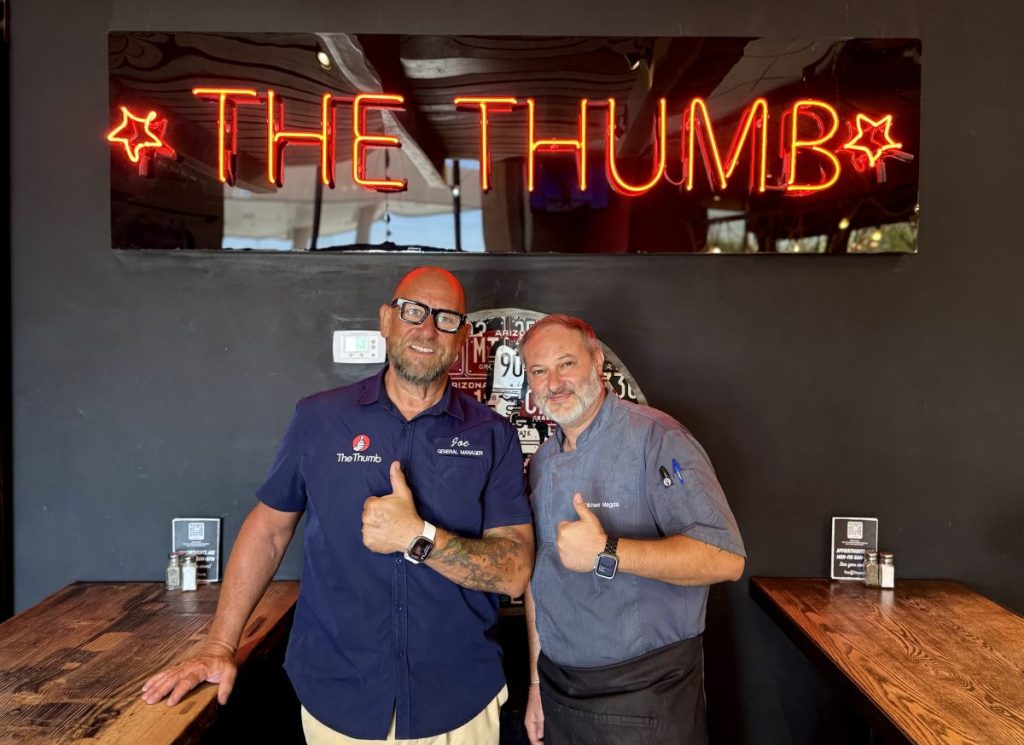
Joe Berman, the general manager of Scottsdale eatery The Thumb, can rattle off bygone Valley barbecue joints with reverence.
As a kid, he dove into massive beef ribs amid the cowboy camp and sawdust-covered floors of Bill Johnson’s Big Apple. When he got older, he sought out no-frills strip mall smokehouses like A & J Chicago-Style Bar-B-Q.
He talks quickly across one of The Thumb’s long community tables. A mounted red neon light casts a glow into his wide-rimmed black frames while he reminisces about the ribs from Bill Johnson’s.
“I just remember the sauce, the quality of the meat, the mouth pull,” he says. “You’re taking it off the bone, but it’s not falling off the bone. You’re not chewing forever … you don’t have sauce all over your face, you have sauce on your fingers.”
Before Berman ever dreamed of running the show of the quirky north Scottsdale road stop that is equal parts gas station, gift shop and Food Network-famous barbecue pit, it seems he ate at every place in town. He found that those early mom-and-pop shops helped people develop a taste for barbecue.
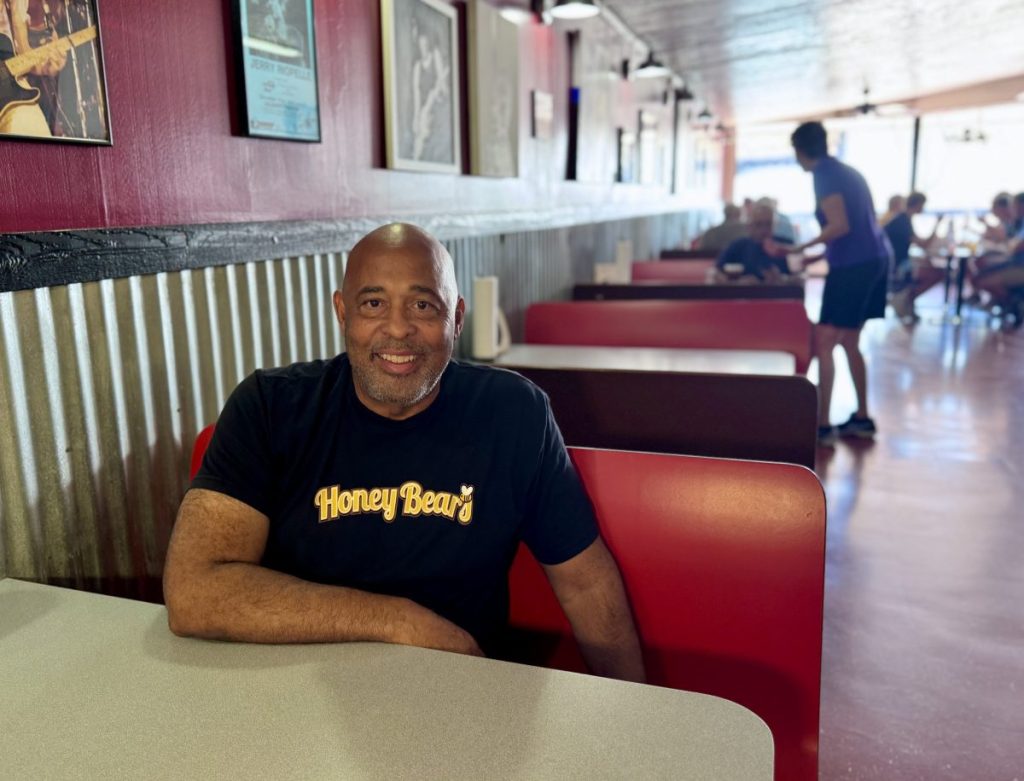
The Thumb opened in 2012, and just like every other barbecue crew in town, it credits Honey Bear’s BBQ as a pioneer. Founder and pitmaster Mark Smith laid “stepping stones to where we are today,” Berman says.
Sara Crocker
Before he moved to Phoenix from Iowa, Smith spent his childhood summers at family reunions in Tennessee. He learned by watching his uncles stay up all night tending a pit with whole hogs and sides of beef. Smith’s mother and grandmother taught him how to smoke chicken and ribs and mix tangy vinegar-based sauces.
When he arrived in Phoenix at 18, he saw an opportunity.
“I saw there was only one barbecue restaurant, and that was Grumpy John’s up in Scottsdale,” Smith recalls while sitting in a curved wood booth in Honey Bear’s red-and-corrugated metal-clad dining room. “I said, ‘I can do this.’”
For two years before he and founding business partner Gary Clark opened Honey Bear’s, they hosted barbecue parties from their apartment. Their guests paid $10 to dine on ribs and chicken with scoops of potato salad and coleslaw.
Smith and Clark opened their smokehouse in 1986 on Van Buren and 50th streets, 12 blocks east of Bill Johnson’s and just north of Phoenix’s historic stockyards. The cattle were gone by then. “The neighborhood was a different kind of neighborhood,” Smith says. “You might see anything on Van Buren.”
In its 40 years, the restaurant received local accolades and the distinction of catering to the cast and crew during the filming of “Bill & Ted’s Excellent Adventure.” Smith’s team has nearly 100 years of experience working together in the kitchen and around the horseshoe of smokers arranged on a back patio.
Smith, who is now 64, is still in the restaurant every day, hitting ribs with the same vinegar basting sauce he learned in Tennessee and greeting customers. Those have included future pitmasters like Scott Holmes, another link in an Arizona tradition that was starting to catch on.
Sara Crocker
Raising the temperature
Before Holmes and his wife, Bekke, would redefine the Valley’s barbecue scene with their Central Texas-centric Little Miss BBQ, he was a 21-year-old culinary school student with a routine. Every Monday, Holmes stopped into Honey Bear’s for “fantastic” smoked wings and sweet potato pie.
Though Holmes loved to cook, no single cuisine spoke to him. He didn’t last long at his kitchen gig at Havana Cafe. So he began a winding career. Holmes shilled medical supplies. He remediated buildings riddled with asbestos, mold and lead. He kept wandering.
A fateful trip to Texas in 2007 pointed Holmes to his true calling. Sitting in Little Miss BBQ’s original Phoenix location on University Drive, his eyes light up as he sets the scene.
The Tempe native made a trip to Texas to meet Bekke’s parents, who promptly whisked the young couple to The Salt Lick BBQ outside of Austin. It was unlike anything Holmes had experienced. His childhood barbecue ideal was ribs from the Americana chain Tony Roma’s.
Pulling up, he saw a couple of low-slung limestone buildings surrounded by oak trees. People at picnic tables sipped on bring-your-own beers.
“You walk in, and they have this big round pit, and there’s just splits of wood burning underneath this big grate,” he says. “They have briskets on there, ribs, sausages hanging down. I thought it was the coolest thing in the entire world.”
Driving around Texas, Holmes noticed smokers softly billowing smoke from what seemed like every third house. People there go out for barbecue with the same devotion they have for Sunday service.
“It’s just a different culture,” he says, “and we don’t have that culture.”
That hasn’t stopped Holmes from trying to build it. The trip sparked the couple’s years-long quest to master barbecue, first for themselves, then at a competition level, and finally by opening their own restaurant in 2014.
“I love the science of it. I love the challenge of it. I love trying to figure it out, the seasoning, how it reacts in the smoker, how it breaks down,” Holmes says. “All that stuff, I can geek out on. I go to bed thinking about this stuff.”
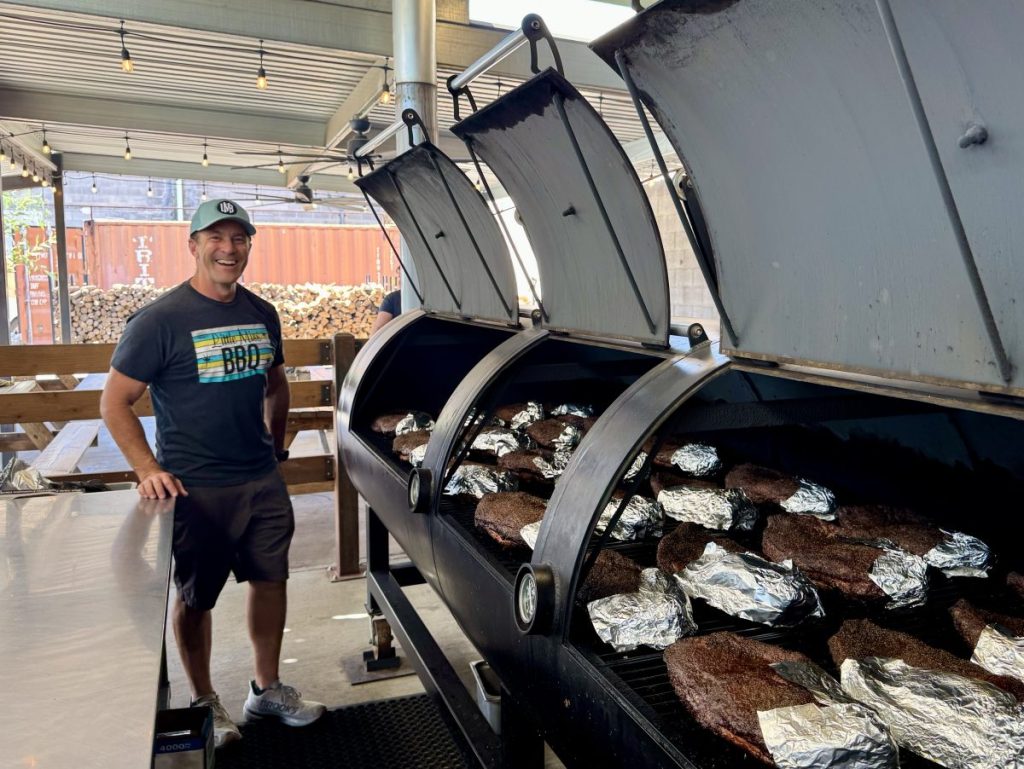
Little Miss pays homage to the smokehouses of Central Texas. As in the Lone Star State, diners line up, with some arriving early to sit in camping chairs stationed outside. At the counter where cooks slice meat to order, customers get a piece of glistening, fatty brisket as a teaser to their meal.
They serve tender ribs, succulent slices of pepper-crusted turkey, squares of pork belly sugar-brined and lacquered with sauce for a meatier, candied bacon effect. Their brisket has the bark of an ancient redwood but the tender buttery center of a prime filet. The whole bounty bleeds wet into the butcher paper that lines the trays.
Mere months after he began smoking meat on University Drive, Holmes and his crew’s small meat market-style counter had become the Valley’s smokehouse darling.
In a 2014 Arizona Republic review, long-time Valley food critic Howard Seftel awarded Little Miss BBQ a raving 4.5 stars. The writer laid bare his assessment of barbecue in the Valley — and nothing held a candle to what he ate there.
“During my 25 years in the Valley, the needle on my barbecue meter has oscillated predictably between ‘not bad’ and ‘pretty good,’” he wrote. “Until now. Little Miss BBQ’s ‘Central Texas’-style meats have blasted the needle way beyond ‘pretty good,’ way beyond ‘very good,’ all the way, when it comes to brisket and sausage, to ‘insanely scrumptious.’”
After Seftel’s review, the number of people lined up to try Little Miss multiplied tenfold, Holmes estimates.
The meteoric rise of the neophyte pitmaster put a spotlight on the rest of the barbecue joints in town.
“Little Miss BBQ brought excitement and consistency to the Valley,” says Berman, of The Thumb. “They really opened the scene back up for so many other people.”
From the beginning, the couple aimed to craft the best Central Texas-style ’cue of anyone in the country. Yelp’s “elite squad” of reviewers recently weighed in and agreed. Little Miss took the No. 1 ranking in a list of the best places in the U.S. for barbecue.
Looking around Arizona’s barbecue scene 12 years after Little Miss arrived, Holmes sees proof in the (banana) pudding.
“Everybody has elevated their game,” Holmes says. “It’s risen the quality of barbecue in Phoenix dramatically.”
Sara Crocker
Why not Arizona barbecue?
Following Little Miss, Caldwell County and Eric’s Family BBQ arrived in the respective East and West valleys, forming a holy trinity in the Valley’s barbecue landscape.
“If I can be so bold, I think we’re part of creating barbecue history out here,” Caldwell head Taylor says.
That ascension flows with the nation’s growing preference for Central Texas-style barbecue. The format that took off in meat markets helmed by German and Czech immigrants in the 1800s has “the best cheerleaders” who tout it wherever they go, food historian Miller explains.
“And it helps that it is delicious,” he adds.
Taylor and his Caldwell crew eat their way through Texas twice a year, hitting more than two dozen smokehouses on a massive staff field trip. Texas pitmasters from some of those stops have even come to work at Caldwell over the years, Taylor says.
“We share secrets and help each other out,” he says. “We’re all trying to learn together.”
Though Valley pitmasters stick to the low, slow, offset wood-fired smoking techniques of Central Texas, they’re not afraid to infuse Arizona flavor with local wood or work familiar Southwestern ingredients into sides.
Part of the growing Caldwell empire includes Caldwell County Mexi-Q, which the owners opened with their original manager, Julio Coronado. At the Gilbert restaurant, Coronado draws from the traditions of his home state of Sonora, Mexico, to build dishes such as guajillo ribs, chile verde pork and brisket birria.
The Thumb likewise works its brisket and other ’cue into crunchy tacos, burritos and massive breakfast stacks with hashbrown cakes, over-easy eggs, chipotle aioli and green onions.
A new wave of barbecue joints has arrived, with upstart hobbyists such as the Middle Eastern-influenced Wild Barbecue in Tempe and the Scottsdale brewhouse-smokehouse Beerded BBQ joining the fray.
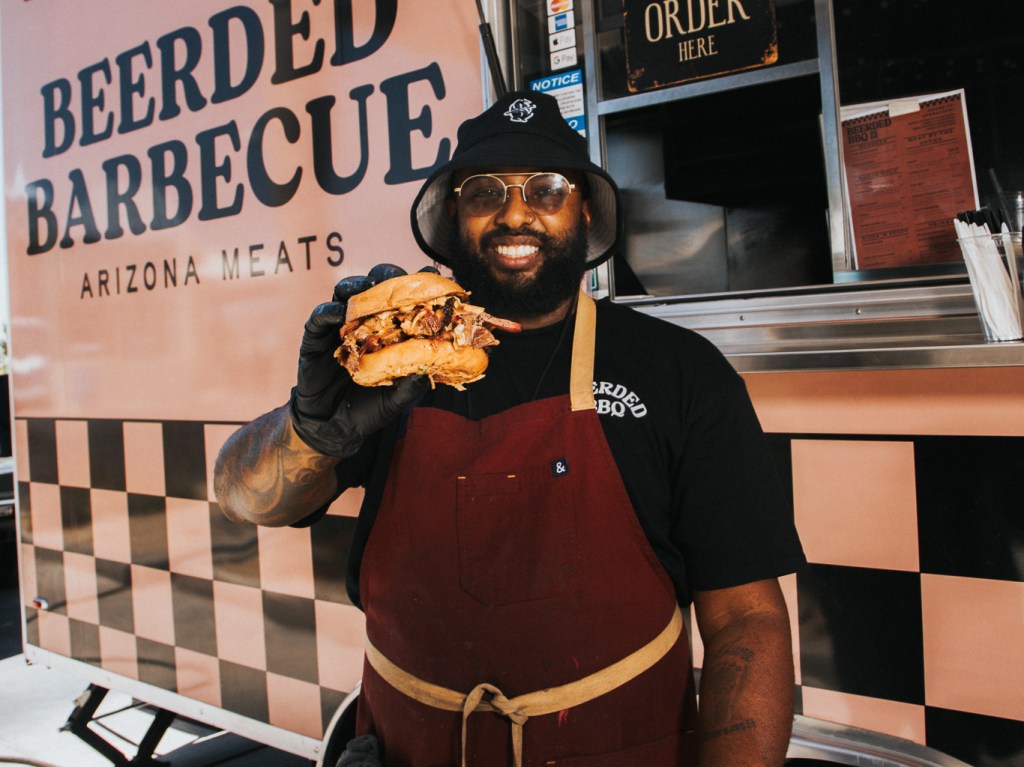
Akil Zakariya launched Beerded BBQ as a pop-up in late 2020. He’d smoked meats at home for years and had a background in brewing, but now he and his wife, Sarah, hauled a smoker to breweries and taprooms around town. They settled into a pink food trailer parked at Pinnacle Brewing Co. in Scottsdale. At the center of the barbecue’s logo is an abstract face made from a foamy beer mug and a bushy hop, mirroring Zakariya’s glasses and curly black beard.
He proudly set out to create a “lane” for Arizona barbecue.
The pitmaster serves barbacoa tacos, crisp smoked-and-grilled wings and brisket sandwiches that can be made delightfully messy with coleslaw and sauce infused with Pinnacle beer. He uses pecan and mesquite woods, infuses chiltepin into meats and sauces and has collaborated with local chefs.
“Arizona barbecue to me is using things that inspire the local cuisine,” Zakariya says.
Food historian Miller has advocated for chefs to do this, leaning into the meat, wood and historic practices true to their area.
“There’s rich ground to create your own thing,” he says.
Zakariya is more than intent on it.
“Some of the best barbecue right now is coming from people who are mobile,” he says. “I love competition. I love telling people that I think I’ve got the best barbecue in the Valley.”
Are we approaching our prime?
Competition is showing up in the form of out-of-state smokehouses, some of massive proportions.
Maryland-born Mission BBQ added a third Valley location in 2025, near the bustling PV development, and has another in the works in Gilbert. The San Diego County rib joint Phil’s BBQ plans to add a Chandler smokehouse.
Then there’s Buc-ee’s. The Texas-based gas station chain with a Texas-sized mega mart will land in Buckeye on June 22. At its most simplified, Buc-ee’s is a road stop known for affordable gas, fanatically clean bathrooms and beaver-branded snacks and swag. That doesn’t do justice to the Costco-meets-Disneyland scale and fandom for, yes, a travel center.
Taylor caught his first glimpse of a Buc-ee’s as he woke from a meat-induced nap during a barbecue-eating Texas road trip somewhere between Austin and Dallas. The scale of the place baffled him.
“What in the world — 90 pumps in one single gas station? This is insane,” he says. “It’s just kind of a fun cultural thing that is just like part of Texas that nobody else understands until they come to your town.”
In the middle of every Buc-ee’s is a circular barbecue counter — a physical and almost spiritual hub of the store. Attendants there sling literal tons of chopped brisket, pulled pork and smoked sausage sandwiches. To keep those sandwiches flowing from 11:30 a.m. until after midnight, the brisket is cooked at a central smokehouse, packaged, delivered to Buc-ee’s stores and rewarmed.
To thousands of travelers a day, this is about to be their destination for barbecue in Arizona — the ultimate Texas transplant.
Barbecuers in the Valley shrug off the brisket-slinging beaver’s arrival. Berman calls Buc-ee’s “entertainment barbecue.” He likes to see the smokers in action when he visits a place.
That won’t stop most local barbecuers from visiting once Buc-ee’s opens to see the spectacle of staff chopping brisket amid the frenzied market. Buc-ee’s won’t share its official sales numbers, but one manager said that brisket sandwiches are more popular than the 69-cent fountain sodas.
Will this growth, be it local, out-of-state, or beaver, outstrip demand?
Miller has seen the signs of “peak barbecue” in places like Denver, where one new smokehouse siphons off the same niche dining crowd. He and restaurant owners likewise worry about sustaining customers while beef prices and other food costs remain high.
But Valley pitmasters see plenty more meat on the bone. Arizona barbecue has come a long way. There’s now room for the entertainment barbecue. And room to continue to grow.
“We’re just in the prime of our barbecue culture,” Berman says. “The more food that complements what we’re doing, the more push there is to do better.”